
Statin-Antifungal Interaction Checker
Medication Interaction Checker
Enter your statin and antifungal medications to check for potential interaction risk.
What This Means
This interaction could lead to rhabdomyolysis - a life-threatening condition where muscle tissue breaks down.
Potential Symptoms
- Muscle pain, tenderness or weakness
- Dark, tea-colored urine
- Fatigue, confusion
Important Safety Notes
If you experience any of these symptoms, stop the statin immediately and contact your healthcare provider.
When you take a statin to lower cholesterol and then get a fungal infection, it’s easy to assume your doctor will just prescribe an antifungal without thinking twice. But that simple combo-statin plus antifungal-can trigger a life-threatening muscle breakdown called rhabdomyolysis. This isn’t a rare edge case. It’s a well-documented, preventable danger that happens more often than most people realize.
Why This Interaction Is So Dangerous
Statins like simvastatin, lovastatin, and atorvastatin work by blocking an enzyme in your liver that makes cholesterol. But your body doesn’t clear these drugs on its own. They’re broken down mostly by a liver enzyme called CYP3A4. Now, many antifungals-especially the azole class like itraconazole, ketoconazole, and voriconazole-are powerful inhibitors of that same enzyme. When you take them together, your body can’t break down the statin fast enough. The statin builds up in your bloodstream, sometimes to levels five times higher than normal.That overload hits your muscles hard. Muscle cells start breaking down, spilling their contents into your blood. One of those contents, creatine kinase (CK), can spike to 10,000 U/L or more-normal is 30-200 U/L. When that happens, your kidneys can’t filter it all. They get clogged. That’s when kidney failure, heart rhythm problems, or even death can follow.
Not All Statins Are Created Equal
Some statins are far more dangerous to mix with antifungals than others. It all comes down to how much they rely on CYP3A4 to get cleared from your body.- High risk: Simvastatin, lovastatin, and atorvastatin. These are metabolized mostly by CYP3A4. Taking simvastatin with itraconazole can boost its levels by more than 10 times. That’s why the FDA banned simvastatin doses above 20 mg with itraconazole or ketoconazole.
- Moderate risk: Pitavastatin and rosuvastatin. These use CYP3A4 a little, but also other pathways. Still, voriconazole can raise pitavastatin levels by 2.5 times. Use with caution.
- Low risk: Pravastatin, fluvastatin, and rosuvastatin (at standard doses). These are cleared mostly by other liver enzymes or kidney excretion. Pravastatin, for example, shows almost no interaction with any azole antifungal.
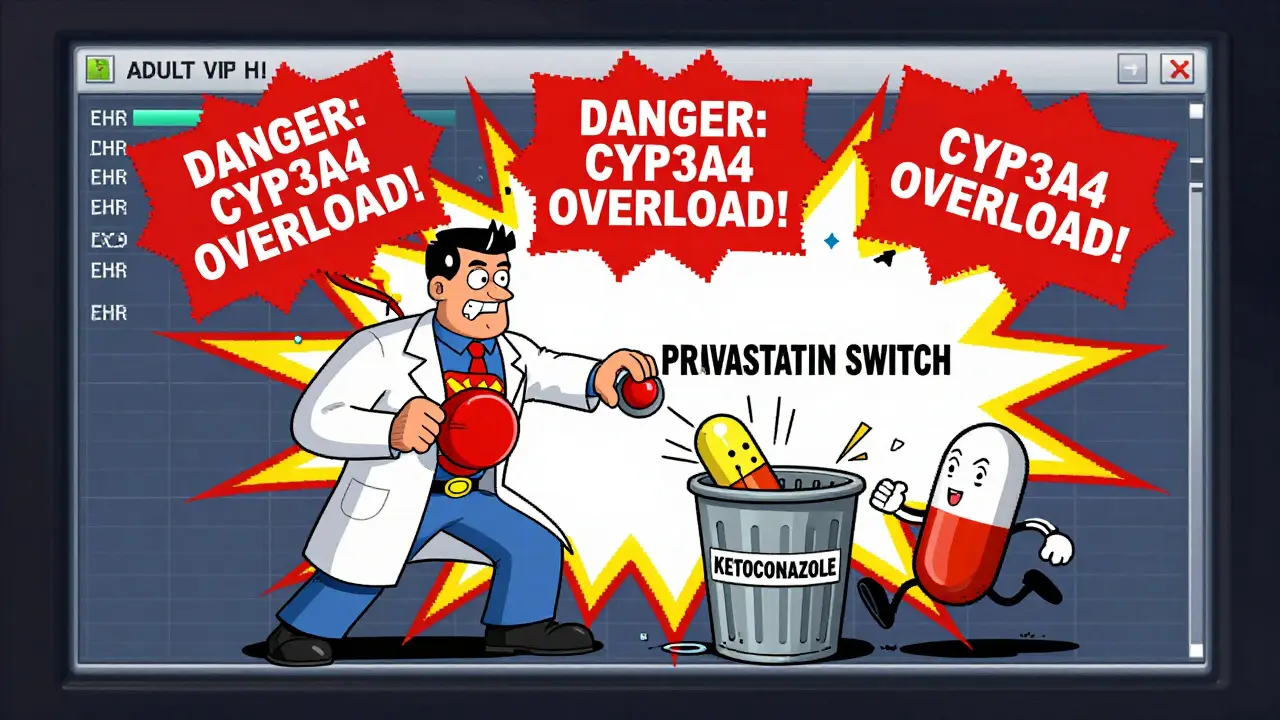
So if you’re on a high-risk statin and need an antifungal, your doctor should switch you to pravastatin or fluvastatin-no waiting, no guessing.
Which Antifungals Are the Worst Offenders?
Not all antifungals are equally dangerous. Their ability to block CYP3A4 varies widely.- Strong inhibitors: Ketoconazole, itraconazole, voriconazole. These are the biggest red flags. Ketoconazole is the strongest-so strong that it’s now rarely used for fungal infections because of this risk.
- Moderate inhibitor: Fluconazole. Even this common drug, often used for yeast infections, can be dangerous. At 200 mg daily, it can raise simvastatin levels by 350%. Many patients don’t realize they’re at risk because fluconazole is available over the counter in some places.
- Low risk: Isavuconazole. This newer antifungal, approved in 2015, barely touches CYP3A4. It’s a safer choice for long-term treatment, especially if you’re on a statin.
A 2020 analysis of FDA reports found that simvastatin with itraconazole caused nearly 39% of all rhabdomyolysis cases linked to antifungals. Fluconazole with simvastatin was second, at nearly 30%. That’s not a coincidence-it’s a pattern.
Who’s Most at Risk?
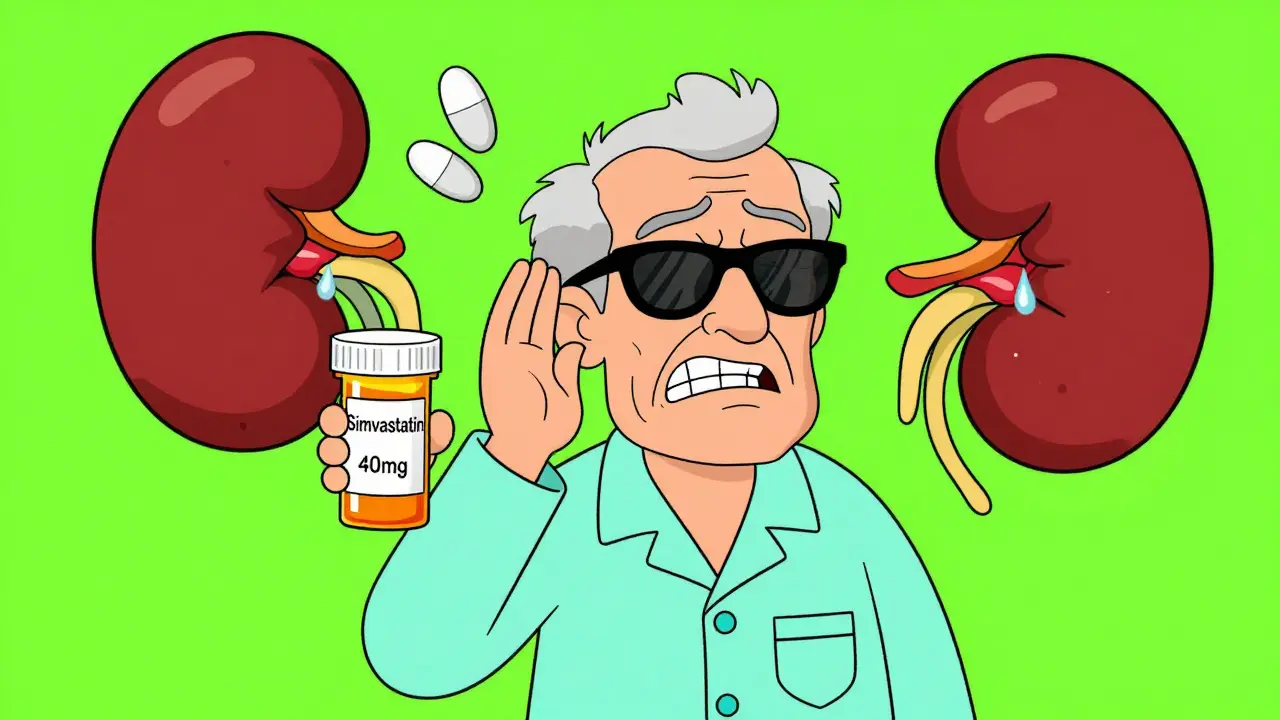
This isn’t just about the drugs. Your body matters too.- Aged 65 and older: Muscle mass declines with age. Liver and kidney function slow down. A 75-year-old on simvastatin 40 mg and fluconazole 200 mg is 23% more likely to get a dangerous interaction than a younger adult.
- People with kidney disease: Your kidneys help clear statin byproducts. If they’re not working well, even small increases in statin levels become toxic.
- Those on multiple medications: If you’re also taking a blood pressure pill like diltiazem or an antibiotic like clarithromycin-both CYP3A4 inhibitors-the risk stacks up.
- People with genetic variations: About 20-30% of people carry a gene variant (CYP3A5*3/*3) that makes them poor metabolizers. For them, even moderate statin doses can become dangerous when combined with antifungals.
One case from 2018 involved a 68-year-old man on simvastatin 40 mg for high cholesterol. He got fluconazole for a toenail fungus. Seven days later, he couldn’t walk. His CK was 18,400 U/L. He spent three days in the hospital. He wasn’t told the risk. Neither was his pharmacist.
What Should You Do If You’re on Both?
If you’re prescribed an antifungal while taking a statin, don’t wait. Ask these questions:- Which statin am I on? Is it simvastatin, lovastatin, or atorvastatin?
- Which antifungal am I getting? Is it itraconazole, ketoconazole, voriconazole, or fluconazole?
- Is there a safer statin I can switch to? Pravastatin or fluvastatin?
- Can we use isavuconazole instead of fluconazole or itraconazole?
- Will my creatine kinase be checked before and during treatment?
If you’re on simvastatin and your doctor prescribes itraconazole, the answer should be simple: stop the simvastatin. Don’t reduce the dose. Don’t wait. Stop it. Use pravastatin 40 mg instead. Resume simvastatin only 2-3 days after finishing the antifungal.
For fluconazole, if you must stay on simvastatin, the maximum safe dose is 10 mg daily. Atorvastatin should not exceed 20 mg daily. Anything higher is risky.
How Doctors Are Fighting Back
Hospitals and clinics aren’t ignoring this. Many electronic health record systems now block prescriptions automatically.At Mayo Clinic, Epic’s EHR system was programmed to stop any doctor from prescribing simvastatin over 20 mg with itraconazole. After the change, inappropriate prescriptions dropped by 87%. That’s not luck-it’s smart tech saving lives.
Pharmacists are also stepping up. In community pharmacies, many now run automatic alerts when a statin and azole are prescribed together. One pharmacist in Manchester reported seeing 2-3 cases of severe muscle damage each year from this interaction-mostly in elderly patients who didn’t know the risk.
The Bigger Picture
Around 36 million Americans take statins. Over 15 million azole antifungals are prescribed each year in the U.S. alone. That means millions of people are potentially exposed to this interaction. A 2022 study found that nearly 1 in 5 patients still get a contraindicated combo-especially in outpatient settings where communication gaps are common.The economic cost is heavy. A single rhabdomyolysis hospitalization can cost between $15,000 and $50,000. But the human cost is worse: pain, kidney failure, permanent muscle damage, or death.
Thankfully, awareness and tools have helped. Between 2015 and 2022, rhabdomyolysis cases from this interaction dropped by 34%. Better alerts, better guidelines, and better education are making a difference.
What You Can Do Right Now
If you’re on a statin:- Know which one. Write it down.
- Know your dose. Is it simvastatin 40 mg? That’s a red flag.
- When you get a new prescription-even for a yeast infection or athlete’s foot-ask: “Could this interact with my statin?”
- Watch for muscle pain, weakness, or dark urine. If you notice these after starting an antifungal, stop the statin and call your doctor immediately.
You don’t need to be a medical expert to protect yourself. You just need to ask the right questions.
What’s Next?
New guidelines from the American College of Cardiology and Infectious Diseases Society of America are expected in mid-2024. They’ll include decision trees based on age, kidney function, and genetic risk. For now, the rules are clear: avoid high-risk combos. Switch to safer statins. Use safer antifungals when possible.This isn’t about fear. It’s about control. You have the right to know what your drugs are doing to your body. And when two common medications can cause life-threatening damage, you deserve to be warned.






Joanne Smith
December 28, 2025 AT 00:39So let me get this straight-I take simvastatin for my cholesterol, get a fungal toenail, and suddenly I’m one fluconazole pill away from my muscles turning into soup? And my doctor just shrugs and says ‘take it easy’? 😅
Thanks for spelling this out like I’m not a walking pharmacy label. I’m switching to pravastatin tomorrow. No questions asked.
Prasanthi Kontemukkala
December 28, 2025 AT 01:44This is such an important post. I’ve seen so many elderly patients in my community clinic get prescribed fluconazole for yeast infections without realizing their statin could be silently attacking their muscles.
Thank you for breaking it down clearly-especially the part about pravastatin being safe. I’m printing this out to keep in my office. Everyone deserves to know this.
Alex Ragen
December 29, 2025 AT 06:57Ah, yes-the CYP3A4 enzyme: the unsung hero of pharmacokinetic tragedy. A molecular ballet, where inhibition becomes a dirge, and statin accumulation, the final, grotesque crescendo.
One cannot help but marvel at the Darwinian elegance of this interaction: the body, in its infinite wisdom, fails to metabolize what it cannot, and thus, the muscles pay the price. A poetic tragedy, written in creatine kinase.
And yet-how many patients, like unthinking atoms, remain oblivious to the quantum entanglement of their own biochemistry? The tragedy isn’t the drug interaction-it’s the ignorance that permits it.
Bryan Woods
December 30, 2025 AT 09:04Well-researched and clearly presented. The data on FDA reports and EHR interventions at Mayo Clinic are particularly compelling.
I’ve seen this exact scenario unfold in our hospital’s pharmacy department-two prescriptions, no communication, and a patient admitted with CK levels over 20,000. It’s preventable, and that’s what makes it so frustrating.
Thank you for highlighting the practical steps patients can take. This should be mandatory reading for anyone on statins.
wendy parrales fong
January 1, 2026 AT 07:33My grandma was on simvastatin and got fluconazole for a yeast infection. She couldn’t walk for a week. No one warned her.
I’m so glad someone finally said this out loud. I’m showing this to my mom. She’s on a statin too. She needs to know.
Don’t wait for the hospital. Ask the question now. Seriously.
Jeanette Jeffrey
January 2, 2026 AT 00:16Oh wow. Another ‘knowledge is power’ post. How original.
Let me guess-next you’ll tell us not to mix alcohol with acetaminophen? Or that we shouldn’t swallow bleach? This is just common sense wrapped in a 2000-word essay.
Meanwhile, people are still dying from driving while texting. But hey, at least we can now name the exact enzyme that killed grandma.
Save the drama for something that actually matters.
Shreyash Gupta
January 3, 2026 AT 04:18Wait… so if I’m on rosuvastatin and take fluconazole, I’m still at risk? 😅
But I read on Reddit that it’s fine because my kidneys are ‘strong’. Also, I’m Indian, so I probably have better metabolism? 🤔
Just asking because my uncle did this and lived. So… maybe it’s not that bad? 🤷♂️
Ellie Stretshberry
January 4, 2026 AT 06:05i didnt know this was a thing
my mom takes simvastatin and she had that yeast infection thing last month
she said her legs felt weird but she thought it was just old age
im gonna call her right now
thank you for this
Zina Constantin
January 4, 2026 AT 06:42As someone who works in global health, I’ve seen this interaction kill people in rural clinics where pharmacy records are handwritten and patients are given fluconazole over the counter.
This isn’t just an American problem-it’s a global blind spot. In Nigeria, India, and rural Mexico, patients are dying because no one connects the dots.
Thank you for writing this with precision. It deserves translation. I’ll help get it into Spanish, Hindi, and Hausa.
Dan Alatepe
January 5, 2026 AT 23:28Bro… imagine taking a pill for a fungus… and your muscles just… give up?
Like, you’re not even fighting a dragon-you’re just trying to stop your toes from itching… and BAM. Your body says ‘nope, I’m done’.
That’s not medicine. That’s a horror movie.
My cousin had this happen. He’s still walking… but he can’t climb stairs anymore. 😢
PLEASE tell your doctor. PLEASE.
Matthew Ingersoll
January 7, 2026 AT 19:49The fact that hospitals now block these prescriptions automatically is the only reason we’re seeing a 34% drop in cases. Technology saving lives-finally.
But the real win? Patients asking questions. That’s the real upgrade.
carissa projo
January 8, 2026 AT 19:30I’m a nurse. I’ve seen this too many times. A 70-year-old woman on simvastatin gets fluconazole for a yeast infection. She comes in a week later with dark urine and can’t stand.
She didn’t know. Her pharmacist didn’t know. Her daughter didn’t know.
This post? It’s a lifeline. I’m sharing it with every patient I see who’s on a statin. No one should be blindsided by this.
Thank you for writing it like you care.
josue robert figueroa salazar
January 10, 2026 AT 09:35