Symptom Checker: Side Effect vs. Adverse Reaction
You take a pill for your headache, and suddenly you feel nauseous. Is that just a normal side effect, or is it something more serious? Most people use these terms interchangeably, but in medicine, the difference can mean the gap between staying on a life-saving treatment and stopping it unnecessarily.
Understanding this distinction isn't just academic-it’s practical. It helps you decide when to call your doctor, when to adjust your dose, and when to simply wait it out. Let’s clear up the confusion once and for all.
The Core Definitions: What Are We Talking About?
To get this right, we need to look at how experts define these terms. The World Health Organization (WHO) formalized the definition of an Adverse Drug Reaction (ADR) as a response to a drug which is noxious and unintended and which occurs at doses normally used in man for prophylaxis, diagnosis, or therapy of disease back in 1972. This is the gold standard.
An ADR is harm directly caused by the drug when taken correctly. It’s not an accident; it’s a known consequence of the chemistry interacting with your body.
Now, what about a side effect? In clinical trials and medical literature, a Side Effect is a secondary, often unwanted effect of a drug that is distinct from its primary therapeutic purpose. Crucially, side effects are usually predictable and dose-dependent. If you take more ibuprofen, the risk of stomach irritation goes up. That’s a side effect.
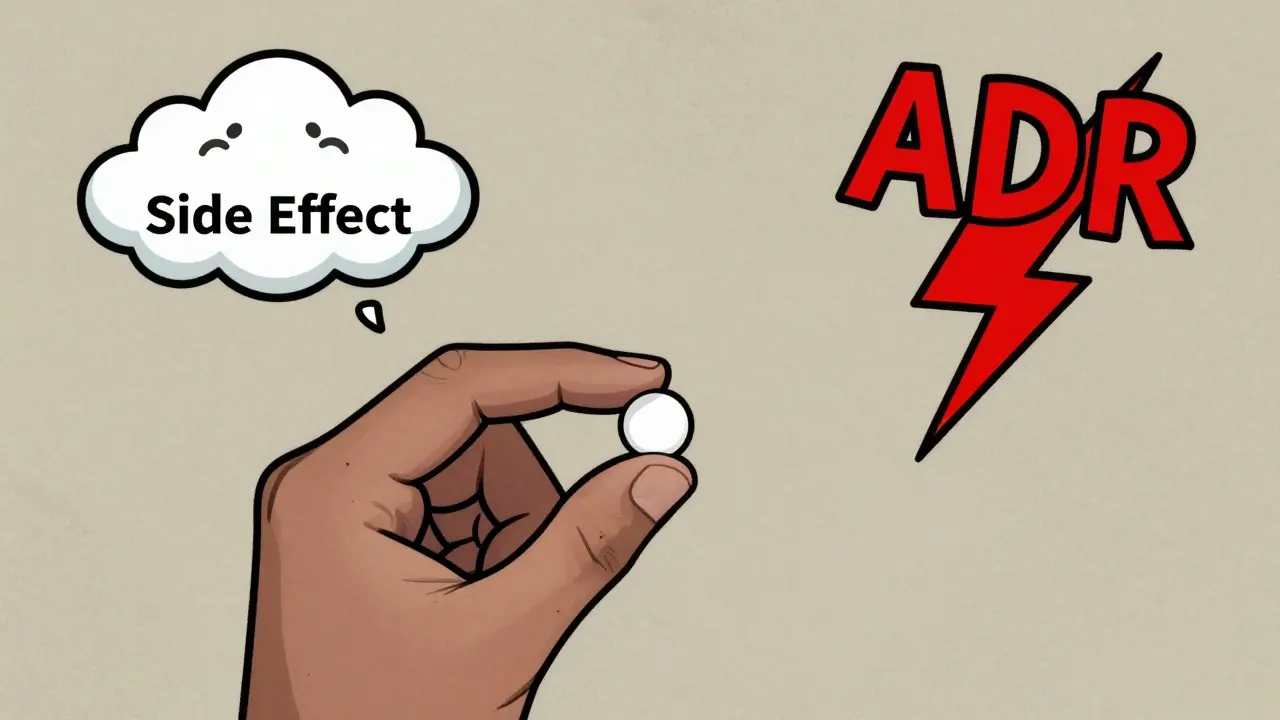
Here is the tricky part: All side effects are technically adverse events, but not all adverse events are side effects. And while many people use "side effect" and "adverse reaction" as synonyms, there is a nuance. Side effects are often mild and expected (like dry mouth from antihistamines). Adverse Drug Reactions can be severe, unpredictable, and dangerous (like an allergic reaction to penicillin).
Adverse Events: The Broad Umbrella
Before we dive deeper into ADRs, we have to talk about Adverse Events (AEs). An adverse event is any negative health occurrence that happens while you are taking a medication, regardless of whether the drug caused it.
Imagine you start a new blood pressure medication and break your leg falling down the stairs two days later. That broken leg is an adverse event because it happened during treatment. But did the drug cause it? Probably not. It was coincidental.
This distinction is vital for researchers. In clinical trials, they track every single bad thing that happens to patients. Then, they use statistics to figure out which ones are actually linked to the drug. If headaches happen in 12% of the group taking the drug and 11% of the group taking a sugar pill (placebo), the headache is likely just an adverse event, not a side effect of the drug. But if major bleeding happens in 2% of the drug group and only 0.5% of the placebo group, that’s a confirmed side effect/adverse reaction.
Type A vs. Type B: Predictable vs. Unpredictable
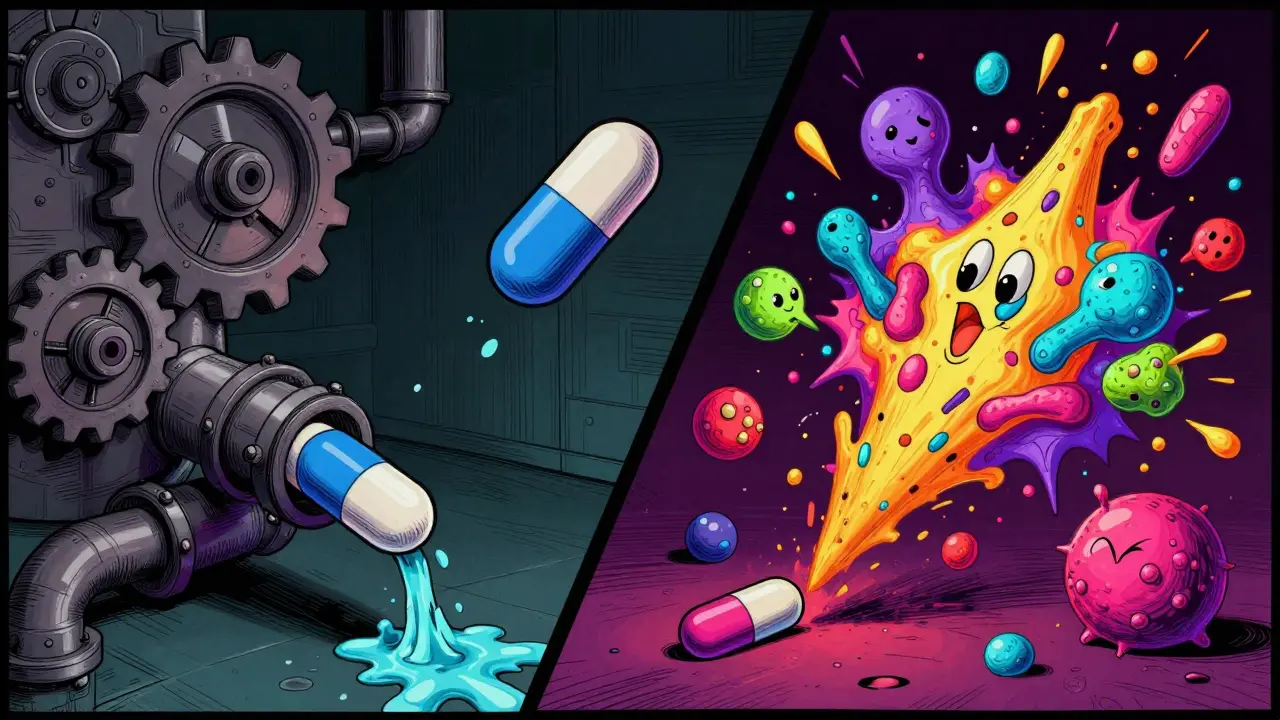
Medical professionals classify Adverse Drug Reactions into two main types to help manage them. Understanding this can help you anticipate what might happen with your meds.
| Feature | Type A (Augmented) | Type B (Bizarre) |
|---|---|---|
| Predictability | Predictable based on drug mechanism | Unpredictable, idiosyncratic |
| Dose Dependency | Yes, higher dose = higher risk | No, unrelated to dose |
| Frequency | Common (85-90% of ADRs) | Rare |
| Mortality | Low | High |
| Example | Nausea from chemotherapy | Severe skin rash from antibiotics |
Type A reactions are the most common. They are extensions of the drug’s normal action. For example, blood thinners like warfarin work by preventing clotting. A Type A reaction would be excessive bleeding because the drug worked too well. These are often manageable by adjusting the dose.
Type B reactions are different. They are bizarre, rare, and often immune-mediated. You can’t predict them by looking at the drug’s label. An example is Stevens-Johnson Syndrome, a severe skin reaction triggered by certain drugs like allopurinol. These are not dose-dependent; even a tiny amount can trigger a catastrophic response in susceptible individuals.
Why Does This Distinction Matter to You?
You might wonder, "So what? If I feel bad, I feel bad." But the classification changes how doctors treat you and how insurance covers you.
If you report an "adverse event," your doctor investigates. Did the drug cause it? Or was it a virus you caught at the grocery store? If they determine it’s a confirmed side effect (Type A), they might lower your dose. If it’s a Type B reaction, they will likely stop the drug immediately and switch you to a completely different class of medication.
Misunderstanding these terms leads to real-world problems. A 2021 study found that 43% of patients stopped taking life-saving medications because they misinterpreted a minor adverse event as an unavoidable, permanent side effect. Dr. Michael Cohen from the Institute for Safe Medication Practices notes that this conflation causes unnecessary patient anxiety and poor health outcomes.
Furthermore, documentation matters. Doctors must code these events correctly for insurance and legal reasons. According to the American Medical Association’s coding manual, physicians should document "adverse reaction" only when causality is established. Incorrect documentation contributed to 12% of medication-related insurance claim denials in a 2023 study. So, getting the terminology right can literally save you money.
How Doctors Determine Causality
When you tell your doctor you feel worse after starting a new med, they don’t just guess. They use a structured approach to determine if it’s a true ADR or just a coincidence. The University of California San Francisco developed a popular 3-step verification process:
- Temporal Relationship: Did the symptom start after you took the drug? Was there a logical time gap?
- Dechallenge/Rechallenge: If you stop the drug (dechallenge), do symptoms improve? If you restart it (rechallenge), do they come back? *Note: Rechallenge is rarely done if the reaction was severe.*
- Comparison with Known Profiles: Doctors check databases like Micromedex to see if your symptom is a known side effect of that specific drug.
This rigorous process helps reduce unnecessary medication discontinuations. Hospitals that implemented this distinction saw a 27% drop in patients quitting their meds unnecessarily over 18 months.
The Role of Genetics and Technology
We are moving toward a future where side effects are predicted before they happen. Pharmacogenomics is the study of how your genes affect your response to drugs. A groundbreaking 2023 study in Nature Medicine showed that patients with specific CYP2C19 genotypes had an 8.7 times higher risk of gastrointestinal bleeding from clopidogrel (Plavix). For these people, bleeding wasn’t just a random adverse event; it was a genetically predicted side effect.
Technology is also helping. The FDA’s Modernization Act 2.0 requires AI algorithms used in drug safety to distinguish between adverse events and adverse reactions with documented causality assessments. By December 2025, these tools must be integrated into pharmacovigilance systems. This means faster identification of dangerous side effects and less noise from unrelated adverse events.
What Should You Do?
As a patient, you are the first line of defense. Here is how to handle unexpected symptoms:
- Keep a Log: Write down when you take your med and when symptoms appear. Note the severity.
- Don’t Stop Abruptly: Unless you have signs of a severe allergic reaction (difficulty breathing, swelling), don’t just quit your meds. Call your doctor first.
- Ask Specific Questions: Instead of saying "This drug makes me sick," ask "Is this nausea a known side effect, or could it be something else?"
- Report It: You can report adverse events to the FDA MedWatch program. Even if it turns out to be coincidental, reporting helps build the data needed to confirm true side effects.
Remember, a side effect is often a trade-off for the benefit. Dry mouth from antidepressants is annoying, but if the drug lifts your depression, it’s a manageable side effect. A severe liver injury from an antibiotic is an adverse drug reaction that requires immediate action. Knowing the difference empowers you to make better health decisions.
Is a side effect the same as an adverse drug reaction?
Not exactly. While often used interchangeably in casual conversation, medically, a side effect is typically a predictable, dose-dependent secondary effect of a drug (like drowsiness from antihistamines). An Adverse Drug Reaction (ADR) is a broader term for any harmful and unintended response to a drug at normal doses, including unpredictable and severe reactions (allergies). All side effects are ADRs, but not all ADRs are simple side effects.
What is the difference between an adverse event and an adverse reaction?
An adverse event is any negative health occurrence that happens while taking a medication, regardless of cause. For example, breaking your leg while on blood thinners is an adverse event. An adverse reaction is an adverse event where a causal link to the drug has been established. If the blood thinner caused a bleed leading to a fall, that’s an adverse reaction. If you tripped over a rug, it’s just an adverse event.
Are Type A and Type B reactions different?
Yes. Type A reactions are "augmented"-they are predictable, common, and related to the drug’s normal mechanism and dose (e.g., low blood sugar from insulin). Type B reactions are "bizarre"-they are unpredictable, rare, not dose-dependent, and often related to individual genetics or immune responses (e.g., severe skin rashes). Type A accounts for 85-90% of ADRs.
Should I stop my medication if I experience a side effect?
Not necessarily. Mild side effects often go away as your body adjusts. However, never stop prescription medication abruptly without consulting your doctor, as this can be dangerous. Contact your healthcare provider to discuss whether the benefit outweighs the side effect, or if a dosage adjustment or alternative medication is needed.
How can I report a suspected adverse drug reaction?
In the United States, you can report adverse events and reactions to the FDA through the MedWatch program (Form 3500). In other countries, similar pharmacovigilance systems exist (e.g., MHRA in the UK, TGA in Australia). Reporting helps regulatory agencies identify new safety signals and update drug labels.