The short answer is yes, but the technical answer involves a strict set of rules called bioequivalence standards. These rules ensure that a generic drug isn't just a "similar" version of a brand-name medication, but a therapeutic match. While they might look different-different colors, shapes, or flavors-the way they behave in your bloodstream must be nearly identical.
| Feature | Standard Generic Requirement | Narrow Therapeutic Index (NTI) Drugs |
|---|---|---|
| Absorption Range (Confidence Interval) | 80% to 125% | 90% to 111% |
| Primary Metrics | AUC and Cmax | AUC and Cmax |
| Average Actual Difference | ~3.5% to 4.3% | Strictly Controlled |
What Exactly is Bioequivalence?
To understand absorption, we first need to define the central concept. Bioequivalence is the absence of a significant difference in the rate and extent to which the active ingredient becomes available at the site of drug action. In simpler terms, it means the generic drug gets the same amount of active medicine into your blood, in the same amount of time, as the brand-name drug.
This isn't a guess; it's a mathematical certainty required by the FDA (U.S. Food and Drug Administration). Since the Hatch-Waxman Act was passed in 1984, generic manufacturers have had to prove their product is bioequivalent before it can hit the market. They do this using "crossover studies," where a group of healthy volunteers takes both the brand and the generic drug (with a cleanup period in between) to see if the results match.
The Magic Numbers: AUC and Cmax
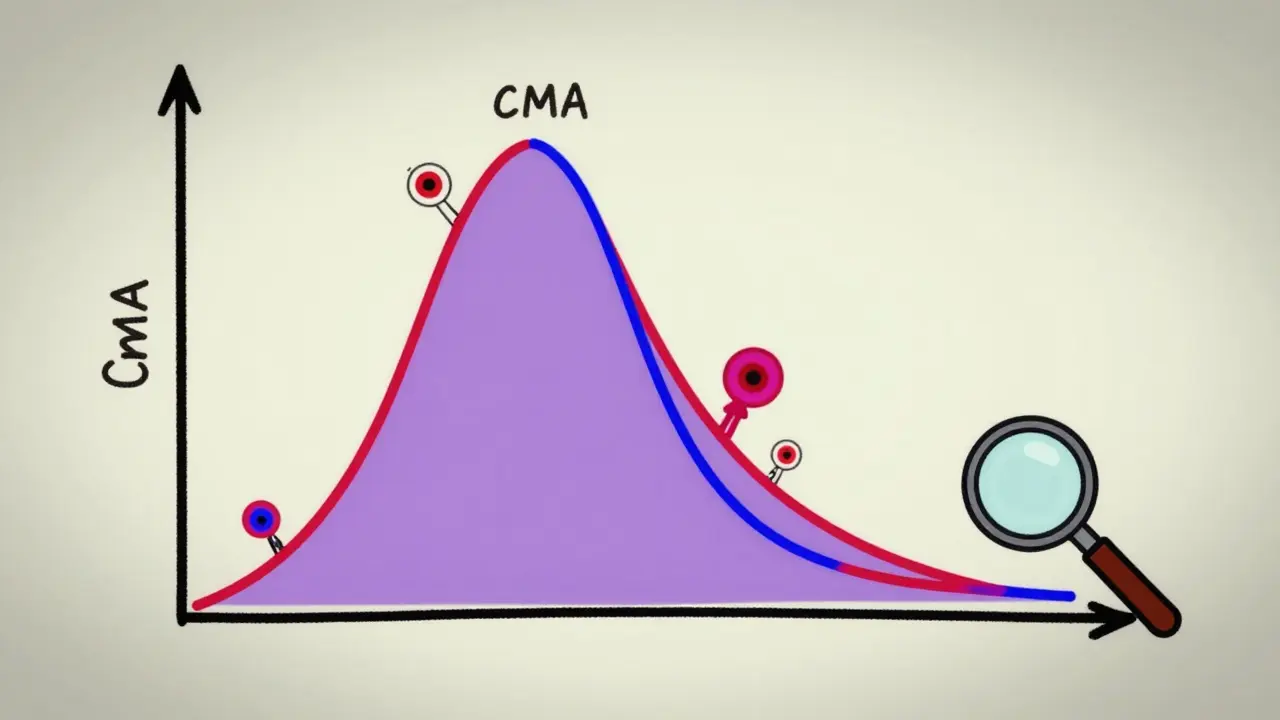
When scientists test a drug, they don't just look at whether you feel better. They look at a plasma concentration-time curve. There are two key numbers they track:
- AUC (Area Under the Curve): This represents the extent of absorption. It's basically the total amount of the drug that reaches your bloodstream over a set period.
- Cmax (Maximum Concentration): This represents the rate of absorption. It is the highest peak concentration the drug reaches in your blood.
For a generic to be approved, the 90% confidence interval for both AUC and Cmax must fall between 80% and 125% of the brand-name drug's values. Now, this often leads to a misconception. People hear "80% to 125%" and think, "Wait, my generic could be 20% weaker or 25% stronger?"
That's not how the math works. The 80-125% range is a statistical window for the confidence interval, not the average. Because the entire interval must fit in that window, the actual average difference is usually tiny. In fact, analysis of over 2,000 studies showed the average difference in absorption is only about 3.5% for AUC and 4.3% for Cmax. That's a negligible difference for the vast majority of people.
When Small Differences Actually Matter
While a 3% difference doesn't matter for a headache pill, it could be dangerous for some medications. This is where Narrow Therapeutic Index (NTI) drugs come in. These are medications where a tiny shift in blood concentration can lead to toxicity or make the drug stop working entirely.
Think of drugs like warfarin (a blood thinner), digoxin (for heart failure), or phenytoin (for seizures). For these, the FDA doesn't allow the standard 80-125% range. Instead, they enforce a much tighter limit of 90-111% for AUC. If you are on one of these medications, your doctor and pharmacist are likely much more cautious about switching brands or generics.
Dissolution vs. Bioequivalence: The Technical Gap
You might hear that some generics dissolve differently in a lab beaker than brand names. This is true. Dissolution testing measures how fast a tablet breaks down in a liquid. Some studies have shown that over half of certain generics have different dissolution rates than the brand name-for example, generic amoxicillin might dissolve faster, while some nifedipine versions dissolve slower.
Does this mean they don't work? Not necessarily. The FDA's stance is that as long as the in vivo (inside the living body) bioequivalence is met, the way a pill dissolves in a test tube doesn't matter. Your stomach and intestines are complex environments; a drug might dissolve differently in a beaker but still deliver the exact same amount of medicine into your blood.
Real-World Experiences and the 'Placebo' Effect
If the science is so solid, why do some people swear that their generic thyroid medication or antidepressant doesn't work as well? In forums like Reddit, users often report perceived differences in effectiveness, particularly with drugs like levothyroxine or bupropion.
Clinical experts, such as those from UCSF, suggest a few reasons for this. First, there's the placebo (or "nocebo") effect. If you believe a generic is inferior, you may perceive it as less effective. Second, some patients are simply more sensitive to the tiny 3-4% variations that are legally allowed. For these rare cases, a doctor might suggest staying on a specific brand or a specific generic manufacturer to maintain stability.
However, when we look at the big data, the results are clear. A meta-analysis of nearly 10,000 patients taking cardiovascular drugs found no significant difference in clinical outcomes between generic and brand versions. Out of 14,000 approved generics between 2008 and 2023, the FDA found only 12 cases of actual therapeutic inequivalence. That is a failure rate of 0.08%.

Navigating Your Options at the Pharmacy
When you're looking at your medication, you can check the FDA Orange Book. This is the official registry that lists therapeutic equivalence ratings. You'll see two main ratings:
- Rating A: The drug is considered therapeutically equivalent. It has the same active ingredient, strength, and bioequivalence. This is the gold standard for automatic substitution.
- Rating B: The drug is pharmaceutically equivalent, but there are some documented bioequivalence concerns. These are not typically substituted automatically.
If you feel a difference in your medication, don't just stop taking it. Talk to your pharmacist about the specific manufacturer. Even between different generic versions of the same drug, there can be slight variations. Finding the one that works best for your specific chemistry is a valid part of your healthcare journey.
Is a generic drug 20% weaker than a brand-name drug?
No. While the regulatory window for the confidence interval is 80% to 125%, this does not mean the drug's potency varies by that much. In reality, the average difference in absorption between approved generics and brand-name drugs is typically around 3.5% to 4.3%.
What are AUC and Cmax in simple terms?
AUC (Area Under the Curve) is the total amount of the drug that enters your bloodstream. Cmax is the highest concentration (the peak) the drug reaches. Both must match the brand-name drug within a tight range for the generic to be approved.
Why do some generics look different if they are the same?
Trademark laws prevent generic drugs from looking identical to the brand-name version. Manufacturers must use different colors, shapes, or sizes, but these cosmetic changes do not affect how the drug is absorbed or how it works in your body.
Are all generic drugs interchangeable?
Most are, especially those with an "A" rating in the FDA Orange Book. However, for Narrow Therapeutic Index (NTI) drugs like warfarin or digoxin, small variations can be risky, and your doctor may require you to stick to one specific version.
Can a generic drug have different side effects than a brand name?
The active ingredient is the same, but the inactive ingredients (fillers and binders) can differ. Some people may have sensitivities or allergies to these inactive components, which can lead to different side effects, even though the drug's absorption rate is the same.
Next Steps and Troubleshooting
If you are starting a new medication or switching from a brand to a generic, keep a simple log for the first two weeks. Note any changes in how you feel or the effectiveness of the drug. If you notice a dip in performance, check if your pharmacy has changed the generic manufacturer. Because different manufacturers can have slight variations within the 80-125% range, you might find that "Generic A" works better for you than "Generic B." Simply ask your pharmacist to keep you on the same manufacturer for your future refills.