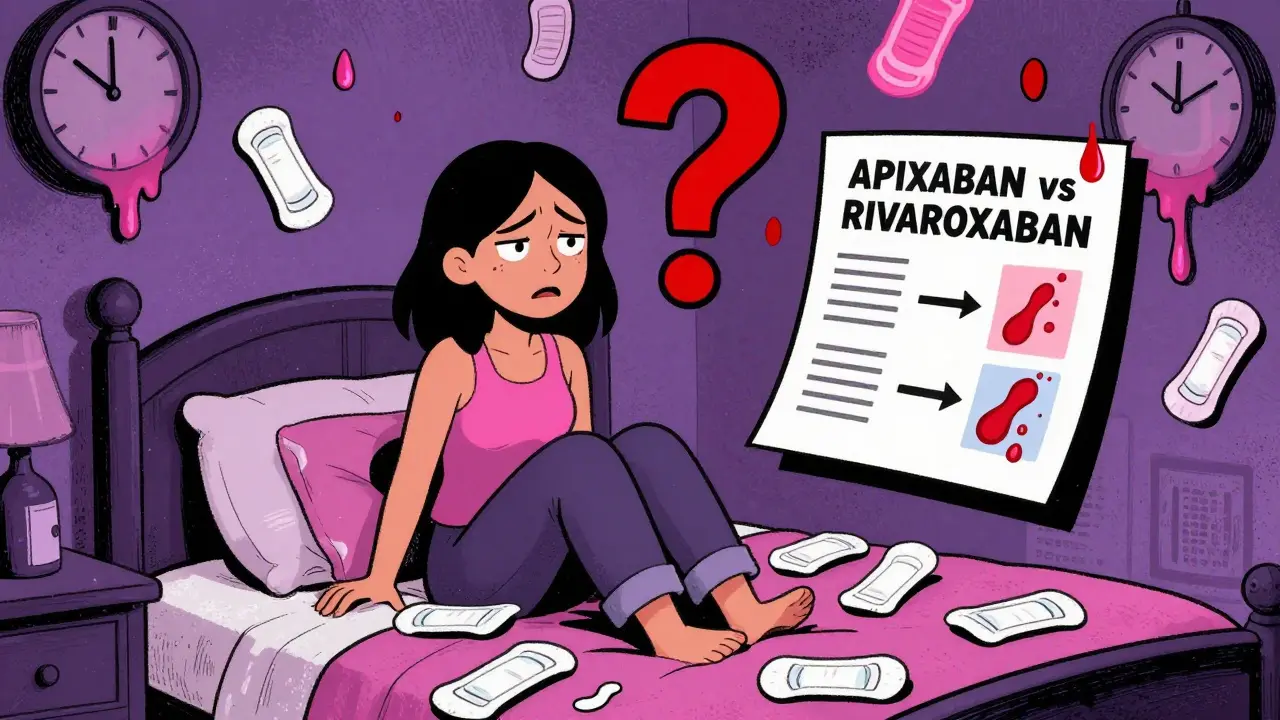
Heavy Menstrual Bleeding Symptom Checker
This tool helps you determine if your menstrual bleeding patterns indicate heavy menstrual bleeding (HMB), especially if you're taking blood thinners. Based on clinical guidelines, HMB can lead to serious health issues if untreated.
Assess Your Menstrual Bleeding
Your Assessment Results
Important: Heavy menstrual bleeding while on blood thinners can lead to serious complications including anemia and requires medical attention. Please consult your doctor as soon as possible.
Imagine needing to change your pad or tampon every 30 minutes. Not because you’re having a particularly bad day, but because your body is reacting to a medication you need to stay alive. For many women on blood thinners, this isn’t rare-it’s normal. And yet, most doctors never ask about it.
Why Blood Thinners Make Periods Heavier
Blood thinners, also called anticoagulants, stop clots from forming in your veins and arteries. That’s life-saving if you’ve had a deep vein thrombosis, pulmonary embolism, or have atrial fibrillation. But they don’t know the difference between a clot in your leg and a clot in your uterus. When your period starts, your body tries to form clots to slow the bleeding. Blood thinners block that process. Result? Heavy, prolonged bleeding.Studies show 66% to 70% of menstruating women on oral anticoagulants develop heavy menstrual bleeding (HMB). That’s more than double the rate in women not on these drugs. And it’s not just inconvenient-it’s exhausting. Women report leaking through products, carrying emergency changes everywhere, missing work, and avoiding social events. One woman on Reddit said she stopped going to the gym because she was scared of bleeding through her leggings.
Not all blood thinners are the same when it comes to periods. Research shows apixaban and dabigatran are linked to less heavy bleeding than rivaroxaban. Warfarin, the older blood thinner, also carries a high risk. If you started bleeding heavily after switching medications, that’s not a coincidence. It’s a signal.
What Heavy Menstrual Bleeding Looks Like
You don’t need a medical degree to know when your period is too heavy. Here’s what to watch for:- Changing pads, tampons, or menstrual cups every hour or less
- Passing clots larger than a quarter
- Leaking through products onto clothes or bedding
- Feeling dizzy, tired, or short of breath (signs of anemia)
- Periods lasting longer than 7 days
If you’re doing any of these regularly, you’re not just "having a rough cycle." You’re losing too much blood. Over time, this can lead to iron deficiency anemia-something your doctor should check with a simple blood test. Yet, a 2023 survey found that 68% of women said their hematologist never asked about their periods after starting anticoagulants.
First-Line Treatment: Hormonal Options That Work
The good news? You don’t have to stop your blood thinner to fix this. There are safe, effective treatments you can use alongside it.The levonorgestrel intrauterine system (IUD), like Mirena or Kyleena, is the most effective option. It releases a low dose of progesterone directly into the uterus, thinning the lining so less tissue sheds each month. Studies show it reduces bleeding by 70-90% within 3-6 months. Many women end up with very light periods-or none at all. One user on the r/anticoag subreddit said: "After getting Mirena while staying on Eliquis, my periods went from ER visits to almost gone in three months."
Other hormonal options include:
- Progestin implants (like Nexplanon)-inserted under the skin, last 3 years
- Progestin-only pills (taken daily)
- Depo-Provera shot (every 3 months)
All of these are safe to use with blood thinners. They don’t increase clot risk like combined estrogen-progestin pills might. In fact, the American Society of Hematology recommends them as first-line treatment.

Non-Hormonal Medications: Tranexamic Acid and NSAIDs
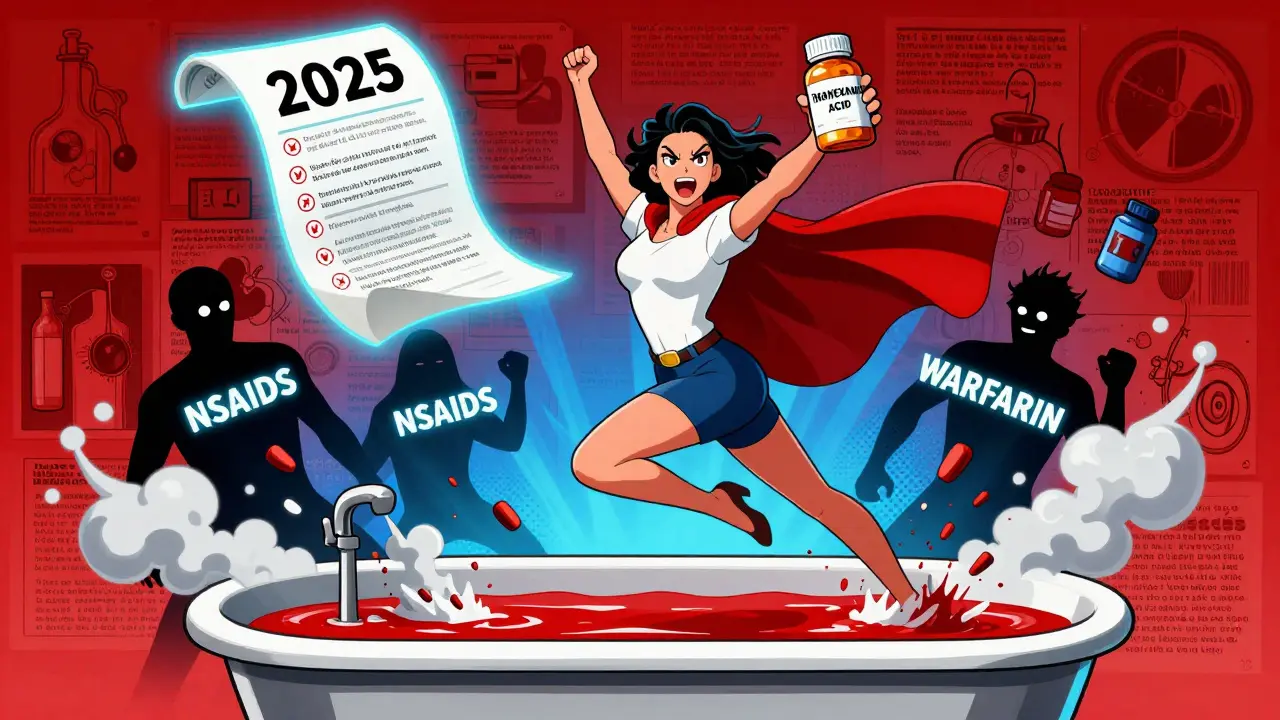
If you don’t want hormones, or can’t use them, there are two other options:Tranexamic acid is a prescription pill you take only during your period-usually 3-4 times a day for up to 5 days. It helps your blood clot normally in the uterus without affecting clots elsewhere in your body. Clinical trials show it cuts menstrual bleeding by 30-50%. It’s safe with blood thinners as long as you don’t take it every day, only during bleeding.
NSAIDs like ibuprofen or naproxen can also help. They reduce bleeding by 20-40% by lowering prostaglandins-the chemicals that make your uterus contract and shed its lining. But here’s the catch: taking NSAIDs with blood thinners increases your risk of stomach bleeding. If you use them, stick to the lowest effective dose for the shortest time. Talk to your doctor before starting.
What Doesn’t Work (And Why)
Some women try to fix heavy bleeding by skipping doses of their blood thinner. That’s dangerous. Stopping or reducing your anticoagulant increases your risk of a new clot by up to five times. You might feel better for a few days, but you’re trading one crisis for a potentially deadly one.Endometrial ablation-a procedure that burns off the uterine lining-is sometimes offered to women with HMB. But for those on blood thinners, it’s risky. Bleeding during or after the procedure can be severe. Most experts recommend it only as a last resort, and even then, only if you’re on a stable, low-risk anticoagulant and can temporarily switch to heparin for safety.
When to Switch Blood Thinners
If you’re on rivaroxaban and your bleeding is unbearable, switching to apixaban or dabigatran might help. It’s not guaranteed, but studies suggest the risk of heavy periods is lower with these drugs. You don’t need to stop anticoagulation entirely-you just switch medications under your hematologist’s supervision.This isn’t a decision to make alone. Your hematologist and gynecologist need to work together. One might focus on preventing clots. The other on stopping bleeding. But both are treating the same person. Coordination matters.
What You Should Ask Your Doctor
Don’t wait for them to ask. Take control. Here’s what to say:- "I’ve noticed my periods have gotten much heavier since I started [medication name]. Is this common?"
- "Can we check my iron levels? I feel constantly tired."
- "What are my options for reducing bleeding without stopping my blood thinner?"
- "Would switching to apixaban or dabigatran help?"
- "Can you refer me to a gynecologist who understands anticoagulant-related bleeding?"
If your doctor says, "It’s just a side effect, you’ll get used to it," find a new one. This isn’t normal. It’s treatable. And you deserve to live without fear of leaking through your clothes.
The Bigger Picture: Why This Is Ignored
Despite affecting up to 750,000 women in the U.S. alone, heavy bleeding on blood thinners isn’t in most clinical guidelines. A 2022 study called it a "major oversight." Only 22% of hematology clinics routinely screen for menstrual changes in women under 50.But things are changing. The American Society of Hematology and the American College of Obstetricians and Gynecologists are working on joint guidelines expected in mid-2025. The National Blood Clot Alliance now recommends that all women be warned about this risk before starting anticoagulants.
It’s not just about periods. It’s about being seen. It’s about not having to choose between living and bleeding. If you’re on a blood thinner and your period is wrecking your life, you’re not alone. And you don’t have to suffer in silence.
Can I take ibuprofen for period pain while on blood thinners?
You can, but with caution. Ibuprofen and other NSAIDs can reduce menstrual bleeding by 20-40%, but they also increase the risk of stomach bleeding when combined with anticoagulants. Use the lowest dose possible-like 200 mg every 8 hours-and only for a few days during your period. Talk to your doctor first, especially if you have a history of ulcers or kidney problems.
Will the Mirena IUD interfere with my blood thinner?
No. The Mirena IUD releases a low dose of progestin directly into the uterus. It doesn’t affect how your blood thinner works in your bloodstream. In fact, it’s one of the safest and most effective treatments for heavy bleeding on anticoagulants. Studies show 70-90% of women see major improvement within 3-6 months.
Can I switch from warfarin to a DOAC to reduce heavy bleeding?
Yes, and many women benefit from it. Warfarin carries a higher risk of heavy menstrual bleeding than newer drugs like apixaban or dabigatran. Switching is safe under medical supervision and doesn’t require stopping anticoagulation. Your hematologist will monitor your INR before and after the switch to ensure you stay protected from clots.
Is tranexamic acid safe with apixaban or Eliquis?
Yes. Tranexamic acid works locally in the uterus to help blood clot during your period. It doesn’t interfere with how apixaban or other DOACs work in your blood vessels. It’s taken only during bleeding days-usually 3-4 times a day for up to 5 days. Clinical studies confirm it’s safe and effective when used this way.
Why don’t doctors talk about this more?
Because it’s been overlooked. Until recently, heavy periods were considered a "minor" side effect, not a real health issue. But studies show it reduces quality of life as much as some chronic diseases. The medical community is catching up-new guidelines are coming in 2025. But until then, you need to speak up. Your bleeding matters.
Next Steps: What to Do Right Now
If you’re on a blood thinner and your period is out of control:- Track your bleeding for one cycle: note how often you change products, if you pass clots, and if you feel fatigued.
- Ask your doctor for a blood test to check your iron and hemoglobin levels.
- Request a referral to a gynecologist experienced in anticoagulant-related bleeding.
- Ask: "Is switching to apixaban or dabigatran an option?" and "Can I try the Mirena IUD?"
- If you’re not getting answers, seek a second opinion. This is treatable. You deserve relief.
Heavy bleeding on blood thinners isn’t something you just have to live with. It’s a known, common, and fixable problem. You’re not broken. Your body isn’t failing. The system just hasn’t caught up to you yet. But you can change that-with the right questions, the right care, and the right treatment.



Steven Destiny
December 27, 2025 AT 03:44Doctors need to stop acting like this is some weird, rare thing. 70% of women on these meds? That’s not a footnote. That’s a fucking epidemic.
Fabio Raphael
December 27, 2025 AT 20:43Got the Mirena last month. Three weeks in, I barely need a pad. I cried in the bathroom. No joke. This isn’t just about comfort-it’s about being able to live without fear. Thank you for writing this. Someone finally said it out loud.
Amy Lesleighter (Wales)
December 29, 2025 AT 02:43Becky Baker
December 30, 2025 AT 11:44Rajni Jain
December 31, 2025 AT 04:28Natasha Sandra
January 1, 2026 AT 08:50Also-tranexamic acid is a miracle. I take it like candy during my week. No side effects. No drama. Just peace.
Doctors: stop being lazy. This is not ‘just how it is.’
Erwin Asilom
January 2, 2026 AT 12:57Sumler Luu
January 3, 2026 AT 08:11It took me 14 months to get help. Don’t let it take you that long. Bring this article to your doctor. Print it. Highlight it. If they don’t take you seriously, go somewhere else. Your life matters more than their outdated protocols.
sakshi nagpal
January 4, 2026 AT 05:27Sandeep Jain
January 5, 2026 AT 03:01roger dalomba
January 6, 2026 AT 12:10Look, if your period is too heavy, maybe you shouldn’t be on anticoagulants. Or maybe you’re just a woman who’s never been taught to manage her body. Either way, this is peak performative victimhood.
Steven Destiny
January 7, 2026 AT 09:51Try being a woman who needs to live. Then come back with your ‘performative victimhood’ nonsense. I’ll wait.