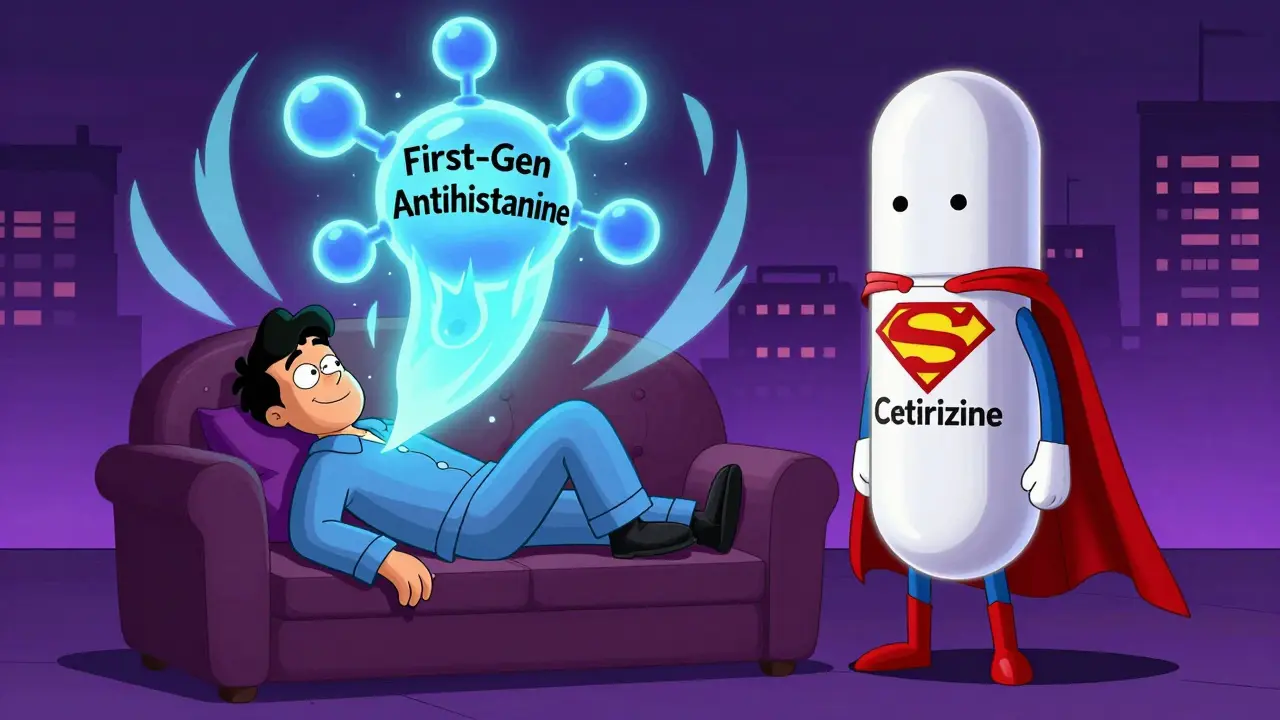
Most people who take allergy meds know the trade-off: you get relief from sneezing and itchy eyes, but you also feel like you’re drifting through a fog. That’s the legacy of first-generation antihistamines like diphenhydramine (Benadryl). They work-but they knock you out. If you’ve ever nodded off after a midday dose, or struggled to focus at work because your meds made you sluggish, you’re not alone. The good news? second-generation antihistamines changed all that.
What Makes Second-Generation Antihistamines Different?
Second-generation antihistamines-like cetirizine (Zyrtec), loratadine (Claritin), and fexofenadine (Allegra)-were designed to do one thing better: block histamine without messing with your brain. First-gen drugs cross the blood-brain barrier easily, which is why they cause drowsiness, dry mouth, and blurred vision. Second-gen ones? They’re built to stay out. Their molecules are bigger, more polar, and too bulky to slip through the barrier that protects your brain. That’s not magic-it’s chemistry.
Studies show these newer drugs are 72-89% less likely to cause sedation than their older cousins. In clinical trials, only 6-14% of people taking second-gen antihistamines reported feeling sleepy, compared to 50-60% for first-gen. That’s why over 78% of U.S. adults with allergies now use them, according to CDC data from 2023.
How Do They Actually Work?
These drugs don’t just randomly block histamine. They lock onto the H1 receptor like a key in a lock. In 2024, researchers used cryo-electron microscopy to map exactly how they bind. The result? They stop a tiny molecular switch (W428 6.48) from flipping, which stops the allergic signal before it starts. What’s even more interesting? They found a second binding site on the receptor. That’s a big deal-it means future drugs could be even more precise, targeting only the allergy response without touching anything else.
Unlike first-gen antihistamines, these don’t interfere with acetylcholine. That’s why they don’t help with sneezing from colds-something diphenhydramine can do. But for true allergies-hay fever, hives, itchy skin-they’re just as effective, if not better.
How Long Do They Last? And How Do You Take Them?
One pill a day. That’s the standard. Most second-gen antihistamines last 12 to 24 hours. Cetirizine clears your system in about 8.3 hours, fexofenadine in 11-15, and loratadine in 8-18. But because they’re designed to stay active in your tissues longer, you only need one dose. No more setting alarms to take your next pill at 4 p.m.
They’re available as tablets, chewables, and syrups. For best results, take them 1-2 hours before you know you’ll be exposed to allergens-like before stepping outside on a high-pollen day. A 2019 study found this preemptive approach cuts symptoms by 40-50% compared to taking them only after you start feeling bad.
Side Effects? Yes, But Not What You Think
They’re not side-effect free. But the side effects are different-and far less disruptive.
- Drowsiness: Still happens in 6-14% of users, but often only at higher doses. Some people are just more sensitive. Cetirizine is more likely to cause mild sleepiness than loratadine or fexofenadine.
- Headaches: Reported by about 15-20% of users. One Reddit user described three straight days of pounding headaches after starting loratadine-switched to cetirizine and it vanished.
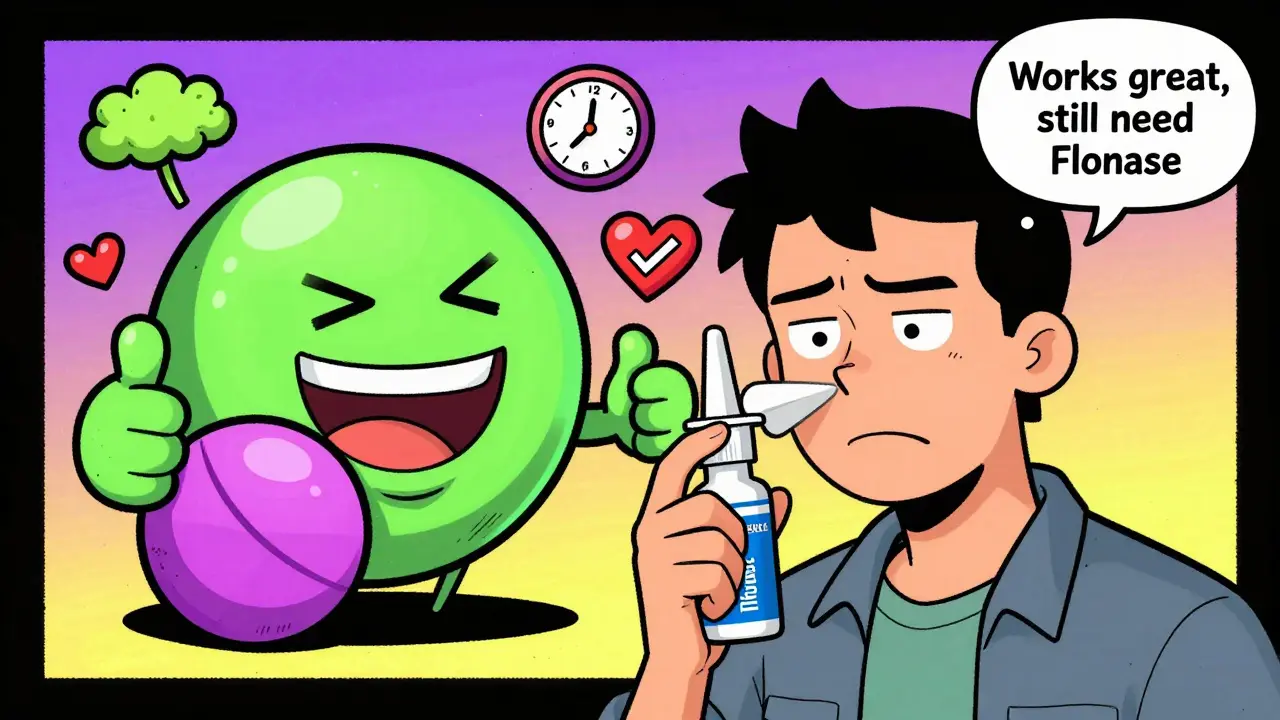
- Nasal congestion: This is the big gap. None of these drugs do much for a stuffy nose. That’s why so many people end up using Flonase or another nasal spray alongside them.
- Taste changes: Rare, but real. Some users report a bitter or metallic taste, especially with fexofenadine.
On WebMD, cetirizine has a 4.2/5 rating from nearly 13,000 reviews. About 78% of users say it works “excellent” or “good.” But 23% admit to occasional drowsiness-higher than clinical studies suggest. Why? Real life isn’t a lab. People take them with grapefruit juice, drink alcohol, or skip meals. These things can change how the drug behaves.

Drug Interactions and Safety
Back in the 90s, two second-gen antihistamines-terfenadine and astemizole-were pulled from the market because they caused dangerous heart rhythm problems when mixed with certain antibiotics or antifungals. That’s why people still worry.
But today’s common ones? Fexofenadine is the safest. Only 5% of it is processed by the liver. Most passes through unchanged and leaves your body in urine and stool. Loratadine and cetirizine are metabolized by CYP3A4, so they can interact with drugs like ketoconazole or erythromycin. But the risk is low if you’re healthy and not on multiple meds.
The FDA updated labeling rules in 2021 to make warnings clearer. If you’re on statins, antidepressants, or antifungals, talk to your pharmacist. Don’t assume it’s safe just because it’s over-the-counter.
Which One Should You Try?
There’s no single “best” second-gen antihistamine. People respond differently. Here’s what the data says:
| Medication | Brand Name | Dose | Half-Life | Most Common Side Effect | Best For |
|---|---|---|---|---|---|
| Cetirizine | Zyrtec | 10 mg | 8.3 hours | Mild drowsiness | Itching, hives, runny nose |
| Loratadine | Claritin | 10 mg | 8-18 hours | Headaches | Daytime use, low sedation risk |
| Fexofenadine | Allegra | 180 mg | 11-15 hours | Taste disturbance | People on other meds, minimal liver processing |
A 2023 Mayo Clinic survey found that 35% of users tried two or three different second-gen antihistamines before finding one that worked without side effects. Start with loratadine if you want the lowest chance of drowsiness. Try cetirizine if your main issue is itching or hives. Go with fexofenadine if you’re on other medications or have liver concerns.
Why So Many Still Need Nasal Sprays
Here’s the hard truth: second-gen antihistamines don’t fix congestion. That’s because they don’t target the inflammation in your nasal passages-they only block histamine in the blood and skin. For stuffiness, you need a nasal steroid like fluticasone (Flonase) or mometasone (Nasonex). That’s why 41% of users in Consumer Reports’ 2023 survey said they still needed extra meds.
That’s also why combination products like Allegra-D (fexofenadine + pseudoephedrine) are growing. They captured 22% of the congestion treatment market in 2023. But pseudoephedrine can raise blood pressure and cause jitteriness. So if you have high blood pressure or anxiety, stick with the antihistamine alone and add a nasal spray.
What’s Next? The Future of Allergy Meds
Research is moving fast. In early 2024, the FDA gave breakthrough status to bilastine XR-a once-weekly antihistamine. That could be a game-changer for the 37% of users who forget to take daily pills.
And thanks to that 2024 cryo-EM study, scientists now know exactly where to look for even better drugs. The secondary binding site they found could lead to third-generation antihistamines that eliminate the last traces of drowsiness and headaches.
For now, second-gen antihistamines remain the gold standard. They’re safe, effective, and non-sedating for most people. They’ve made daily life possible for millions who used to dread spring, fall, or even pet exposure.
Real Talk: What Users Actually Say
On Reddit’s r/Allergies, the top comment says: “Fexofenadine works great for my seasonal allergies without making me sleepy like Benadryl did, but I still need Flonase for congestion.” That’s the perfect summary.
Another user wrote: “Loratadine gave me severe headaches for three days. Switched to cetirizine-no issues.”
And here’s what a doctor told a patient in a Mayo Clinic follow-up: “It’s not that one is better. It’s that your body responds to one differently than the others. Try one for two weeks. If it doesn’t feel right, swap it.”
That’s the real secret: trial and error. There’s no universal answer. But now you know what to look for.
When to Call Your Doctor
Second-gen antihistamines are safe for most people. But call your doctor if:
- You have liver disease or kidney problems-dosing may need adjustment.
- You’re pregnant or breastfeeding-some are considered safe, but not all.
- You’re taking other meds, especially antibiotics or antifungals.
- You feel your heart racing, dizzy, or faint after taking the pill.
- Your symptoms get worse over time, even with regular use.
Also, don’t assume OTC means risk-free. Read the label. Check for interactions. And if you’re using it every day for more than six months, talk to an allergist. You might need allergy testing or immunotherapy.
Final Thoughts
Second-generation antihistamines didn’t just improve allergy treatment-they changed how people live. You don’t have to choose between feeling better and feeling awake. You can have both.
They’re not perfect. They don’t fix everything. But for itching, sneezing, and runny nose? They’re the most reliable tool we have. And with new versions on the horizon, they’re only going to get better.
If you’ve been stuck with Benadryl because you thought there was no alternative-you were wrong. It’s time to try something that lets you live your life, not just survive it.

Bryan Fracchia
January 27, 2026 AT 11:44Man, I remember when I used to take Benadryl just to chill out on weekends. Didn't even realize I was medicating my anxiety until I switched to Zyrtec and actually remembered what it felt like to be awake. These second-gen meds didn't just help my allergies-they helped me reconnect with my life.
Kevin Kennett
January 29, 2026 AT 08:13Let’s be real-most people don’t know the difference between first and second-gen antihistamines because Big Pharma doesn’t want you to. They make billions off people taking diphenhydramine like it’s candy. The fact that 78% of adults are now using non-drowsy options? That’s not luck. That’s education. And if you’re still on Benadryl? You’re being exploited.
Rose Palmer
January 30, 2026 AT 00:41While the clinical data presented is robust and aligns with current therapeutic guidelines, it is imperative to acknowledge individual variability in pharmacokinetics. For instance, while loratadine demonstrates a low sedative profile in population studies, metabolic polymorphisms in CYP2D6 and CYP3A4 enzymes may significantly alter drug clearance in specific subpopulations. Therefore, personalized therapeutic trials remain clinically advisable.
Howard Esakov
January 30, 2026 AT 19:44Wow. A whole article about antihistamines and you didn’t even mention the fact that fexofenadine is basically just a fancy version of what they used to sell as ‘allergy tablets’ in Japan in the 90s? 😏 I mean, come on. This isn’t breakthrough science-it’s repackaged 30-year-old tech with a new label and a marketing budget. 🤓
Lexi Karuzis
February 1, 2026 AT 16:36Wait… so you’re telling me the FDA approved these drugs… but they still don’t fix congestion? And you’re saying this is ‘safe’? 🤔 What if the real problem isn’t allergies… but the fact that EVERYTHING is laced with chemicals? Did you know that the ‘second-gen’ antihistamines were originally developed by the same labs that made Agent Orange? I’m not saying it’s a conspiracy… but… WHY are they so cheap? WHY are they everywhere? WHY don’t they tell you about the ‘secondary binding site’? …I’ve been reading the labels… and I’m scared.
Ambrose Curtis
February 3, 2026 AT 10:28Y’all are overthinking this. I took claritin for 3 years, got headaches like a mother, switched to zyrtec-boom, no more headaches, just a little sleepy if i drink soda. fexofenadine? Tasted like licking a battery so i ditched it. point is: try one for two weeks, if it sucks, try another. no magic pill, but one of em works for you. and yeah, flonase is your best friend for the nose. i use both. done. 🤷♂️
Linda O'neil
February 3, 2026 AT 21:10If you’re reading this and still using Benadryl because you think it’s ‘stronger’-please, just stop. Your brain doesn’t need that kind of punishment. Second-gen meds aren’t just safer-they’re more effective for what they’re meant to do. And if you’re still congested? Add a nasal spray. It’s not weakness, it’s strategy. You deserve to breathe easy without nodding off. You got this.
Chris Urdilas
February 5, 2026 AT 06:21So let me get this straight… we’ve got a whole article about how these drugs don’t make you sleepy… but then admit 14% of people still get drowsy? And headaches? And weird tastes? And you’re calling this ‘non-sedating’? 😂 Classic pharma marketing: ‘It’s not a side effect if it’s in the fine print.’ Meanwhile, I’m over here taking two pills a day and still feeling like I’m underwater. Thanks for the optimism, guys.
Jeffrey Carroll
February 6, 2026 AT 03:53The scientific rationale underlying the structural design of second-generation antihistamines is both elegant and clinically significant. Their inability to traverse the blood-brain barrier is not an incidental feature, but a deliberate pharmacological achievement. That said, the persistence of individual variability in response suggests that future therapeutic paradigms may require genotypic stratification for optimal outcomes.
Phil Davis
February 6, 2026 AT 11:58Someone’s gotta say it: we’re treating symptoms like they’re the disease. Allergies aren’t the problem-our environment is. These pills let us ignore the fact that our air is full of plastics, pesticides, and mold. They’re not a solution. They’re a Band-Aid on a broken leg. And we’re all just pretending we’re fine.