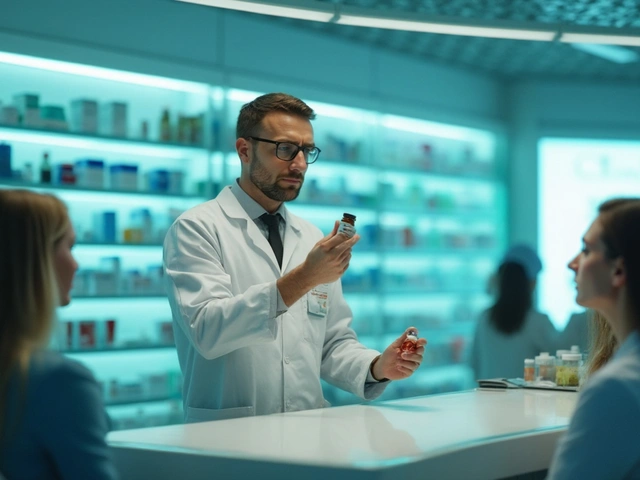
You take your morning pill. It’s a white tablet, maybe scored down the middle. You know it works because you’ve been taking it for years. But have you ever wondered why that little circle of compressed powder costs pennies instead of dollars? The answer lies in a highly regulated, scientifically rigorous process that ensures your generic drug is therapeutically identical to its expensive brand-name cousin.
Generic drugs are not just "cheap copies." They are pharmaceutical products that contain the same active ingredients as their brand-name counterparts, delivered in identical dosage forms, strengths, and routes of administration. According to the U.S. Food and Drug Administration (FDA), these medications typically cost 80-85% less than the original branded versions. This massive price difference doesn’t come from cutting corners on quality; it comes from skipping the multi-billion-dollar clinical trials that brand-name companies must conduct to prove safety and efficacy for the first time.
The Legal Foundation: How Generics Got Here
To understand how generic drugs are made, we first need to look at the rules that allow them to exist. Before 1984, if a company wanted to sell a drug after a patent expired, they had to run their own full set of clinical trials. This was too expensive and redundant, so few generics were ever produced. That changed with the Hatch-Waxman Act (Drug Price Competition and Patent Term Restoration Act), signed into law on September 24, 1984.
This legislation created the Abbreviated New Drug Application (ANDA) pathway. Instead of proving a drug is safe and effective from scratch, generic manufacturers only need to prove that their version is bioequivalent to the already-approved brand-name drug, known as the Reference Listed Drug (RLD). This framework allows manufacturers to demonstrate therapeutic equivalence without conducting extensive and costly human trials, accelerating market entry while maintaining rigorous quality standards.
Today, this system operates under GDUFA IV (Generic Drug User Fee Amendments), reauthorized in October 2022. The impact is staggering: approximately 90% of all prescriptions in the United States are filled with generic drugs, representing over $1.7 trillion in healthcare savings over the past decade.
Step 1: Reverse Engineering the Brand-Name Drug
The manufacturing process begins long before any pills are pressed. It starts with characterization. Generic manufacturers must perform a detailed analysis of the brand-name product to identify its composition. This involves reverse engineering the RLD to determine exactly what it contains.
Scientists analyze the molecular structure, therapeutic effects, and formulation characteristics of the original drug. They identify the Active Pharmaceutical Ingredient (API)-the chemical compound that produces the intended effect-and the excipients, which are inactive ingredients like binders, fillers, and coatings that help form the pill. While the API must be identical, the inactive ingredients can differ, which is why generic pills might look different or taste slightly different than the brand name. However, US trademark law explicitly prohibits generic products from physically resembling brand-name versions to avoid consumer confusion.
Step 2: Formulation Development Using Quality by Design
Once the components are identified, the real work begins: formulation development. Modern generic manufacturing follows the Quality by Design (QbD) framework established by the International Council for Harmonisation (ICH). This isn’t guesswork; it’s a scientific approach that identifies Critical Quality Attributes (CQAs) that impact safety and efficacy.
Manufacturers then determine the Critical Material Attributes (CMAs) of raw materials and Critical Process Parameters (CPPs) that affect those CQAs. For example, if the CQA is how fast the drug dissolves in the stomach, the CPP might be the pressure used during tablet compression. This stage requires precise balancing. As one pharmaceutical manufacturing engineer noted, even a slight change in lactose particle size from a supplier can throw off tablet hardness and dissolution profiles entirely.
Step 3: The Seven Stages of Physical Manufacturing
With the formula locked in, the physical production begins. This sequence consists of seven precise stages, each strictly controlled to ensure consistency:
- Formulation: Designing the exact mix of API and excipients based on the QbD model.
- Mixing and Granulation: Combining raw materials into a consistent mixture. This often involves wet granulation, where a binder solution is added to create small clusters of particles.
- Drying: Removing moisture from the granules to ensure stability and prevent microbial growth.
- Compression and Encapsulation: Pressing dry granules into tablets using high-pressure dies or filling capsules with the powder blend.
- Coating: Applying a protective layer to mask taste, control release, or improve stability.
- Quality Control: Rigorous testing at multiple stages. Every batch is tested for identity, strength, purity, and quality.
- Packaging and Labeling: Sealing the product in blisters or bottles with specific labeling requirements mandated by the FDA.
These processes happen in controlled environments. Facilities must comply with Current Good Manufacturing Practices (CGMPs), which require specific temperature (20-25°C), humidity (45-65% RH), and particulate matter limits. Cleanrooms are classified by ISO standards (Class 5-8) depending on the process stage to prevent contamination.
Step 4: Proving Bioequivalence
You can make a perfect-looking pill, but if your body doesn’t absorb it the same way as the brand-name drug, it fails. This is where bioequivalence testing comes in. It is the cornerstone of the ANDA process.
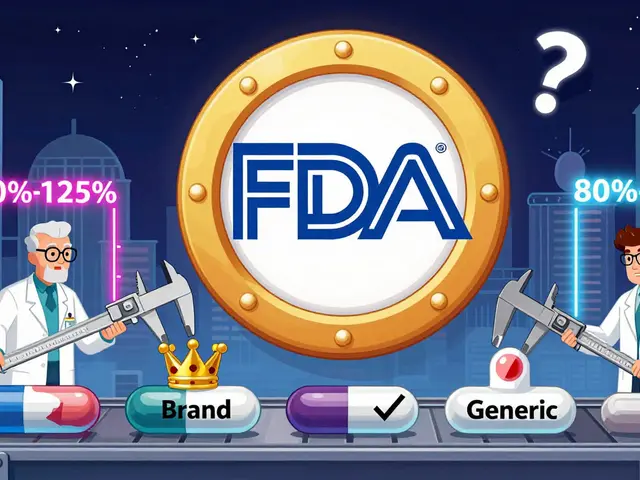
Manufacturers must conduct pharmacokinetic studies with 24-36 healthy human subjects. These studies measure two key metrics: Cmax (maximum concentration of the drug in the blood) and AUC (area under the curve, representing total exposure). The FDA requires that the generic drug’s results fall within an 80%-125% confidence interval of the brand-name drug’s parameters. In simpler terms, the generic must deliver the same amount of medicine to your bloodstream at roughly the same speed.
For most simple generics, this is straightforward. However, for complex generics like inhalers, topical creams, or modified-release formulations, traditional bioequivalence testing may be insufficient. The FDA’s Complex Generic Products Initiative has published over 127 product-specific guidances to address these challenges, as in vitro testing cannot always predict in vivo performance.
Step 5: Regulatory Approval and Inspection
Once the manufacturing data and bioequivalence studies are complete, the manufacturer submits the ANDA. This submission is massive, typically containing 5,000-10,000 pages of technical data, including analytical methods, batch records, and study reports.
The FDA reviews the application, which takes approximately 17 months for standard cases, though GDUFA IV aims to review 90% of original ANDAs within 10 months. During this time, the FDA inspects the manufacturing facility to ensure CGMP compliance. Common deficiencies cited in warning letters include inadequate investigation of out-of-specification results (37% of cases) and insufficient process validation (29%).
The ANDA also includes patent certifications. Manufacturers must declare whether the brand-name drug’s patents have expired (Paragraph II) or if they believe the patent is invalid or not infringed (Paragraph IV). Paragraph IV filings often trigger litigation, which can delay market entry by 30 months on average, but they are crucial for introducing competition sooner.
Quality Control: Why Your Generic Works
Skeptics sometimes worry about quality variations between different generic manufacturers. While the FDA requires strict batch-to-batch consistency, critics like Dr. Jerry Avorn of Harvard Medical School have raised concerns about potential differences in dissolution profiles for narrow therapeutic index drugs.
However, real-world data suggests high reliability. A 2023 survey by the Association for Accessible Medicines found that 89% of pharmacists reported high confidence in generic drug quality, with only 3% noting any meaningful differences in clinical outcomes compared to brand-name products. Successful manufacturers implement robust quality management systems, including documented procedures for deviation handling and stability testing (minimum 12 months of real-time data before approval).
| Feature | Brand-Name Drug | Generic Drug |
|---|---|---|
| Development Time | 10-15 years | 3-4 years |
| Cost to Develop | $2.6 billion | $5-10 million |
| Clinical Trials Required | Extensive Phase I-III trials | Bioequivalence studies only |
| Regulatory Pathway | New Drug Application (NDA) | Abbreviated New Drug Application (ANDA) |
| Price Premium | High (Patent protected) | Low (80-85% cheaper) |
The Future of Generic Manufacturing
The industry is evolving. Continuous manufacturing, approved by the FDA for 17 facilities as of 2023, is replacing traditional batch processing. This technology reduces production time from weeks to hours and improves quality consistency, with some manufacturers achieving 99.98% batch acceptance rates.
AI-driven quality control systems are also emerging, with pilot programs reducing visual inspection errors by 40%. Meanwhile, the market is shifting toward complex generics, which now represent 35% of pending ANDAs. These products, such as nasal sprays and ophthalmic suspensions, offer higher margins and less competition than simple generics, which often face 15-20 competitors and rapid price erosion.
Despite challenges like supply chain concentration-with 78% of U.S. generic APIs coming from China and India-the sector remains vital. With projected annual growth of 6-8% through 2027 and cumulative savings expected to reach $1.8 trillion by 2028, generic drugs continue to democratize access to essential medicines.
Are generic drugs really as effective as brand-name drugs?
Yes. The FDA requires generic drugs to be bioequivalent to brand-name drugs, meaning they must deliver the same amount of active ingredient to your bloodstream within the same timeframe. Studies show that 90% of prescriptions in the U.S. are filled with generics, and surveys indicate that 89% of pharmacists have high confidence in their quality. While inactive ingredients may differ, the therapeutic effect is identical.
Why do generic pills look different from brand-name pills?
US trademark law prohibits generic products from physically resembling brand-name versions to prevent consumer confusion. Therefore, generics may differ in color, shape, size, and flavoring due to different inactive ingredients (excipients). However, the active pharmaceutical ingredient (API) must be chemically identical.
How long does it take to get a generic drug approved?
The development and approval process typically takes 3-4 years, significantly shorter than the 10-15 years required for new brand-name drugs. Under GDUFA IV, the FDA aims to review 90% of original ANDA applications within 10 months, though complex generics may take up to 36 months due to additional testing requirements.
What is bioequivalence testing?
Bioequivalence testing involves clinical studies with 24-36 human subjects to measure how quickly and completely the drug is absorbed into the bloodstream. The generic must demonstrate that its maximum concentration (Cmax) and total exposure (AUC) fall within an 80%-125% confidence interval of the brand-name drug’s results.
Can generic drugs have side effects different from brand names?
Since the active ingredient is identical, the primary side effects should be the same. However, because inactive ingredients (fillers, dyes, binders) can differ, individuals with specific allergies or sensitivities to these non-active components might react differently. This is rare, but patients with known sensitivities should check the ingredient list.