
Psoriasis isn’t just a rash. It’s a full-body immune problem that shows up on the skin - and sometimes inside the body too. If you’ve got thick, scaly patches on your elbows, knees, or scalp, you’re likely dealing with plaque psoriasis, the most common form. If you’ve suddenly broken out in small, drop-like spots after a sore throat, that’s probably guttate psoriasis. And if your skin is covered, your joints ache, or you’re tired all the time, you might need systemic treatment - drugs that work from the inside out.
Over 125 million people worldwide live with psoriasis. In the UK alone, about 2% of the population has it. What’s changed in the last few years isn’t just the number of cases - it’s how we treat them. We’re no longer just slathering on creams and hoping for the best. We’re targeting the exact immune signals that cause the flare-ups.
Understanding Your Type: Plaque vs. Guttate
Plaque psoriasis makes up 80-90% of all cases. It’s the classic version: raised, red patches covered in silvery scales. These often show up on elbows, knees, the lower back, and scalp. The skin doesn’t just look weird - it can crack, bleed, and hurt. For many, it’s not just about appearance. It’s about itching that keeps you awake, pain that makes walking hard, and shame that keeps you from wearing shorts.
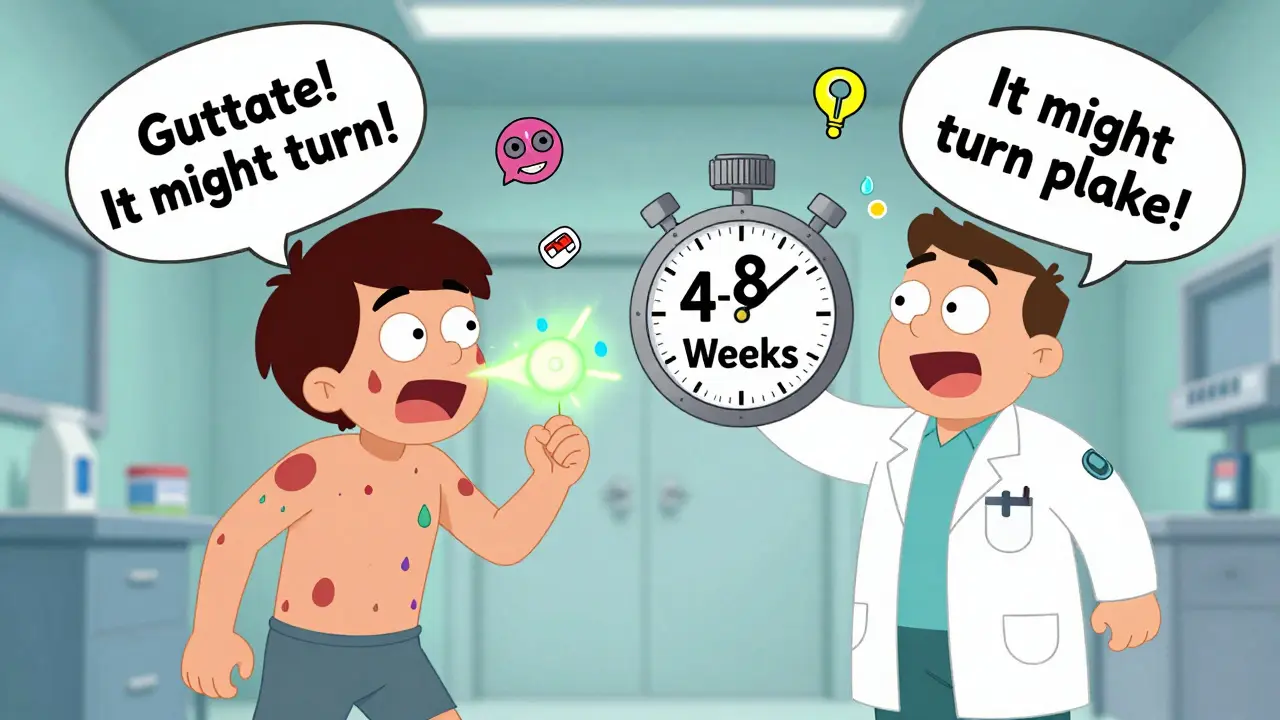
Guttate psoriasis is different. It hits fast - often after a strep infection like strep throat. You get dozens of small, teardrop-shaped spots all over your torso, arms, or legs. It’s common in kids and young adults. Unlike plaque psoriasis, guttate often clears up on its own within weeks or months. But for some, it turns into chronic plaque psoriasis. That’s why treating it early matters.
Topical treatments - creams, ointments, foams - are the first line for both. But they don’t work the same for everyone. Corticosteroids (like hydrocortisone or betamethasone) reduce inflammation fast. But if you use them too long, your skin can thin out. Calcipotriol, a vitamin D-based cream, helps slow down skin cell growth. Used together, a 0.005% calcipotriol/betamethasone foam clears up 89% of genital psoriasis cases. That’s not a fluke - it’s science.
When Topicals Aren’t Enough: Systemic Therapies
If more than 5% of your skin is covered - or if your joints hurt - topicals alone won’t cut it. That’s where systemic treatments come in. These are pills or injections that change how your immune system behaves.
Traditional oral drugs include methotrexate, cyclosporine, and acitretin. Methotrexate, taken once a week, helps about 50-60% of people get 75% clearer skin. But it needs regular blood tests. Cyclosporine works faster - often in 4-8 weeks - but can damage kidneys if used long-term. Acitretin, a vitamin A derivative, is good for stubborn plaques but can dry out your skin and raise cholesterol.
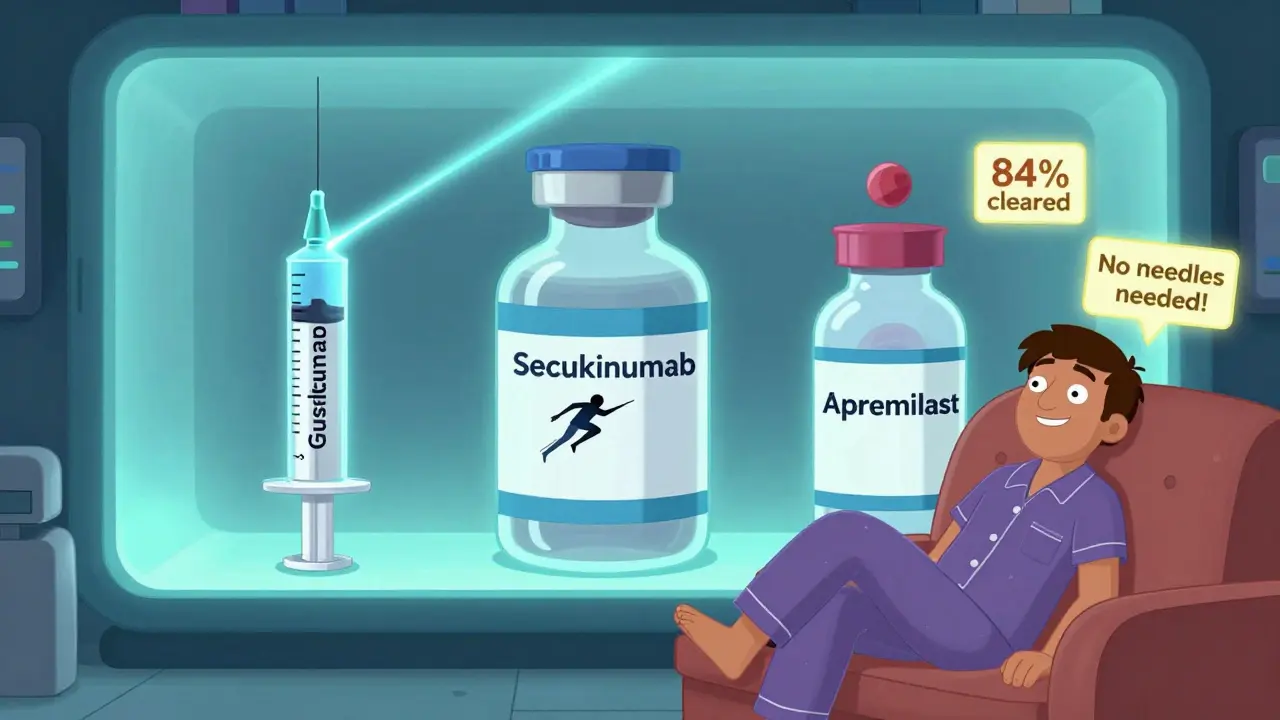
Then there’s apremilast (Otezla). It’s a pill you take twice a day. It doesn’t suppress your whole immune system. Instead, it blocks a specific enzyme linked to inflammation. About 33% of users hit PASI 75 (75% skin clearance) after 16 weeks. It’s safer than older drugs - no liver or kidney monitoring needed. But it can cause nausea or diarrhea at first.
The real game-changer? Newer oral drugs like deucravacitinib. Taken once daily, it blocks a pathway called TYK2. In trials, 58.7% of users hit PASI 75 in 16 weeks. That’s better than most older pills. And no needles.
Biologics: The Precision Medicine Revolution
Biologics are drugs made from living cells. They’re like guided missiles - they lock onto one specific part of the immune system. No more guessing. You get a drug that matches your body’s inflammation pattern.
There are three main families:
- TNF inhibitors - like adalimumab (Humira). They block tumor necrosis factor, a key inflammation signal. About 78% of users get 75% clearer skin. But they’re older. Many now get replaced by newer options.
- IL-17 inhibitors - like secukinumab (Cosentyx). They target interleukin-17. Around 79% hit PASI 90 (90% clearance) in 16 weeks. They work fast - often within 2-4 weeks. Great for people who need quick results.
- IL-23 inhibitors - like guselkumab (Tremfya), risankizumab (Skyrizi), and tildrakizumab (Ilumya). These are the new leaders. They block interleukin-23, which sits higher up in the inflammation chain. That means they’re more effective long-term. Guselkumab clears 84% of users to PASI 90. And you only need an injection every 8 weeks after the first two.
Real-world data from 31,521 patients shows risankizumab has the highest persistence rate - 78.4% of people stayed on it after a year. That’s huge. If a drug works well and you don’t have to inject it every week, you’re more likely to stick with it.
IL-23 inhibitors also shine on tricky areas: scalp and nails. Guselkumab cleared 74% of scalp psoriasis at 16 weeks. That’s better than ustekinumab (70%). And for nail psoriasis - where pitting and thickening make daily life hard - intralesional triamcinolone injections give 75% improvement in pitting at 12 weeks.
What Works Best? A Real-World Comparison
Here’s how the top treatments stack up in real patients:
| Drug Type | Example | PASI 75 at 16 Weeks | PASI 90 at 16 Weeks | Dosing Schedule | Key Pros | Key Cons |
|---|---|---|---|---|---|---|
| Topical | Calcipotriol/Betamethasone foam | 35-40% | Not applicable | Once daily | Safe, no blood tests | Only for mild cases |
| Oral | Deucravacitinib | 58.7% | ~45% | Once daily | No injections, good safety | Slower than biologics |
| Biologic (TNF) | Adalimumab | 78.3% | 60-65% | Every 2 weeks | Long track record | Higher infection risk |
| Biologic (IL-17) | Secukinumab | 79.3% | 75-80% | Every 4 weeks | Fast action, good for scalp | May worsen IBD |
| Biologic (IL-23) | Guselkumab | 84.1% | 84-90% | Every 8 weeks | Best long-term clearance, low dosing | Cost, insurance hurdles |
IL-23 inhibitors aren’t just more effective - they’re more convenient. One injection every two months. That’s easier than weekly shots or daily pills. And for patients with psoriatic arthritis or IBD, IL-23 drugs are safer than IL-17 ones. Dr. Robert Rissmann at ESDR 2025 said it plainly: “Don’t use IL-17 inhibitors if you have Crohn’s.”
Cost, Access, and Patient Experience
Let’s be real - these drugs are expensive. A year of guselkumab costs about $34,200. Secukinumab is $32,800. Apremilast is $7,200. That sounds impossible. But here’s the twist: 85% of insured patients in the UK and US pay $0-$150 per month thanks to manufacturer assistance programs. Most pharmacies now have patient navigators who help you get coverage.
Insurance approval can take 4-6 weeks. That’s why many dermatologists now start the paperwork before your first injection. Electronic prior authorizations have cut approval time from 14 days to under 6 days in big clinics.
Patients report real wins. Reddit user u/PsoriasisWarrior said: “After failing methotrexate and adalimumab, guselkumab cleared 95% of my plaques in 3 months. Quarterly shots? Life-changing.” But not everyone’s happy. Some say secukinumab took 4 months to work - too slow for a job interview. Others got injection site reactions.
Support matters. The National Psoriasis Foundation’s Biologics Navigator tool has 87% user satisfaction. Telehealth services like Dermatology Telehealth Network offer 48-hour consults. And apps that remind you to take your pill or inject yourself? They boost adherence by over 70%.
The Future: Oral Biologics and Functional Cures
Next up? Oral biologics. No needles. Just a pill. Phase 3 trials for selective IL-23 receptor blockers show 82% of patients hit IGA 0/1 (clear or almost clear skin). That’s biologic-level results - without the injection.
And here’s the craziest part: researchers are testing whether you can stop treatment entirely. The GUIDE trial, finishing in mid-2026, is giving guselkumab to patients who clear completely. Then they stop. Early results? Some stay clear for over a year. That’s not just control - it’s remission. Maybe even a functional cure.
By 2030, IL-23 inhibitors could be first-line for 70-80% of moderate-severe cases. Oral peptides might replace 25% of current treatments. And topical creams targeting JAK pathways? They could hit 50-60% clearance by 2027 - making topicals useful again for moderate cases.
The message? Psoriasis isn’t a life sentence anymore. We know what’s driving it. We have tools to stop it. And we’re getting smarter every year. Your treatment isn’t one-size-fits-all. It’s about matching the drug to your type, your body, and your life - not the other way around.

Kathy Leslie
March 12, 2026 AT 10:24Been living with plaque psoriasis for 12 years and honestly? Guselkumab changed my life. I used to avoid swimming, beach trips, even wearing tank tops. Now? I’m out there in shorts and a crop top like it’s nothing. The every-8-weeks schedule? Perfect for my work schedule. No more weekly injections or daily pills. Just one quick visit and I’m good. I didn’t think anything could make me feel normal again. Turns out, science did.
Also, the patient navigator at my pharmacy literally walked me through insurance paperwork. I cried. Not because I was upset - because someone cared enough to help.
Psoriasis isn’t just skin deep. But now? My skin’s finally catching up to my soul.
Amisha Patel
March 13, 2026 AT 09:41So deucravacitinib works without needles? That’s huge. I’ve been on methotrexate for 3 years. Blood tests every month. Liver checks. Nausea every time I take it. I’ve been scared to try biologics because of the injections. This sounds like a game changer. No more panic when I see the syringe in the fridge.
Also curious - does it help with nail psoriasis? My nails look like they’ve been chewed by a raccoon. Been too embarrassed to show them even to my derm.
Elsa Rodriguez
March 14, 2026 AT 20:51OMG I just read this and I’m sobbing. I’ve been on 5 different treatments. 5. I’ve cried in dermatology offices. I’ve been told ‘it’s just psoriasis’ like it’s a pimple. I lost my job because I refused to take off my long sleeves in 95-degree heat. I had to quit my favorite hobby because I couldn’t wear sandals.
And then I got guselkumab. 90% clearance in 3 months. My sister said I looked like my 18-year-old self again. I didn’t know I was still in there.
But why is it so hard to get? My insurance denied it twice. I had to appeal. Twice. I’m tired. I’m so tired.
Also - why is no one talking about how much this costs? I’m not rich. I’m not a CEO. I’m just a woman trying to live without shame. Someone needs to fix this.
Serena Petrie
March 16, 2026 AT 14:13IL-23 > IL-17. Done.
Stephanie Paluch
March 18, 2026 AT 13:38Just got my first guselkumab shot last week 😭💖
My scalp was so bad I was wearing hats 24/7. Now? I went to the gym without a hat. And I didn’t hide. I just… existed. People didn’t stare. I didn’t feel like a freak.
Also - the app that reminds me to inject? Lifesaver. I used to forget. Now I get a little ping and a 💉 emoji. Weirdly motivating.
And yes, my nails are finally growing back. No more pitting. No more hiding my hands. I’m crying again. This time, happy tears. 🥹
tynece roberts
March 19, 2026 AT 19:16so i’ve been on apremilast for 6 months and honestly? it’s okay. not great. not terrible. i mean, i’m 30% clearer? cool. but i still look like i have dandruff on my elbows and my knees are always red. i don’t mind the nausea - i just take it with food. but the fact that it doesn’t even work on my scalp? that’s the kicker. i’ve got a whole patch on my forehead that just won’t go away. i think i’m switching to deucravacitinib next. at least it’s a pill. no needles. no monthly blood work. just a little white tablet and hope. also - why do all the biologics cost more than my rent? i’m not rich. i’m not even middle class. i’m just a woman with bad skin and a bad system.
Hugh Breen
March 19, 2026 AT 23:00As someone who’s been treating psoriasis since 2015 - I’m BLOWN AWAY by how far we’ve come. The stats here? Real. The data? Solid. IL-23 inhibitors aren’t just better - they’re revolutionary. Guselkumab? Skyrizi? These aren’t drugs. They’re liberation.
And the fact that you can now get a 48-hour telehealth consult? That’s healthcare equity. That’s dignity.
But let’s not forget - this only works if you’re insured. If you’re in rural America. If you’re undocumented. If you’re in India and can’t afford a single dose. We need global access. Not just better science. Better justice.
Also - shoutout to u/PsoriasisWarrior. You’re not alone. We’re all in this. 💪❤️
Byron Boror
March 21, 2026 AT 21:31So you’re telling me the government pays for these $30K drugs but my kid’s school can’t afford new textbooks? This is why America’s going to hell. We’re spending millions on rich people’s rashes while veterans sleep in their cars. Someone needs to shut this down. Stop treating psoriasis like a luxury. It’s not a disease - it’s a scam. And the pharma companies are laughing all the way to the bank.