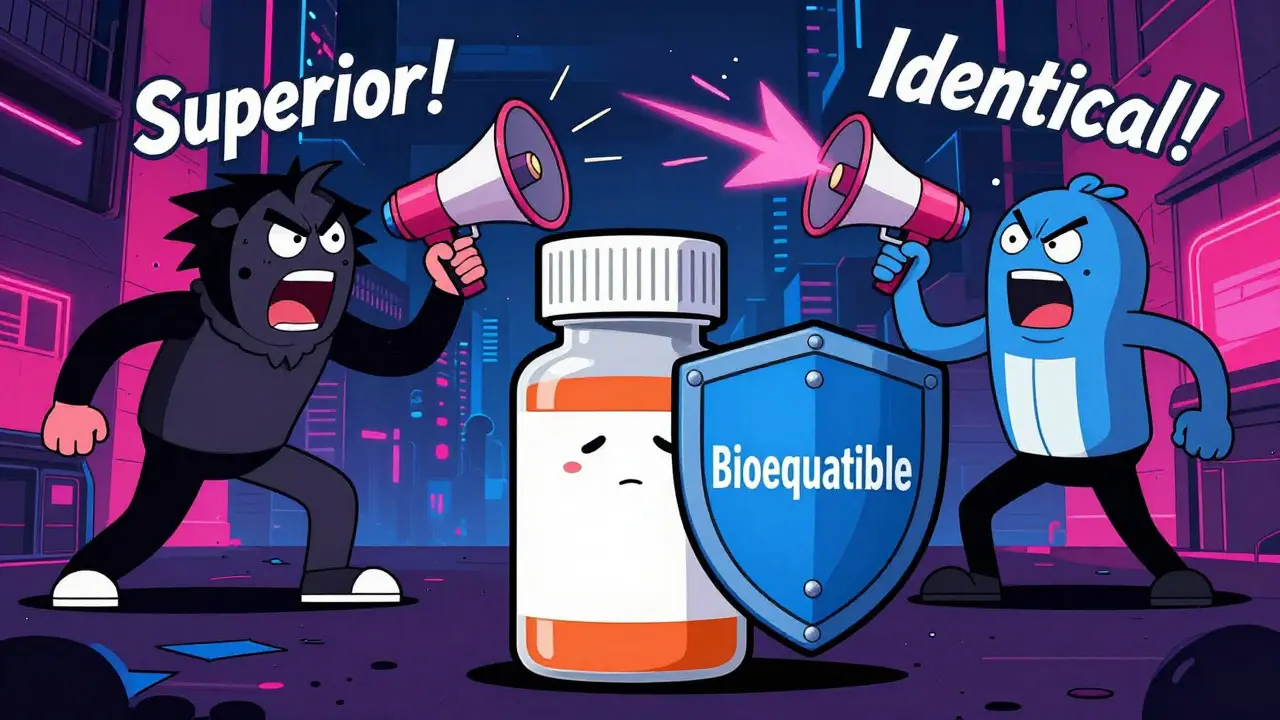
You might think that because a generic drug is cheaper than its brand-name counterpart, it’s automatically safe to market with bold claims. But the legal reality is far more complex. False advertising in the generic pharmaceutical sector isn’t just about catchy slogans; it’s a high-stakes minefield involving federal laws, state consumer protections, and aggressive enforcement by the Food and Drug Administration (FDA). As of late 2025, the regulatory landscape has shifted dramatically. A presidential memorandum issued in September 2025 directed the Department of Health and Human Services to crack down on misleading direct-to-consumer (DTC) ads that disadvantage cheaper generics or misrepresent their safety profiles. For manufacturers, marketers, and even patients, understanding these rules is no longer optional-it’s essential for avoiding massive fines, lawsuits, and reputational damage. Here is what you need to know about the legal risks, the specific rules governing generic drug advertising, and how the recent crackdown changes the game.
The Core Problem: What Constitutes False Advertising in Generics?
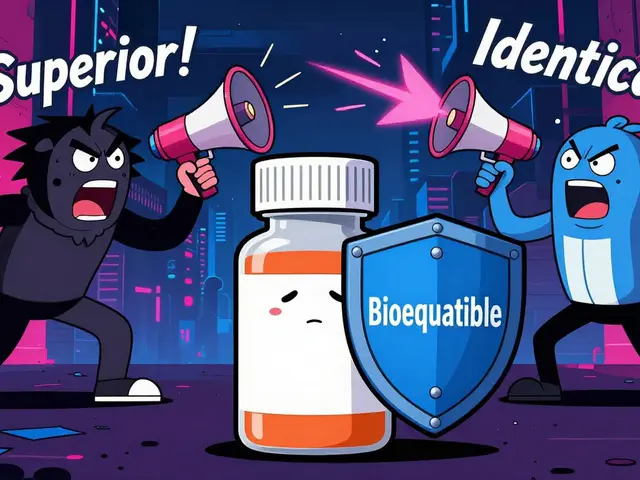
False advertising in this context refers to any deceptive marketing practice that misrepresents the efficacy, safety, equivalence, or regulatory status of a generic drug product. It’s not enough to simply sell a pill; the way you talk about it must align strictly with scientific evidence and regulatory approval. The primary issue arises when companies blur the lines between "bioequivalent" and "therapeutically identical." While the FDA requires generics to demonstrate they are bioequivalent to the reference listed drug-typically falling within 80-125% of the brand-name drug's pharmacokinetic parameters-they do not always require head-to-head clinical trials proving identical therapeutic outcomes for every condition. When an ad implies that a generic will work exactly like the brand name in every single scenario without disclosing necessary caveats, it crosses into false advertising territory. This is particularly dangerous for narrow therapeutic index drugs, where small differences in concentration can have significant health impacts.
The Regulatory Framework: Laws That Keep Companies Honest
To understand the risks, you first need to understand the rules. The framework governing generic drug advertising is built on three main pillars:
- The Federal Food, Drug, and Cosmetic Act (FD&C Act): Specifically Section 352, which prohibits misbranding. If your label or ad contains false or misleading statements about the drug’s strength, quality, or purity, you’re violating federal law.
- The Lanham Act § 43(a): This is where competitors come in. If a brand-name company believes your generic ad is confusing consumers or falsely claiming superiority, they can sue you under the Lanham Act. Recent cases show that using terms like "FDA Approved" for products that only received "FDA Clearance" has triggered significant liability here.
- State Consumer Protection Statutes: Each state has its own rules. For example, New York’s General Business Law § 349 allows for penalties up to $10,000 per violation, while California’s Unfair Competition Law imposes even stricter substantiation requirements than federal standards.
The foundation of this system was laid by the Hatch-Waxman Act of 1984, which created the Abbreviated New Drug Application (ANDA) pathway. This act allowed generics to enter the market faster by relying on the safety data of the original brand-name drug, but it also established strict boundaries on how those generics could be marketed relative to their predecessors.
The 2025 Shift: Closing Loopholes and Increasing Scrutiny
If you thought the rules were static, think again. In September 2025, the FDA announced a major enforcement initiative. This wasn't just a warning shot; it resulted in thousands of warning letters and approximately 100 cease-and-desist orders targeting deceptive pharmaceutical advertising. One of the biggest targets was the "adequate provision" loophole created in 1997. Previously, broadcast ads could reference where viewers could find complete risk information rather than listing all risks in the ad itself. The FDA is now closing this gap, requiring that all broadcast and digital advertisements include complete risk information directly in the ad. This means no more hiding behind tiny footers or directing users to obscure websites for critical safety data. Additionally, the new guidelines emphasize "fair balance." Ads must present risks and benefits equally. You cannot exaggerate the benefits of a generic while downplaying its side effects, nor can you create a misleading impression that it is superior to the brand name without robust clinical evidence.
| Feature | Brand-Name Drugs | Generic Drugs |
|---|---|---|
| Risk Disclosure | Must disclose all major risks in DTC ads | Must disclose risks, often with stricter font size/contrast rules |
| Superiority Claims | Allowed if substantiated by clinical trials | Prohibited unless supported by head-to-head trials |
| Cost Savings Messaging | N/A | Can state "lower cost" but cannot quantify savings without rigorous proof |
| Visual Identity | Distinct branding allowed | Must avoid visual elements that confuse with brand-name product |
Legal Risks: Fines, Lawsuits, and Reputational Damage
The consequences of getting it wrong are severe. Under the Lanham Act, competitors can seek treble damages-meaning you pay three times the actual harm caused. In New York, courts can award up to $1,000 per violation under General Business Law § 350, plus triple damages. Beyond financial penalties, there’s the human cost. A 2024 FDA analysis of over 1,200 patient complaints revealed that 32% of patients who discontinued medications based on fear-mongering lawsuit ads (which often targeted generics incorrectly) experienced adverse health outcomes. When patients refuse generic substitution due to misleading online ads claiming "generics are dangerous," they suffer physically and financially. For companies, the risk extends to market share. The U.S. generic drug market is valued at $140 billion and represents 90% of all prescriptions dispensed. Losing trust in this space can devastate a manufacturer’s bottom line. Major players like Teva, Sandoz, and Mylan face intense scrutiny, with compliance costs averaging $2.1 million annually per major manufacturer.
Practical Compliance: How to Avoid Pitfalls
So, how do you navigate this? First, build a multidisciplinary team. You need regulatory affairs specialists with at least five years of FDA experience, medical writers, legal counsel, and marketing professionals. The learning curve for new compliance officers averages 18 months, so invest in training early. Second, scrutinize your language. Avoid absolute terms like "identical" or "superior" unless you have the clinical data to back them up. Use precise language regarding bioequivalence. Instead of saying "just as good," say "demonstrated bioequivalent to [Reference Listed Drug]." Third, ensure visual clarity. Your ads must clearly state "This is a generic drug" and disclose the reference listed drug. Avoid packaging or ad designs that mimic the brand-name product too closely, as this creates consumer confusion-a key trigger for Lanham Act lawsuits. Finally, stay updated on state-specific laws. Florida’s H.B. 1205 prohibits certain types of health alert language, while California demands higher substantiation standards. One-size-fits-all campaigns rarely survive legal review in today’s fragmented regulatory environment.
The Future of Generic Drug Marketing
Looking ahead, expect tighter coordination between the FDA and the Federal Trade Commission (FTC). Draft legislation like H.R. 4582, the "Transparency in Drug Advertising Act," proposes standardized risk disclosure requirements across all media platforms. Industry analysts project that enforcement actions will increase by 35% annually through 2027. Companies that invest in robust compliance infrastructure will maintain a competitive advantage. Those that cut corners risk not just fines, but exclusion from a market that relies heavily on trust. As Dr. Peter Lurie of the Center for Science in the Public Interest noted, ads that fail to disclose that a generic remains FDA-approved unless recalled cause unnecessary panic and discontinuation of necessary medications. The goal is clear: protect patients from health risks while ensuring fair competition. For marketers, this means creativity must be balanced with precision. Every claim must be backed by data, every risk must be visible, and every comparison must be honest.
What is the difference between "FDA Approved" and "FDA Cleared" for generics?
While often used interchangeably in casual conversation, legally they carry different weights. "FDA Approved" typically applies to new drugs that have undergone full clinical trials. "FDA Cleared" often applies to devices or generics that have demonstrated equivalence to an existing approved product. Using "Approved" for a generic that only has "Clearance" status can trigger Lanham Act liability from competitors who argue this misleads consumers about the level of testing undergone.
Can I advertise that my generic drug is cheaper than the brand name?
Yes, but with caution. You can state that the generic is "lower cost" or "more affordable." However, you cannot quantify specific savings (e.g., "Save $50") unless you have rigorous, current data to substantiate that exact figure for the target audience. The FTC requires strong evidence for any specific price comparison claims.
What happened to the "adequate provision" rule?
The "adequate provision" policy, introduced in 1997, allowed TV and radio ads to tell viewers where to find full risk information instead of listing all risks in the ad. As of September 2025, the FDA is closing this loophole. New rules require that all broadcast and digital ads include complete risk information directly in the advertisement, ensuring patients see critical safety facts immediately.
Who can sue a generic manufacturer for false advertising?
Several parties can bring action. The FDA can issue warning letters and fines under the FD&C Act. Competitors (usually brand-name manufacturers) can sue under the Lanham Act for unfair competition and consumer confusion. Additionally, state attorneys general can enforce local consumer protection laws, such as New York’s General Business Law § 349, which allows for significant penalties.
How does the 2025 Presidential Memorandum affect generic drug marketing?
The September 2025 memorandum directed the Department of Health and Human Services to specifically target ads that mislead the public about risks and benefits, encourage medication over lifestyle changes, or advantage expensive brand-name drugs over cheaper generics. This has led to increased scrutiny of comparative ads and a push for greater transparency in risk disclosures.