
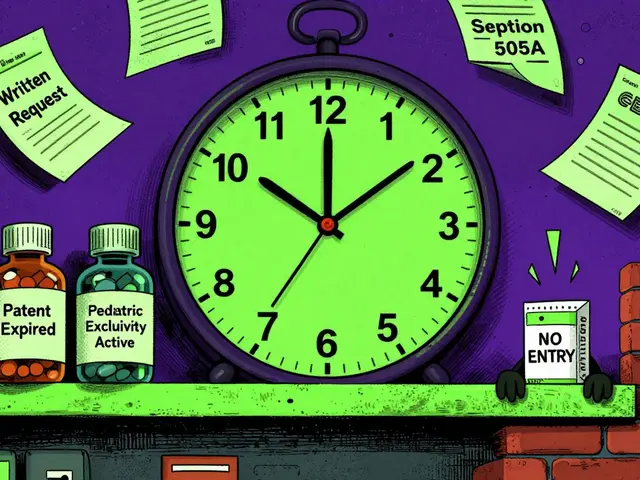
When you pick up a prescription, you might not realize that the pill in your hand isn’t always the brand-name drug your doctor wrote on the slip. More than 90% of prescriptions in the U.S. are filled with generic versions. But not all generics are treated the same. Some can be swapped in without a second thought. Others? Not so much. That’s where therapeutic equivalence codes come in - the FDA’s secret language for telling pharmacists exactly which generics are safe to substitute.
What therapeutic equivalence really means
Therapeutic equivalence isn’t just about having the same active ingredient. It’s about proving that a generic drug will work the same way in your body as the brand-name version - same speed, same strength, same safety. The FDA doesn’t guess. It tests. And it assigns a code to every multisource prescription drug that tells pharmacists: yes, you can substitute or no, hold off.The system is built on three pillars: pharmaceutical equivalence, bioequivalence, and clinical performance. Pharmaceutical equivalence means the generic has the same active ingredient, strength, dosage form, and route of administration. Bioequivalence means the drug gets into your bloodstream at the same rate and amount as the brand. And clinical performance? That’s the bottom line - does it work the same in real patients?
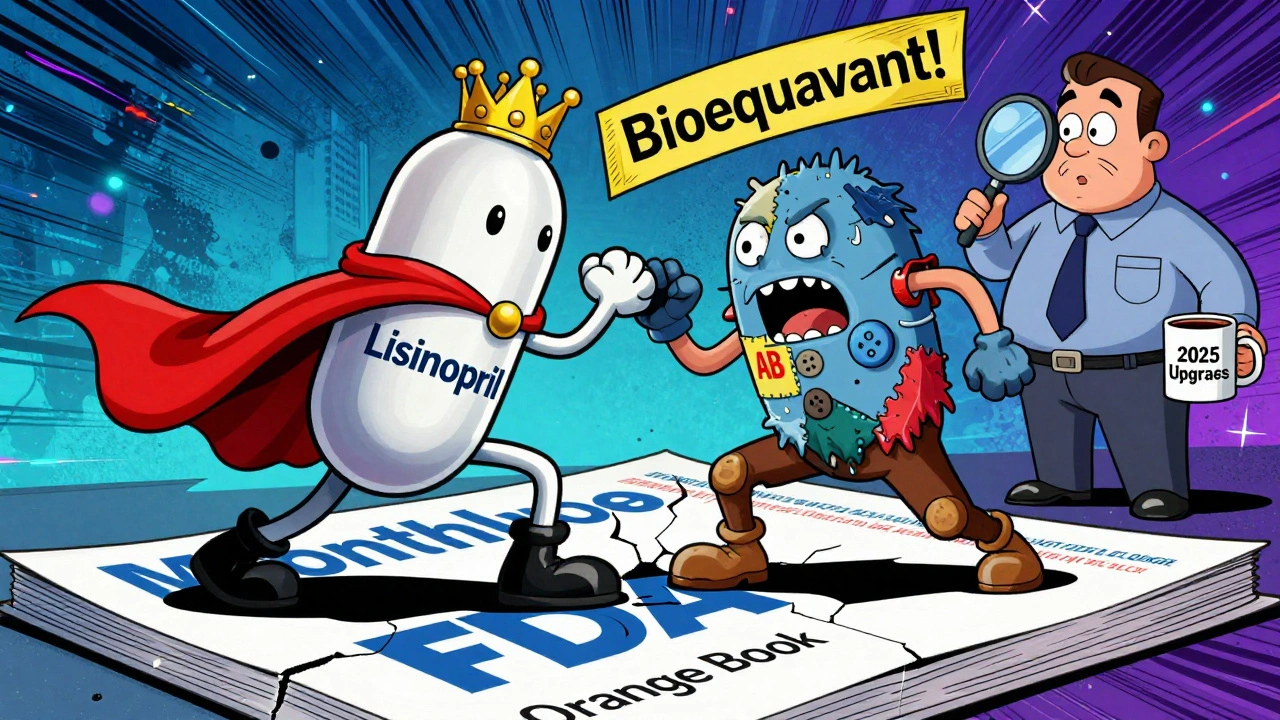
Only products that pass all three get an ‘A’ rating. That’s the green light. The FDA’s Orange Book, published since 1980, is the official list where these codes live. It’s updated monthly. Pharmacists check it. State boards require it. And it’s the reason you can walk into any pharmacy and get a cheaper version of your medicine without calling your doctor.
The code system: A, B, and what the letters mean
The code is simple: one or two letters. The first letter tells you the big picture. The rest? Details.If a drug starts with an ‘A’, it’s approved for substitution. That’s it. No extra steps. About 90% of generics in the U.S. carry this rating. But here’s where it gets tricky. Not all ‘A’ codes are the same.
- AB - The most common. These drugs have passed bioequivalence studies. AB1, AB2, AB3? That just means there are multiple brand-name versions out there, and this generic matches one of them. If your prescription says “Lisinopril 10mg,” and your pharmacy has AB1 and AB2 generics, either one is fine.
- ABN - For nasal sprays and inhalers. These are harder to test, but if they get an ABN, they’ve met the FDA’s special standards.
Now, if you see a ‘B’, stop. Don’t substitute. Not without talking to your doctor.
- BC - Extended-release pills. These are tricky. The drug is designed to release slowly. If the generic doesn’t match the release pattern exactly, it could cause side effects or not work as well.
- BT - Topical creams, ointments, gels. Skin absorption varies. Two creams might look identical, but one might not penetrate the same way.
- BN - Aerosol delivery systems. Think asthma inhalers. These are complex. Even tiny differences in particle size matter.
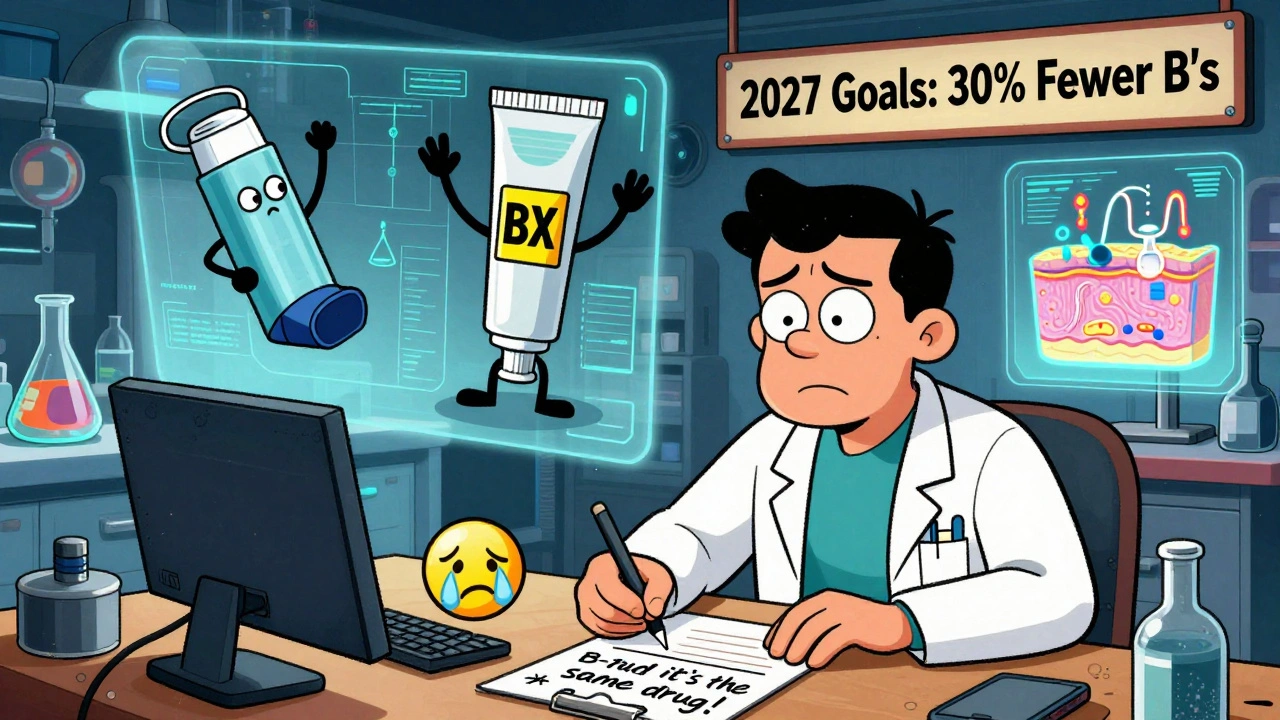
- BX - The red flag. Not enough data. The FDA hasn’t been able to confirm if it’s equivalent. Don’t substitute. Ever.
These ‘B’ codes aren’t about safety failures. They’re about uncertainty. The FDA doesn’t say they’re bad. It says: we need more proof. That’s why some pharmacists get nervous - and why some doctors are confused.
Why pharmacists rely on the Orange Book
Every week, pharmacists open the FDA’s Orange Book website. They search by drug name. They check the code. Then they decide: swap or don’t swap. According to a 2022 survey of 1,200 community pharmacists, 87% say this system saves time and reduces errors. On average, they spend about 2.7 minutes per prescription verifying the code. That adds up - and it’s why generics save the U.S. healthcare system $1.2 billion a year just through substitution.But it’s not perfect. A 2022 AMA survey found that 42% of physicians don’t fully understand what ‘B’ means. Some think it means the drug is unsafe. Others think it’s just a paperwork issue. One doctor told a patient, “I don’t trust that B-rated generic,” even though the drug had been used safely for years. The patient switched back to the brand - and paid $150 more per month.
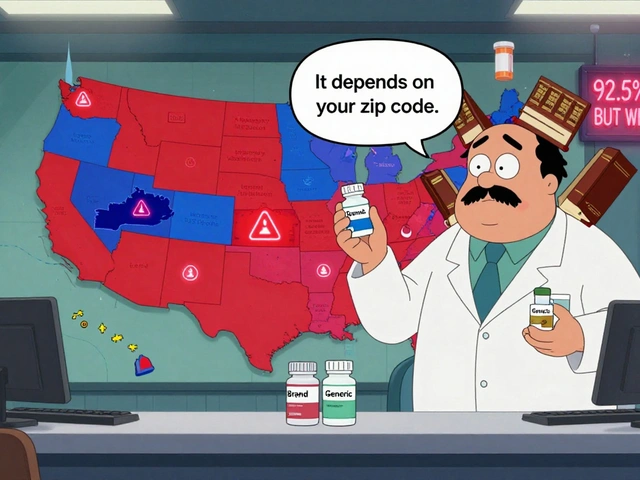
Pharmacists have rules too. In 38 states, they’re legally required to notify the prescriber if they substitute a ‘B’-rated product. In 49 states, they can swap ‘A’-rated drugs without permission. Only one state - New York - requires a doctor’s approval for every substitution, regardless of code.
Where the system breaks down
The TE code system works great for simple pills. Take a 10mg tablet of metformin. The science is solid. Bioequivalence studies are easy. It’s a no-brainer: AB.But what about a topical cream for eczema? Or an inhaler for COPD? Or a complex injectable? These aren’t just pills. They’re delivery systems. The active ingredient might be identical, but how it’s absorbed? That’s different. And traditional blood tests can’t always capture it.
That’s why the FDA has seen a 22% rise in ‘B’ ratings for complex generics between 2018 and 2022. Experts like Dr. Duxin Sun from the University of Michigan say the current system isn’t built for these drugs. “We’re using 1980s tools to judge 2020s medicines,” he wrote in 2022.
Take a steroid cream. Two brands have the same concentration of triamcinolone. But one uses a different emulsifier. The patient feels better on one. The FDA can’t prove why - because there’s no standard test for skin absorption. So it gives it a ‘BT’ code. The pharmacist won’t substitute. The patient pays more. The system is working - but it’s not fair.
What’s changing in 2025
The FDA knows this. In 2022, it released a draft guidance to update how it evaluates complex products. The goal? Reduce ‘B’ ratings for these drugs by 30% by 2027.They’re doing three things:
- Writing more Product-Specific Guidelines (PSGs) - 1,850 now - to tell manufacturers exactly how to prove bioequivalence for each drug.
- Accepting new data types, like real-world evidence from patient outcomes and advanced imaging.
- Testing in vitro methods that mimic how the drug behaves in the body, instead of just measuring blood levels.
These changes won’t fix everything overnight. But they’re moving the system forward. The FDA’s Office of Generic Drugs is now working with universities and labs to develop better tools for testing inhalers, patches, and injectables.
And it’s working. In 2023, over 12,600 of the 14,000 products in the Orange Book got an ‘A’ rating. That’s up from 12,100 in 2021. More generics are getting the green light. More patients are saving money. The system is adapting.
What you need to know as a patient
You don’t need to memorize codes. But you should know this: if your pharmacist switches your medication, they’re not doing it randomly. They’re following federal rules. If you get a generic and it doesn’t feel right - tell your doctor. Don’t assume it’s the drug. But also don’t assume the brand is better.Ask your pharmacist: “Is this an A-rated generic?” If it is, you’re good. If it’s a B, ask why. Is it because the FDA hasn’t confirmed equivalence? Or because the drug is complex and the system can’t yet prove it’s the same? That’s not a failure. It’s transparency.
And if you’re worried about cost? Remember: generics make up 90% of prescriptions but only 23% of drug spending. That’s $370 billion saved every year. The TE code system isn’t perfect - but it’s the reason you can afford your medicine at all.
What does an AB code mean on a generic drug?
An AB code means the generic drug has been proven to be pharmaceutically and bioequivalent to the brand-name version. It can be safely substituted without any change in effectiveness or safety. AB1, AB2, etc., just indicate which brand-name drug it was tested against - all are interchangeable.
Can I refuse a generic if it has an A rating?
Yes. Even if a generic has an A rating, you can ask your pharmacist to dispense the brand-name drug. Some insurance plans may require you to pay more, or even the full price, if you choose the brand over a covered generic. Always check with your pharmacy and insurer.
Why do some generics have a B rating if they’re the same drug?
A B rating doesn’t mean the drug is unsafe or ineffective. It means the FDA hasn’t yet confirmed that it’s therapeutically equivalent based on current testing methods. This often happens with complex products like inhalers, creams, or extended-release pills where traditional blood tests can’t fully predict how the drug will behave in the body.
Are over-the-counter (OTC) drugs assigned therapeutic equivalence codes?
No. The FDA only assigns therapeutic equivalence codes to prescription drugs. OTC medications are regulated under different standards and are not included in the Orange Book. You can still compare ingredients, but there’s no official substitution code for them.
How often is the Orange Book updated?
The FDA updates the Orange Book monthly. New drugs get added, codes change if new data becomes available, and withdrawn products are removed. Pharmacists and prescribers rely on these monthly updates to make accurate substitution decisions.
Next steps if you’re confused
If you’re unsure about your medication: call your pharmacist. Ask them to show you the Orange Book entry for your drug. You can also search the FDA’s website yourself - it’s free and public. Type in your drug name, check the TE code, and ask: “Is this an A-rated generic?” If it is, you’re getting a safe, proven substitute. If it’s B, ask why - and whether your doctor has a reason to prefer the brand.The system isn’t perfect. But it’s the best tool we have to make generics work safely. And right now, it’s saving millions of people money - without compromising care.


Marvin Gordon
December 5, 2025 AT 01:47Been using generics my whole life and never had an issue. The system works. If your doctor’s cool with it and the FDA says AB, you’re good. Stop overthinking it.
Norene Fulwiler
December 7, 2025 AT 01:21My grandma switched from brand-name blood pressure med to an AB-rated generic and saved $120/month. She’s been stable for 3 years. This isn’t just about cost-it’s about access. People shouldn’t have to choose between meds and groceries.
Ada Maklagina
December 7, 2025 AT 12:11BT codes are nonsense. Same active ingredient same milligrams same manufacturer different emulsifier and suddenly it’s a B. The science is lazy. We need better testing not more letters.
Harry Nguyen
December 9, 2025 AT 11:03Of course the FDA says it’s fine. They’re in bed with Big Pharma. The brand-name companies pay to keep the B ratings so they can jack up prices. You think this is about science? It’s about profit. Always has been.
James Moore
December 9, 2025 AT 18:54Let’s pause for a moment and consider the epistemological framework underpinning therapeutic equivalence: the FDA’s reliance on bioequivalence as a proxy for clinical equivalence is fundamentally reductionist. We measure plasma concentration curves, but we ignore inter-individual pharmacodynamic variance, gut microbiome modulation, and patient-reported outcomes. The Orange Book is a 1980s relic in a 2025 world-where we have AI-driven pharmacokinetic modeling, real-world evidence from wearables, and patient-centric data lakes. We’re quantifying molecules while ignoring the human experience of illness. The system isn’t broken-it’s philosophically obsolete.
Kylee Gregory
December 10, 2025 AT 19:04I appreciate how the system tries to balance safety and access. It’s not perfect, but it’s thoughtful. The fact that they’re updating guidelines for complex drugs shows they’re listening. Maybe we don’t need to tear it down-just improve it.
Lucy Kavanagh
December 12, 2025 AT 06:34Did you know the FDA gets funding from pharmaceutical companies? That’s why they’re slow to change B ratings. They don’t want to upset the apple cart. The real reason they won’t approve more generics is because the same CEOs own both the brand and the generic divisions. It’s all one big cartel.
Chris Brown
December 13, 2025 AT 13:01I find it deeply concerning that pharmacists are permitted to substitute medications without explicit physician consent. This is not a minor detail-it is a fundamental erosion of clinical autonomy. The physician-patient relationship is being undermined by bureaucratic convenience. We are not widgets on an assembly line. Medicine is not a commodity.
Stephanie Fiero
December 14, 2025 AT 20:23Just had a patient cry because her eczema cream got switched to a BT generic and it burned like hell. She’s been on the brand for 8 years. The pharmacist didn’t even tell her it was a different formula. We need better communication-not just codes. This isn’t just about science. It’s about trust.
Laura Saye
December 16, 2025 AT 03:28The therapeutic equivalence framework, while imperfect, reflects a nuanced attempt to reconcile empirical rigor with clinical pragmatism. The B-rating category functions as a precautionary epistemic boundary-a recognition that not all pharmacological equivalence can be reduced to plasma AUC metrics. The emerging methodologies-real-world evidence, in vitro permeation models, patient-reported outcomes-signal a paradigmatic shift toward a more holistic, phenomenological understanding of therapeutic equivalence. This evolution is not merely technical; it is ontological.
Michael Dioso
December 16, 2025 AT 15:53AB code? Yeah right. My cousin took a generic and his blood sugar went nuts. The FDA doesn’t know anything. They just print the code and call it a day. You think your life is worth a few bucks? Think again.
sean whitfield
December 18, 2025 AT 15:47They say generics save billions. Funny how the same companies that make the brand also make the generic. The whole system’s a shell game. You’re not saving money-you’re just paying the same guy under a different name.