Have you ever switched from a brand-name drug to a generic version and felt like something was off? Maybe your blood pressure spiked, or you started feeling dizzy. You aren't alone in noticing this. A significant number of patients report experiencing different or worse side effects after making the switch. But here is the tricky part: science says these two pills are essentially the same. So, why does it feel so different? The answer lies somewhere between strict regulatory standards, invisible ingredients, and the powerful way our minds influence our bodies.
To understand whether adverse reactions are actually more likely with generics, we have to look past the label. We need to dig into how generic drugs are defined by regulators, what the data on safety really shows, and why some people genuinely suffer while others blame their imagination. This isn't just about saving money; it's about understanding your health.
The Regulatory Promise: What Bioequivalence Really Means
When you hear that a generic is "equivalent" to a brand-name drug, that’s not just marketing fluff. It’s a legal requirement. In the United States, the Food and Drug Administration (FDA) requires every generic manufacturer to prove bioequivalence. This means the generic must deliver the same amount of active ingredient into your bloodstream within the same timeframe as the brand-name version.
Specifically, the FDA allows a 90% confidence interval where the generic’s absorption rate falls between 80% and 125% of the brand-name drug’s performance. For most medications, this slight variance is clinically meaningless. If you take a pill for high cholesterol, a 10% difference in how fast it absorbs won’t change the outcome. However, this standard was established under the Hatch-Waxman Act of 1984, which aimed to balance innovation with affordable access. While this framework works for the vast majority of drugs, it leaves a small window where individual biology might react differently.
It’s also crucial to remember that generics contain the same active pharmaceutical ingredient. They do not, however, have to match the inactive ingredients. These inactive components-fillers, binders, dyes, and preservatives-are what give the pill its shape, color, and stability. While they don’t treat your condition, they can trigger allergies or sensitivities in some patients. If you are sensitive to lactose or certain dyes, switching manufacturers could introduce a new allergen, leading to what feels like a "side effect" but is actually an allergic reaction to the filler.
What the Data Says: Safety Studies and Contradictions
If you ask a doctor, they will likely tell you that generics are safe. And broadly speaking, they are right. A comprehensive 2018 study published in PLOS Medicine, led by Dr. Aaron Kesselheim at Harvard Medical School, analyzed 38 clinical trials involving cardiovascular drugs. The researchers found no evidence that generics were less effective or safer than their brand-name counterparts. Patients taking generic versions of drugs like alendronate or quinapril had similar rates of heart attacks, fractures, and hospitalizations compared to those on brand-name versions.
However, the picture gets murkier when we look at real-world reporting rather than controlled trials. A 2018 analysis of the National Institutes of Health (NIH) database examined over 27,000 adverse event reports for common drugs like amlodipine and metoprolol. The study used Reporting Odds Ratios (RORs) to compare patterns. While authorized generics (brand-name drugs sold under generic labels) showed fewer significant differences, there were notable spikes in reported events for specific generic formulations. For instance, peripheral edema (swelling) was significantly more often reported with generic amlodipine compared to authorized generics.
Then there is the manufacturing origin factor. A controversial 2022 study from Ohio State University suggested that generic drugs manufactured in India were linked to a 54% higher rate of severe adverse events-including hospitalization and death-compared to equivalents produced in the U.S. The researchers noted this disparity was driven largely by "mature" generics that had been on the market for a long time. The FDA disputes this interpretation, arguing that facility location doesn't equal product quality, especially given that the FDA oversees approximately 1,700 global manufacturing facilities, with rigorous inspections increasing from 42 in 2010 to 317 in 2022 under the Generic Drug User Fee Amendments (GDUFA). Still, the fear remains among some healthcare providers that supply chain complexities can impact consistency.
| Study Source | Year | Key Finding | Implication |
|---|---|---|---|
| PLOS Medicine (Kesselheim et al.) | 2018 | No inferior efficacy or safety in cardiovascular trials | Generics are clinically equivalent for most major conditions |
| NIH Database Analysis | 2018 | Different reporting odds for specific adverse events (e.g., swelling) | Some generics may have distinct side-effect profiles due to formulation |
| Ohio State University | 2022 | Indian-manufactured generics linked to higher severe events | Manufacturing origin and quality control may play a role |
| Nature Scientific Reports | 2020 | Brand-name users had higher cardiac events in some classes | Generics may sometimes be better tolerated or cheaper, allowing adherence |
The Nocebo Effect: When Expectation Creates Symptoms
Here is where things get psychological. Have you ever heard someone say, "I’m only taking the cheap version," and suddenly start feeling unwell? This is known as the nocebo effect. It’s the opposite of the placebo effect. Instead of believing a treatment will help you, you believe it will harm you-or simply that it’s "inferior." That belief alone can trigger real physical symptoms.
A 2012 study published in PubMed demonstrated this clearly. Participants were given identical placebo pills. One group was told they contained a brand-name medication; the other was told they contained a generic. The group expecting the generic reported significantly more side effects (average of 1.83) compared to the brand-name group (average of 0.87), even though neither pill contained any active drug. The mere perception of taking a generic influenced their bodily experience.
This bias is powerful. A 2016 study in the European Journal of Public Health found that 54% of patients labeled as receiving generics discontinued their medication early due to perceived side effects, compared to only 33% in the brand-name group. Again, the pills were identical placebos. In the real world, this translates to patients blaming their generic levothyroxine or bupropion for anxiety or instability, when the issue might be unrelated timing, diet, or stress. Reddit discussions on pharmacy forums are filled with anecdotes of patients reporting insomnia after switching to generic bupropion, despite pharmacists noting that bioequivalence studies show no difference. The mind expects a problem, and the body delivers one.
When Generics Actually Fail: Narrow Therapeutic Index Drugs
While the nocebo effect explains many complaints, there is a specific category of drugs where generics truly require caution. These are called Narrow Therapeutic Index (NTI) drugs. For these medications, the difference between a helpful dose and a toxic dose is tiny. Small variations in absorption-even within the FDA’s allowed 80-125% range-can lead to serious consequences.
Common NTI drugs include:
- Warfarin: A blood thinner where too little increases clot risk, and too much causes bleeding.
- Levothyroxine (Synthroid): Used for thyroid replacement; slight changes can cause fatigue or heart palpitations.
- Phenytoin: An anti-seizure medication where levels must be tightly controlled.
- Cyclosporine: An immunosuppressant for transplant patients.
For these drugs, switching between different generic manufacturers can cause fluctuations in blood levels. A patient stable on one generic warfarin might see their INR (International Normalized Ratio) spike if switched to another manufacturer’s version because of slight differences in fillers affecting dissolution rates. The American Medical Association recommends that physicians specify "Dispense as Written" for these drugs to maintain consistency. If you are on an NTI drug, do not assume all generics are interchangeable without talking to your doctor. Consistency in the manufacturing source matters more here than with most other medications.
Practical Steps for Patients and Providers
So, what should you do if you’re worried about side effects? First, don’t panic. The consensus among major health organizations, including the American College of Physicians, is that the benefits of generic substitution outweigh the risks for nearly all medications. Generics account for 90% of prescriptions filled in the U.S., saving billions in healthcare costs. Abandoning them entirely is neither practical nor medically necessary for most people.
However, you can take proactive steps to manage your health:
- Track Your Symptoms: If you switch to a generic and feel worse, keep a log. Note the date of the switch, the specific symptoms, and their severity. This helps distinguish between a true reaction and a coincidental illness.
- Ask About the Manufacturer: Pharmacists know which company makes each generic. If you react poorly to one brand of generic, ask if your pharmacy can stock a different manufacturer’s version. Often, the issue is the inactive ingredient, not the drug itself.
- Educate Yourself: Understanding that bioequivalence is a rigorous standard can reduce anxiety. A 2020 study in the Journal of General Internal Medicine showed that patients who received detailed explanations about generic equivalence were 37% less likely to report adverse effects after switching.
- Consult for NTI Drugs: If you take warfarin, levothyroxine, or phenytoin, discuss consistency with your provider. You may want to stick with one specific generic brand or stay on the brand-name drug if insurance allows.
Healthcare providers also play a key role. Dr. Lucinda Maine, CEO of the American Association of Colleges of Pharmacy, notes that patient complaints often correlate with changes in inactive ingredients. Pharmacists should be ready to explain these differences and offer alternatives if a patient has a documented sensitivity. Open communication between you, your pharmacist, and your doctor is the best defense against unnecessary suffering.
The Future of Generic Safety Monitoring
The debate isn't over. As the generic market evolves, so do the methods for monitoring safety. The FDA’s Sentinel Initiative now monitors 300 million patient records to detect adverse event signals, with specific updates in 2023 targeting generic drug comparisons. Meanwhile, the PORTAL program at Brigham and Women’s Hospital is tracking 500,000 patients across 10 health systems to compare real-world outcomes between generic and brand-name cardiovascular medications. Preliminary data is expected in late 2024.
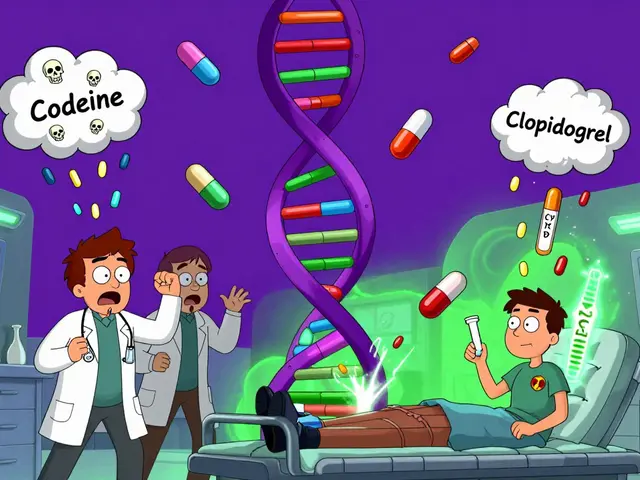
Emerging research in pharmacogenomics suggests that genetic variations may explain why some patients react poorly to specific generic formulations. A 2023 study in JAMA Network Open found that patients with certain CYP2D6 gene variants had a 2.3 times higher risk of adverse events with generic venlafaxine. This points toward a future where personalized medicine might dictate which specific generic manufacturer is safest for an individual, based on their DNA.
Until then, the rule of thumb remains: generics are safe for the vast majority of people. But if you feel something is wrong, trust your body. Investigate the cause, check for inactive ingredient allergies, consider the nocebo effect, and consult your healthcare team. You deserve to feel well, regardless of the price tag on your prescription bottle.
Are generic drugs less effective than brand-name drugs?
No. By law, generic drugs must demonstrate bioequivalence to brand-name drugs, meaning they deliver the same amount of active ingredient into your bloodstream within the same timeframe. Large-scale studies, including a 2018 review in PLOS Medicine, have found no significant difference in clinical outcomes for most conditions, such as cardiovascular disease.
Why do I feel different side effects after switching to a generic?
There are three main reasons: 1) Differences in inactive ingredients (fillers, dyes) that may cause mild allergic reactions or sensitivities. 2) The "nocebo effect," where negative expectations about generics lead to perceived or actual physical symptoms. 3) Variations in absorption rates, which are usually negligible but can matter for drugs with a narrow therapeutic index.
Which medications should I avoid switching to generics?
You should exercise caution with Narrow Therapeutic Index (NTI) drugs, where small changes in dosage can be dangerous. Common examples include warfarin (blood thinner), levothyroxine (thyroid hormone), phenytoin (seizure medication), and cyclosporine (immunosuppressant). For these, consistency in the manufacturer is critical.
Is it true that generic drugs made in India are less safe?
A 2022 study from Ohio State University suggested a link between Indian-manufactured generics and higher rates of severe adverse events. However, the FDA disputes this, stating that facility location does not determine quality and that they rigorously inspect global manufacturing sites. Most experts agree that regulatory oversight, not geography, is the primary indicator of safety.
Can my pharmacist change the generic manufacturer if I have side effects?
Yes. If you suspect a reaction to the inactive ingredients in one generic brand, ask your pharmacist if they can order a different manufacturer’s version. Many pharmacies carry multiple sources for popular drugs. Alternatively, you can request the brand-name drug, though it may cost more.