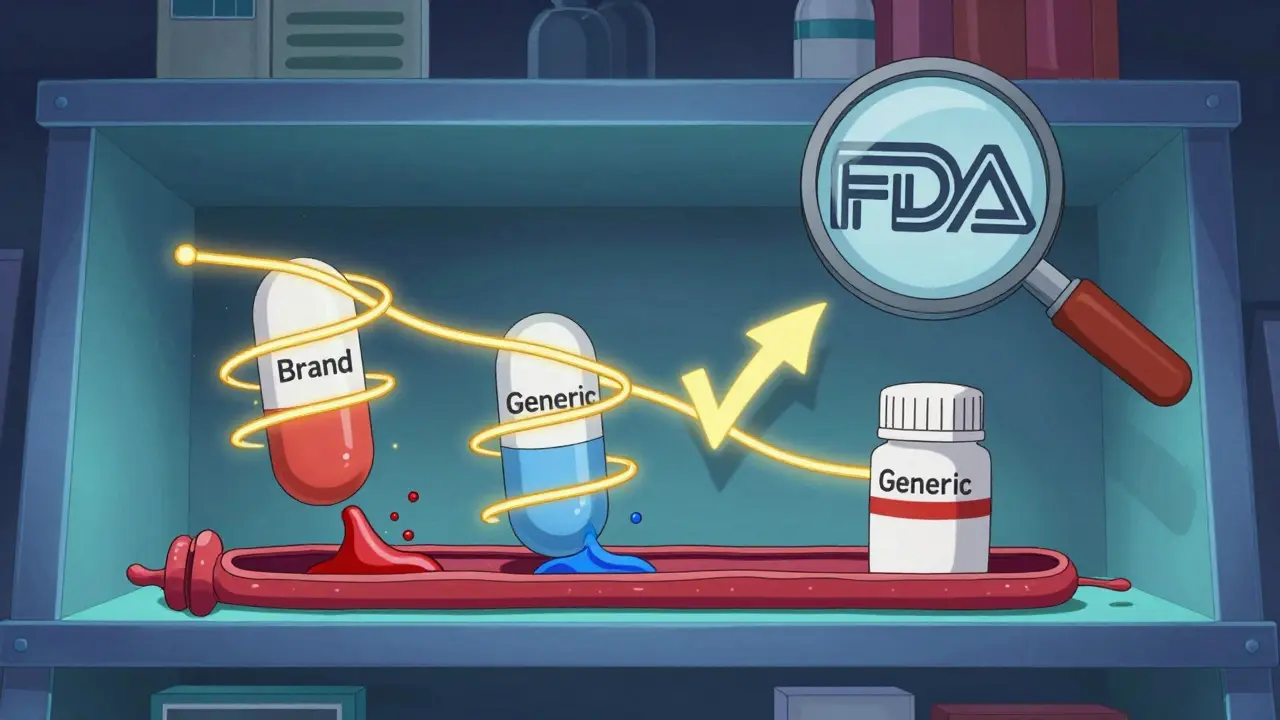
When you pick up a generic pill at the pharmacy, you expect it to work just like the brand-name version. That’s not luck. It’s the result of one of the most tightly controlled processes in medicine. The U.S. Food and Drug Administration (FDA) doesn’t just approve generics because they’re cheaper-it approves them because they must meet the same exact standards for safety, quality, and strength as the original drug. Every tablet, capsule, or injection must be identical in how it works inside your body, even if it looks different or costs a fraction of the price.
What Makes a Generic Drug the Same?
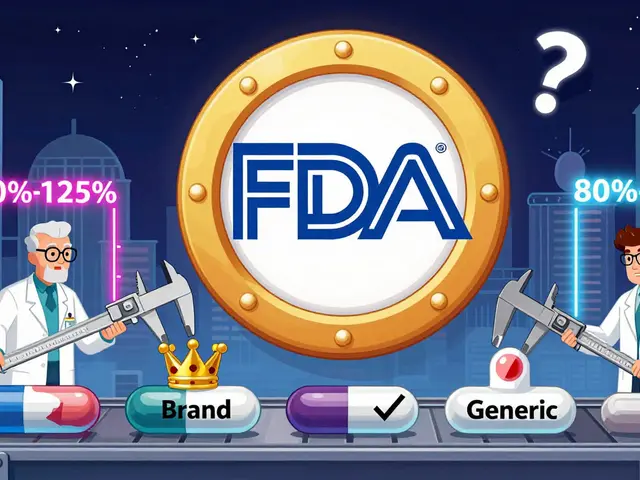
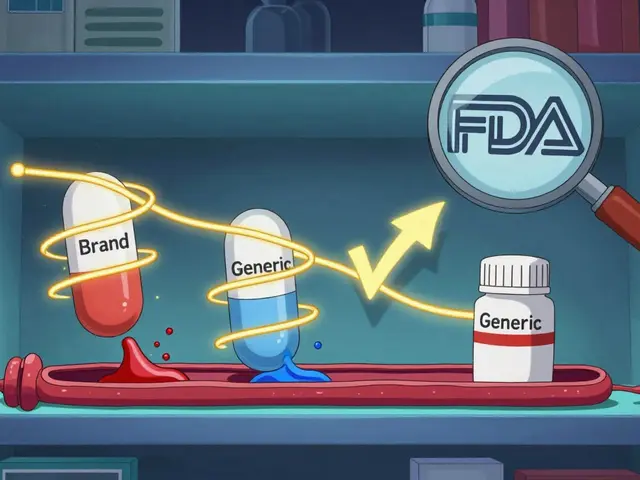
The core rule is simple: a generic drug must have the same active ingredient, in the same strength, in the same form, and given the same way as the brand-name drug. That means if the original is a 10 mg tablet taken by mouth, the generic must be exactly that-no more, no less. But it’s not enough to match the label. The FDA requires proof that the generic delivers the drug to your bloodstream at the same rate and amount as the brand. This is called bioequivalence.
For most pills, that means testing in 24 to 36 healthy volunteers. Blood samples are taken over hours to measure how quickly the drug enters the system and how long it stays. The generic’s results must fall within 80% to 125% of the brand’s numbers for two key measurements: Cmax (peak concentration) and AUC (total exposure over time). This range might sound wide, but it’s based on decades of clinical data showing that within these limits, there’s no meaningful difference in how patients respond. For drugs with a narrow therapeutic index-like warfarin or levothyroxine-the FDA tightens the range to 90%-111% or even 95%-105% to reduce risk.
Manufacturing Must Be Flawless
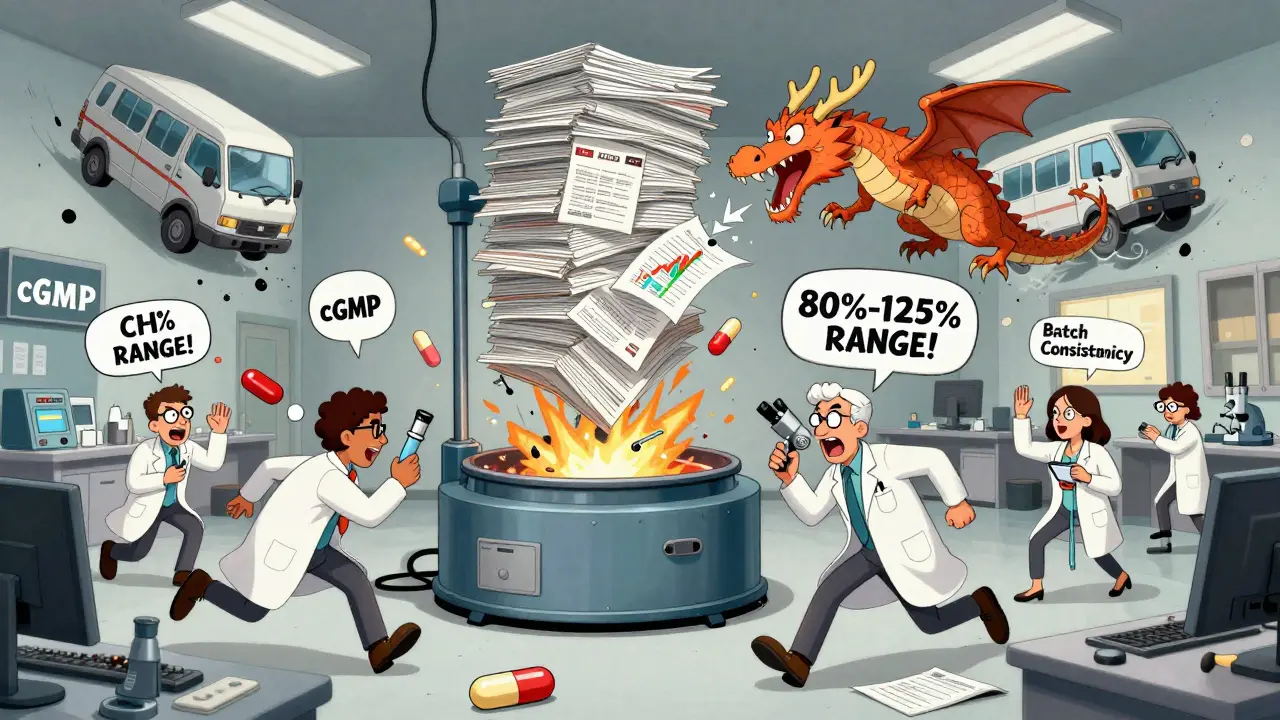
It’s not enough for the drug to work the same way. It must be made the same way, every single time. The FDA requires all generic manufacturers to follow Current Good Manufacturing Practices (cGMP), which are strict rules covering everything from raw materials to packaging. Facilities are inspected before approval-and often unannounced after. In 2022, the FDA conducted about 1,200 pre-approval inspections for generic drugs. If a factory has inconsistent tablet hardness, impurities above limits, or poor record-keeping, the application gets rejected.
One major hurdle for new manufacturers is proving consistency across batches. Teva Pharmaceuticals’ regulatory team says new applicants are often surprised by how much data the FDA demands: at least three full-scale production batches must show identical quality before approval. That means testing each batch for dissolution rate, purity, stability, and physical properties like tablet strength and disintegration time. A single batch that fails can delay approval by months.
The ANDA Process: Abbreviated, But Not Easy
Unlike brand-name drugs, which require years of clinical trials to prove safety and effectiveness, generics use an Abbreviated New Drug Application (ANDA). They don’t need to repeat clinical studies because they rely on the brand’s existing data. But that doesn’t make the process easier-it makes it more technical. A typical ANDA can be 5,000 to 10,000 pages long, filled with chemistry data, manufacturing details, and bioequivalence reports. The FDA’s Question-Based Review (QbR) system digs into every detail, asking: What are the critical quality attributes? How do you control them? What happens if the temperature shifts during production?
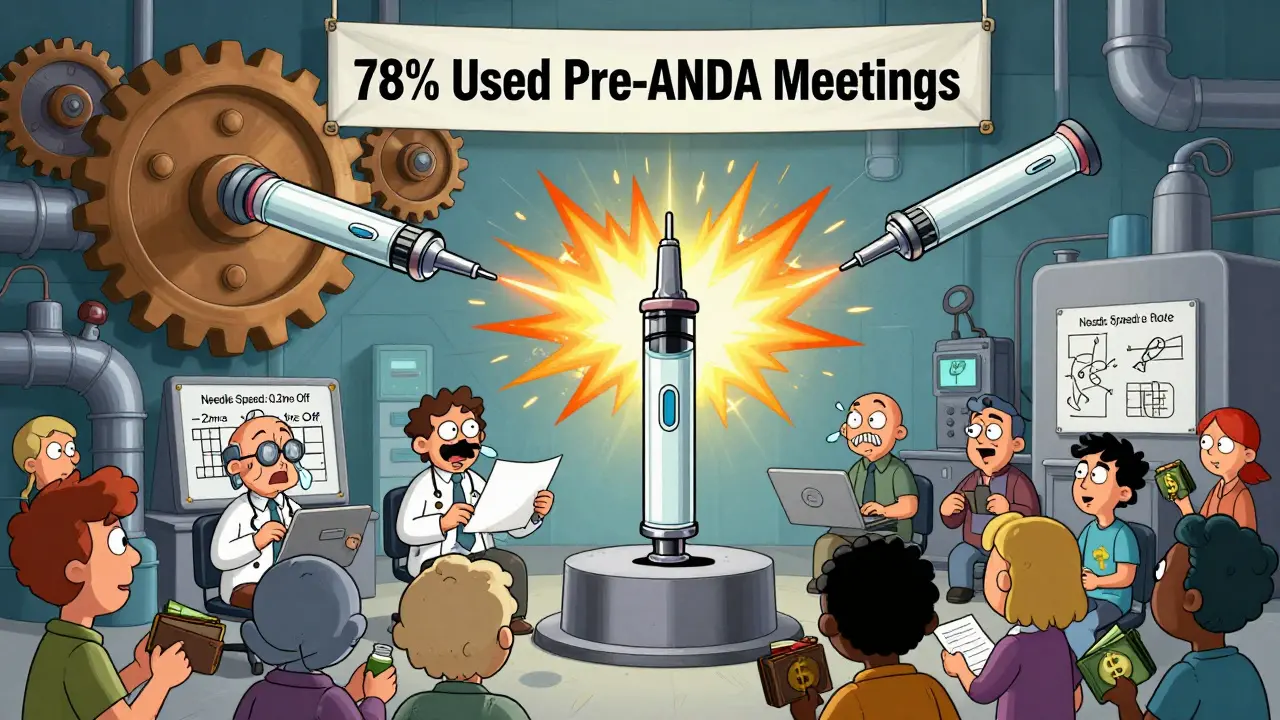
Despite being abbreviated, only about 10% of ANDAs get approved on the first try. Why? Because complex drugs are hard to copy. Inhalers, injectables, topical creams, and extended-release pills have physical properties that are nearly impossible to replicate without deep expertise. For example, between 2015 and 2020, only 3 out of 27 applications for a generic EpiPen were approved-not because the drug didn’t work, but because the auto-injector device couldn’t match the original’s precision. Even the smallest difference in needle speed or pressure can change how much medicine reaches the body.
Complex Generics Are the New Frontier
While simple pills like metformin or lisinopril have dozens of generic options, complex drugs remain rare. The FDA’s 2023 report identified 127 brand-name products with no generic alternatives, representing over $52 billion in annual sales. These include biologics, nanomedicines, and multi-component delivery systems. The agency is now pushing to improve approval rates for these products. By 2027, it aims to approve half of complex generic applications within two review cycles, up from just 28% today.
Recent successes show progress. In December 2023, the first generic of Humira (adalimumab) was approved after years of development. In August 2023, the first generic of Vivitrol (naltrexone extended-release injection) hit the market-critical for opioid addiction treatment. These weren’t easy wins. They required new testing methods, advanced manufacturing, and close collaboration with the FDA through pre-ANDA meetings. Over 78% of successful applicants use this program to get feedback before submitting their full application.
Why It Matters: Cost, Access, and Trust
Generic drugs make healthcare affordable. In 2022, generics made up 90.3% of all prescriptions filled in the U.S., but only 22.8% of total spending. That’s $373 billion saved in one year alone. Without generics, many patients would skip doses or go without treatment entirely.
But affordability means nothing if patients don’t trust the product. That’s why the FDA’s standards are non-negotiable. The American Medical Association reviewed 15 years of post-market data and found that 98.7% of therapeutic categories showed no difference in outcomes between generics and brands. Doctors, pharmacists, and patients can rely on these drugs because the system works.
Still, challenges remain. Patent litigation can delay market entry-even after FDA approval. The Federal Trade Commission found that on average, generics wait 2.4 years after approval to actually reach shelves due to legal battles. And while the average cost to develop a generic is $1.3 million, complex ones can cost up to $25 million. That’s why only a few large companies dominate the market, with the top 10 controlling nearly half of U.S. generic sales.
What Patients Should Know
If your doctor prescribes a brand-name drug and you’re offered a generic, you can safely choose it. The FDA doesn’t approve a generic unless it’s as safe and effective as the original. If you notice a change in how you feel after switching, talk to your doctor or pharmacist. Rarely, differences in inactive ingredients (like fillers or dyes) can cause minor reactions, but these aren’t about strength or efficacy-they’re about individual sensitivity.
For drugs with narrow therapeutic windows-like thyroid medication or seizure drugs-it’s often best to stick with the same generic brand once you’ve stabilized. But that’s not because generics vary in power; it’s because switching between different manufacturers might introduce tiny differences in how your body absorbs the drug. Your doctor can help you decide what’s best.
Looking Ahead
The future of generic drugs isn’t just about copying old pills. It’s about tackling the hardest ones-drugs that were once thought too complex to replicate. With new FDA guidance, better testing tools, and more manufacturer investment, that barrier is falling. The goal isn’t just to lower prices-it’s to make sure everyone, no matter their income, has access to medicines that work exactly as they should.
Are generic drugs as safe as brand-name drugs?
Yes. The FDA requires every approved generic drug to meet the same strict standards for safety, strength, quality, and purity as the brand-name version. There is no clinically meaningful difference in how they work in the body. Post-market studies covering 15 years show equivalent outcomes in 98.7% of therapeutic categories.
How does the FDA test if a generic drug works the same way?
The FDA uses bioequivalence studies. Healthy volunteers take both the brand-name and generic drug, and their blood is tested over time to measure how much of the drug enters the bloodstream and how fast. The generic’s results must fall within 80%-125% of the brand’s for key measurements like Cmax and AUC. For sensitive drugs like warfarin or levothyroxine, the range is tighter-sometimes as narrow as 95%-105%.
Why do some generic drugs get rejected by the FDA?
Most rejections happen because of manufacturing issues-not because the drug doesn’t work. Problems include inconsistent tablet hardness, impurities in the active ingredient, or failure to prove stable performance across batches. Complex products like inhalers or injectables are rejected more often because replicating the delivery system is technically difficult. Over 90% of first-time ANDA applications face at least one deficiency.
Do generic drugs take longer to work than brand-name drugs?
No. Bioequivalence studies prove that generics reach the same peak concentration in the blood at the same rate as the brand. For immediate-release pills, absorption happens within the same time window. For extended-release versions, the release pattern must match exactly-so the drug doesn’t hit too fast or too slow. If a generic delayed absorption, it would fail FDA testing.
Can I switch between different generic brands?
Yes, for most drugs. All FDA-approved generics meet the same standards. But for drugs with a narrow therapeutic index-like thyroid meds or seizure drugs-some doctors recommend sticking with one manufacturer to avoid even tiny variations in absorption. This isn’t because generics are unsafe, but because consistent dosing matters most when the margin between effective and dangerous is small.
How long does it take to get a generic drug approved?
On average, it takes 32.7 months from submission to approval. Simple pills take about 28.5 months. Complex drugs like inhalers or extended-release formulations can take 47.2 months or more. The FDA aims to review standard applications within 10 months after submission, but pre-submission work-like developing the formulation and running bioequivalence studies-often takes 18 to 24 months.
Why are some drugs still only available as brand-name?
Patents and exclusivity rights can block generics for years. Even after a patent expires, companies may use legal tactics to delay entry. Some drugs are simply too complex to copy-like biologics or devices combined with drugs (e.g., EpiPen). The FDA has identified 127 such products with no generic alternatives, representing over $52 billion in annual sales. These are the next frontier for generic development.
Is it true that generics are made in less safe facilities?
No. The FDA inspects all facilities-brand and generic-using the same standards. In fact, many generic manufacturers operate in the same plants as brand-name companies, or under the same parent corporations. The agency conducts over 1,200 pre-approval inspections annually for generics alone. If a facility fails cGMP compliance, the application is denied, regardless of where it’s located.
Generic drugs aren’t a compromise. They’re the result of a science-backed system designed to make life-saving medicines affordable without sacrificing safety. Every pill you take-whether it has a brand name or not-has passed the same rigorous test.


ANA MARIE VALENZUELA
December 28, 2025 AT 07:40Let’s be real-this whole ‘same standards’ thing is a PR stunt. I’ve seen generics that taste like chalk and dissolve slower than my ex’s apologies. The FDA might say 80%-125% is fine, but if your blood levels dip below the curve, you’re not getting treated-you’re being experimented on. And don’t even get me started on the Indian factories where they skip stability tests because ‘it’s just a pill.’
Bradly Draper
December 29, 2025 AT 15:53I switched to generic lisinopril last year and my blood pressure’s been perfect. No weird side effects, no headaches. My pharmacist said the FDA checks these things super hard. I trust that.
Gran Badshah
December 31, 2025 AT 13:07bro i took a generic version of my anxiety med and felt like i was floating through a fog for two days. i went back to brand and boom-normal again. maybe it’s the fillers? or maybe the FDA just lets too much slide? idk man. just saying.
Ellen-Cathryn Nash
December 31, 2025 AT 19:57Oh, so now we’re just supposed to swallow corporate-approved mediocrity because it’s cheaper? How noble. Meanwhile, the same companies that make these ‘identical’ generics also own the brand-name versions. It’s not science-it’s a monopoly dressed up in lab coats. And don’t pretend your ‘bioequivalence’ numbers aren’t just fancy math to justify cutting corners.
Samantha Hobbs
January 1, 2026 AT 22:03my grandma takes generic metformin and swears it gives her heartburn. she switched back to brand and poof-no more issues. she says it’s the ‘dye’ but i think it’s just the generic being sketchy. why risk it when you can pay a few bucks more?
Julius Hader
January 2, 2026 AT 09:25People get so worked up over generics. I mean, if it’s FDA-approved, it’s good. End of story. 🤷♂️
Vu L
January 3, 2026 AT 23:24Oh wow, so generics are ‘exactly the same’? Then why does my thyroid med make me feel like a zombie when I switch brands? Maybe the FDA doesn’t know what ‘same’ means. Or maybe you just don’t want to admit that chemistry isn’t magic.
James Hilton
January 4, 2026 AT 05:04Generic drugs: the only time America says ‘we’ll cut costs, but not your life.’ 🇺🇸💊
Mimi Bos
January 5, 2026 AT 00:49i got my generic adderall last week and it felt like someone replaced my brain with a damp sponge. i asked my dr and she said ‘stick with one brand.’ i just wish the labels said which manufacturer made it… like, hello? transparency?
Payton Daily
January 6, 2026 AT 04:35Think about it-this whole system is just a reflection of our society’s obsession with efficiency over excellence. We don’t want to pay for quality, so we demand sameness… but sameness isn’t identity. A pill isn’t a person. And yet we treat it like it is. We’ve outsourced our health to algorithms and batch numbers, forgetting that biology doesn’t care about your budget. The FDA doesn’t guarantee perfection-they guarantee ‘acceptable.’ And that’s the real tragedy.