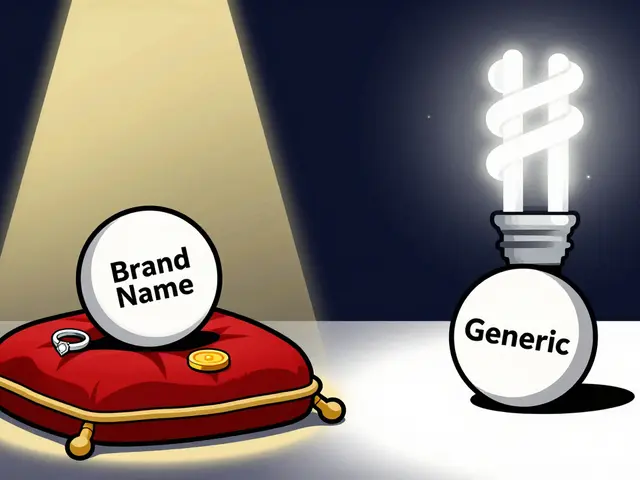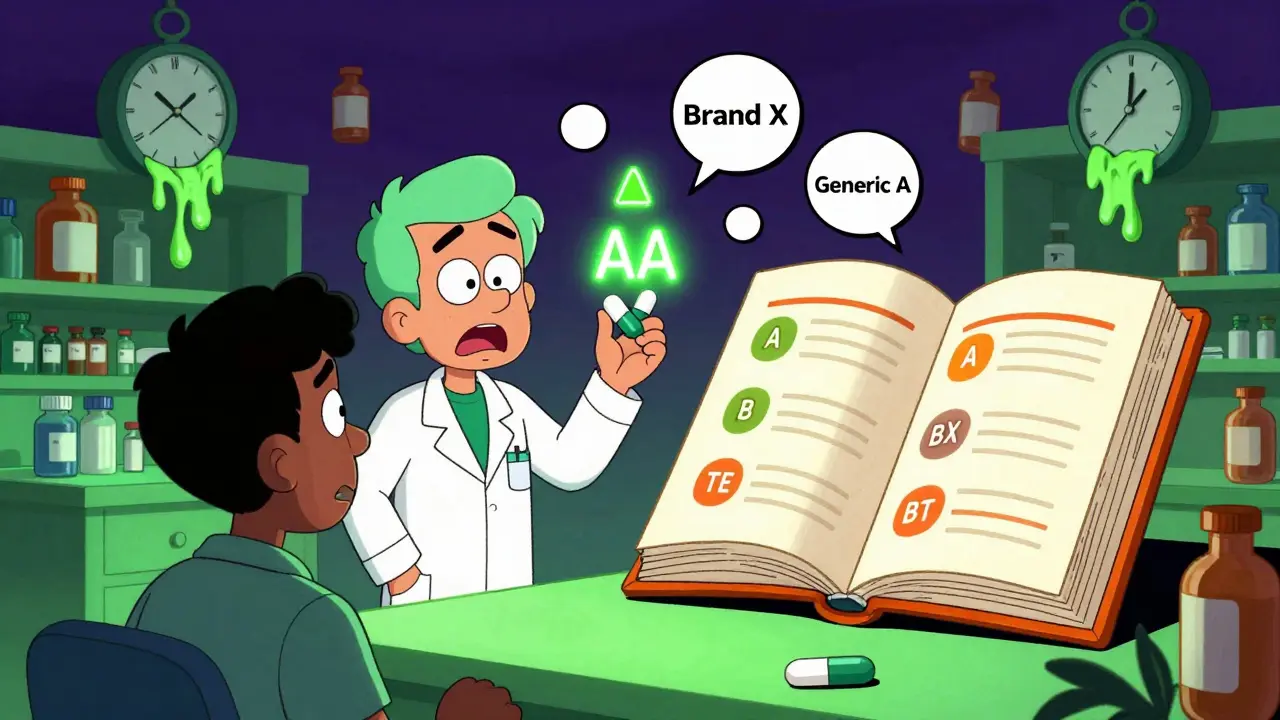
When you pick up a prescription, you might not realize that the pill in your hand wasn’t always the brand-name version your doctor wrote on the script. More than 90% of prescriptions filled in the U.S. are generic drugs. But not all generics are created equal. The difference comes down to something called Therapeutic Equivalency (TE) Codes - a system created by the FDA that legally determines whether a generic drug can be swapped in for the brand-name version without risking your health.
What Are FDA Therapeutic Equivalency Codes?
The FDA assigns TE codes to prescription drugs listed in the Approved Drug Products with Therapeutic Equivalence Evaluations, better known as the Orange Book. This isn’t just a reference guide - it’s the legal backbone of generic drug substitution in every U.S. state. These codes tell pharmacists, doctors, and state boards whether a generic drug is considered interchangeable with its brand-name counterpart. The system started in 1980, but it became truly powerful after the Hatch-Waxman Amendments of 1984. Before that, generic drugs had to prove they were safe and effective from scratch. Hatch-Waxman changed that. It allowed generic manufacturers to rely on the brand’s existing safety data - as long as they could prove their version worked the same way in the body. That’s where bioequivalence comes in. A TE code isn’t just about ingredients matching. It’s about whether the drug gets into your bloodstream at the same rate and amount as the brand. That’s bioequivalence. And it’s not just a lab test. The FDA requires real-world data showing the generic performs the same in patients under the same conditions.The Meaning Behind the Letters: A vs B
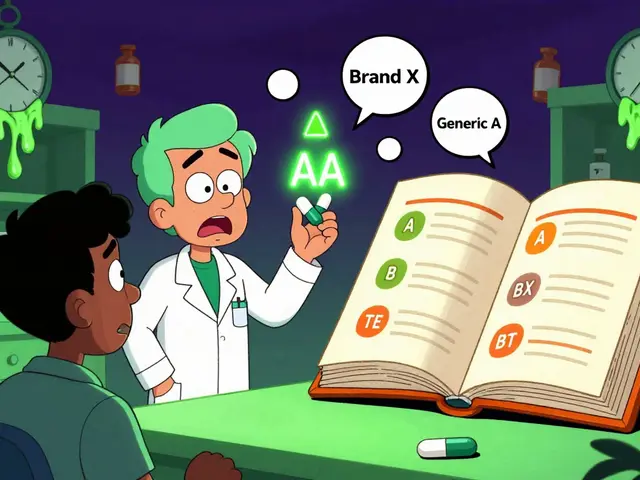
Every TE code has two parts: a letter, then a number. The first letter tells you everything you need to know.- A-rated means the drug is therapeutically equivalent. You can swap it freely. These are the ones pharmacists are legally allowed to substitute unless your doctor says "do not substitute."
- B-rated means the FDA hasn’t confirmed the generic is equivalent. Substitution isn’t recommended - and in most states, it’s not allowed.
- AA = immediate-release oral tablets or capsules with no bioequivalence issues. These are the easiest to substitute.
- AB = products that had initial bioequivalence concerns but later proved equivalent through additional testing.
- BT = topical products (like creams or gels) with unresolved bioequivalence questions. These are tricky. Even if approved, pharmacists often hesitate to substitute.
- BN = aerosol or nebulizer products. Delivery method matters here. A small change in particle size can mean the drug doesn’t reach the lungs the same way.
- BX = insufficient data. The FDA doesn’t have enough evidence to say yes or no. These are essentially gray areas.
How State Laws Turn FDA Codes Into Action
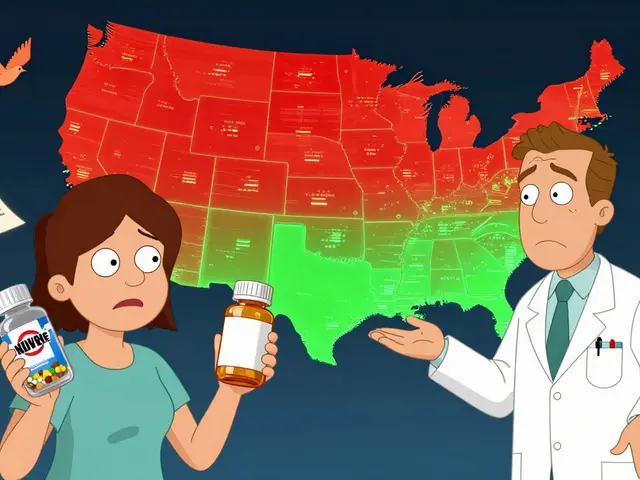
The FDA sets the standard. But states decide what happens in the pharmacy. All 50 states use the Orange Book as their legal reference for substitution. But they don’t all enforce it the same way. In California, for example, the law says pharmacists must substitute if the drug has an A rating - unless the prescriber writes "dispense as written." In New York, pharmacists are required to check the most current Orange Book edition before swapping any generic. In Texas, substitution is allowed unless the prescriber specifically prohibits it. Here’s the catch: even if a drug has an A rating, a pharmacist can still refuse to substitute. Why? Because of patient safety concerns - especially with complex drugs. A 2023 survey by the National Community Pharmacists Association found that 42% of pharmacists felt unsure about how to interpret B codes for inhalers, topical products, or injectables. Many avoid substitution out of caution, even when the FDA says it’s allowed. And it’s not just pharmacists. Doctors often don’t know the difference between AB and BT codes. That’s why some still write prescriptions for brand-name drugs out of habit - even when a cheaper, equally effective generic exists.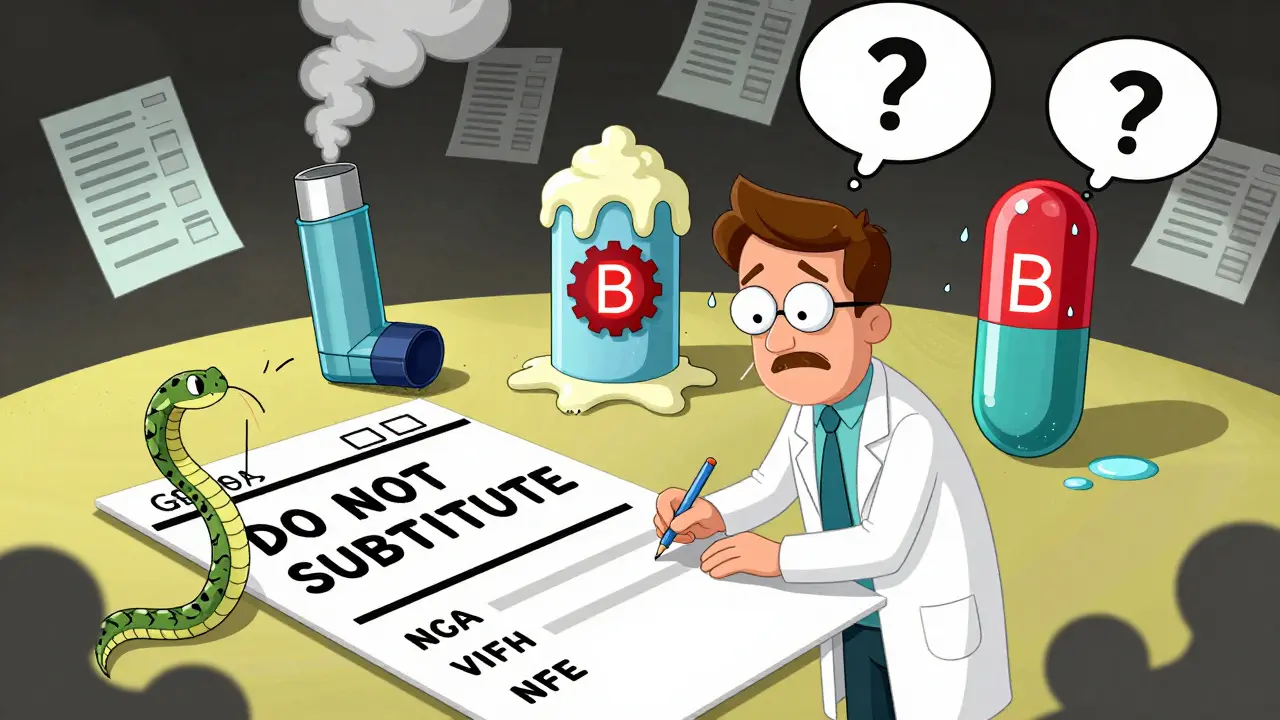
Why Some Drugs Still Have B Codes
You might wonder: if the FDA approves a generic, why isn’t it automatically interchangeable? The answer lies in complexity. Not all drugs are simple pills. Some are:- Topical creams with different base ingredients that affect skin absorption
- Inhalers where particle size and spray pattern matter
- Extended-release tablets that release medication over 12 or 24 hours
- Injectables with complex stabilizers or delivery systems
The Real Impact: Cost Savings and Access
The TE code system isn’t just about science - it’s about money. Since 1995, generic drugs with A ratings have saved the U.S. healthcare system over $1.7 trillion. In 2022 alone, A-rated generics saved $298 billion. But those savings only happen if people can actually use the generics. Products with B codes are rarely substituted - even if they’re cheaper. A 2021 study in the Journal of Generic Medicines found that only 5.3% of generic prescriptions involved B-rated drugs. That’s because pharmacists, insurers, and patients avoid them. The FDA knows this is a problem. Their 2023-2027 Strategic Plan aims to reduce the percentage of B-rated drugs from 24.3% to under 15% by 2027. They’ve already cut the average review time for complex generics from 34 months in 2018 to 22 months in 2023. And they’ve invested $28.7 million through GDUFA III to improve testing methods for complex products.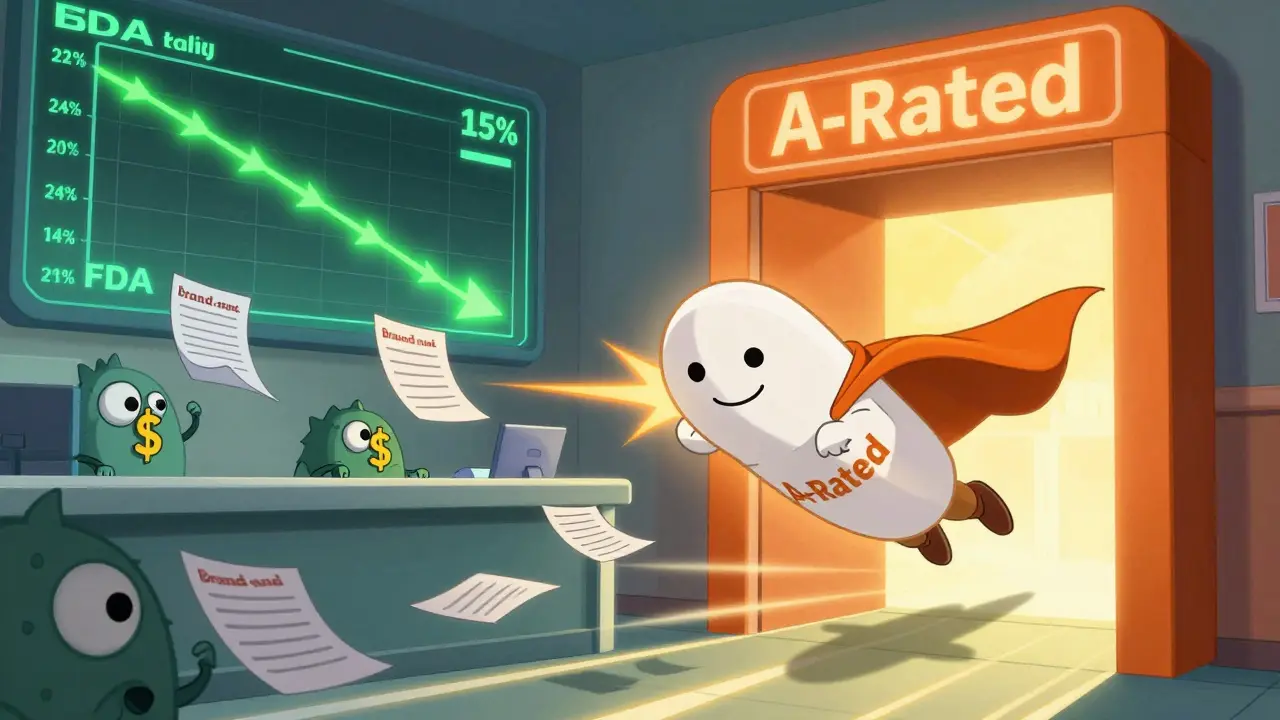
What This Means for You
If you’re taking a generic drug and wondering if it’s safe to switch:- Check your prescription label. If it says “generic,” ask your pharmacist what the TE code is.
- Look up the drug in the FDA’s Orange Book online - it’s free and public.
- If it’s an A-rated drug, you’re safe to substitute. If it’s B-rated, ask your doctor if switching could affect your treatment.
- Don’t assume all generics are the same. Two generics of the same drug can have different codes based on how they’re made.
What’s Next for TE Codes?
The FDA launched a digital version of the Orange Book in January 2023. Now, electronic health records can pull TE codes directly into pharmacy systems. That means less manual checking and fewer errors. New draft guidance released in August 2023 makes it easier for complex drugs - like inhalers and topical creams - to qualify for A ratings. The goal? More generics. More savings. Same results. The future of TE codes isn’t about eliminating B ratings. It’s about reducing them - not by cutting corners, but by getting smarter about how we test. Because in the end, it’s not about saving money. It’s about making sure the money you save doesn’t cost you your health.Can a pharmacist substitute a generic drug without my doctor’s permission?
Yes - but only if the drug has an FDA-assigned "A" therapeutic equivalency code and your doctor hasn’t written "dispense as written" on the prescription. State laws vary, but all 50 states require pharmacists to follow the FDA’s Orange Book ratings. If the drug is rated "B," substitution is not allowed, even if the pharmacist wants to do it.
Why do some generic drugs have different TE codes even if they’re the same medicine?
Because TE codes are assigned to specific products, not just the active ingredient. Two generics of the same drug can have different inactive ingredients, manufacturing processes, or delivery systems. Even small differences - like a different coating or release mechanism - can affect how the drug works in your body. The FDA evaluates each product individually. One might be rated "AA," another "AB," and another "BX" - all for the same active ingredient.
Are over-the-counter (OTC) drugs assigned TE codes?
No. TE codes only apply to prescription drugs approved under Section 505 of the Federal Food, Drug, and Cosmetic Act. OTC drugs are regulated under different standards and are not evaluated for therapeutic equivalence by the FDA. You can still switch between OTC brands, but there’s no official system to guide you.
How often is the Orange Book updated?
The FDA updates the Orange Book monthly. New drugs are added, existing codes are changed, and discontinued products are removed. Pharmacists and pharmacies rely on these updates to ensure they’re substituting correctly. Always check the most current version - using outdated data can lead to illegal or unsafe substitutions.
Can a drug change from a B code to an A code?
Yes. The FDA can reclassify a drug if new scientific evidence proves it’s therapeutically equivalent. Several complex drugs - including some topical creams and inhalers - have moved from B to A after additional bioequivalence studies were submitted. This process can take months or even years, but it’s happening more often as testing methods improve.