Lamotrigine-Valproate Dosing Calculator
This tool helps calculate safe dosing schedules for lamotrigine when combined with valproate. Follow the protocol to reduce serious rash risk.
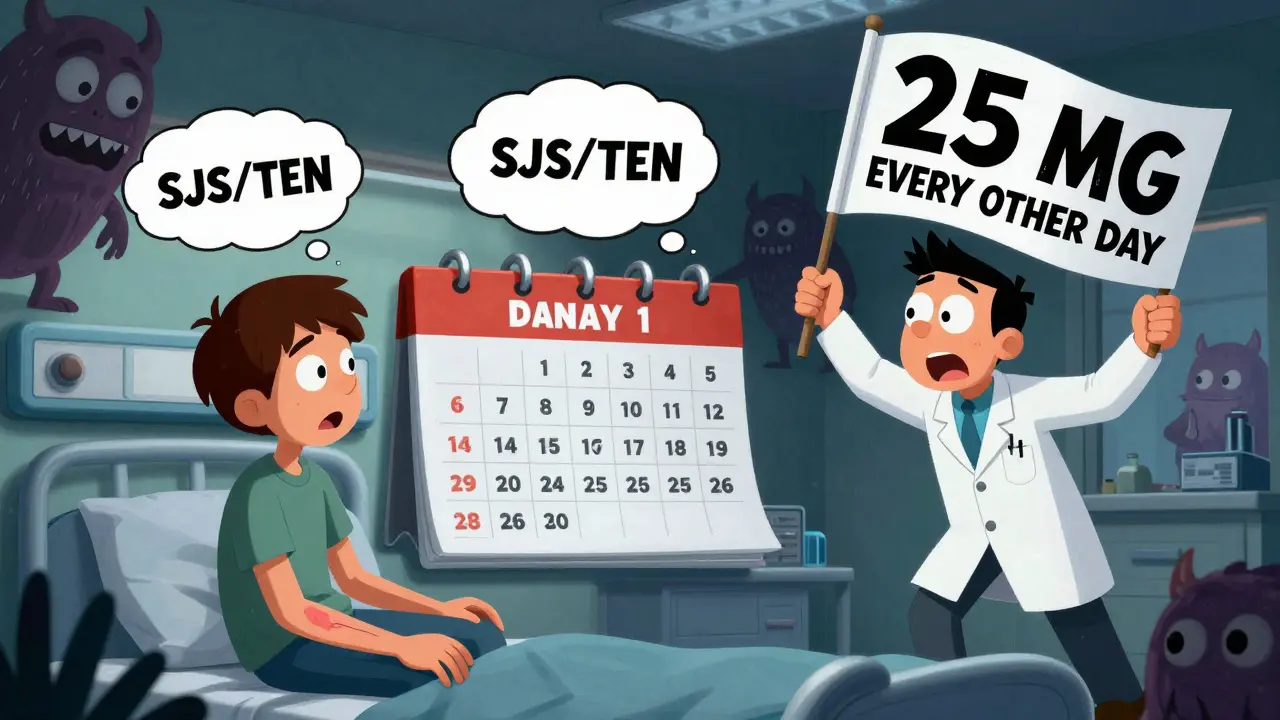
Start at 25 mg every other day when adding lamotrigine to valproate.
Wait two weeks before increasing dose.
Stop immediately if rash appears.
Dosing Schedule
Action Required
If you see any rash, stop lamotrigine immediately and contact your doctor. Do not wait or self-treat. This is a medical emergency.
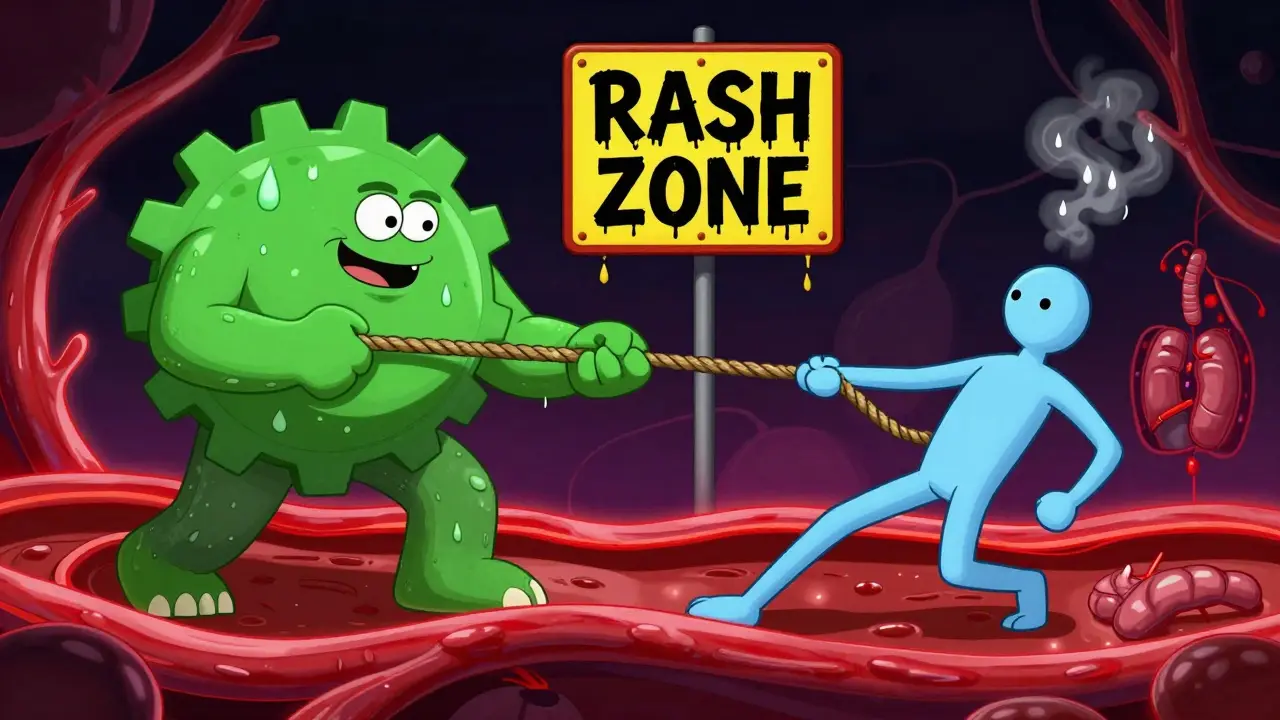
When doctors combine valproate and lamotrigine, they’re not just adding two medications-they’re triggering a hidden chemical tug-of-war inside the body. One drug slows down the other’s breakdown, causing lamotrigine levels to spike. And that spike? It can trigger a dangerous skin reaction. This isn’t a rare guess or a theoretical concern. It’s a well-documented, life-threatening risk that has cost lives-and been dramatically reduced by one simple fix: changing how we start the dose.
Why This Combination Is Risky
Lamotrigine is a go-to drug for epilepsy and bipolar disorder. Valproate does the same, plus helps with migraines. When used together, they work well for mood and seizure control. But here’s the catch: valproate cuts lamotrigine’s clearance by nearly half. That means lamotrigine stays in your system much longer than it should. Your body can’t flush it out fast enough. And when lamotrigine builds up too quickly, your immune system can mistake it for a threat. The result? A rash.This isn’t just a mild itch. The worst-case scenarios are Stevens-Johnson Syndrome (SJS) and toxic epidermal necrolysis (TEN)-conditions where skin blisters, peels off, and internal organs can be damaged. SJS kills 5-10% of people who get it. TEN kills up to 35%. These aren’t theoretical numbers. They’re real outcomes from real cases, documented in hospitals across Europe and the U.S.
Back in the early 1990s, before anyone understood this interaction, lamotrigine-related rashes were alarmingly common. In Germany, over 500 patients developed severe skin reactions in just two years. Then, something changed. Doctors started lowering the starting dose. They slowed the titration. And the numbers dropped-fast. By 1999, serious cases had fallen by more than 80%. The lesson was clear: it wasn’t the drugs themselves. It was how we gave them.
The Dose That Saves Lives
If you’re already taking valproate and your doctor wants to add lamotrigine, here’s what you need to know:- Start at 25 mg every other day. Not daily. Not 50 mg. Every other day. This is non-negotiable.
- Wait two weeks before increasing. The standard schedule for lamotrigine alone is to increase by 25 mg per week. With valproate, you double that wait time.
- Don’t rush. Even if you feel fine, don’t jump ahead. The rash doesn’t always show up right away. It can appear weeks later, even after you’ve been on the same dose for a while.
Why so slow? Because lamotrigine’s rise in blood levels isn’t linear. A small increase in dose can cause a huge jump in concentration when valproate is present. One study found that patients who started at 50 mg daily-instead of 25 mg every other day-had a 10-fold higher risk of rash. That’s not a typo. Ten times more likely.
And if you’re switching from lamotrigine alone to adding valproate? The risk doesn’t spike. That’s important. The danger isn’t in adding valproate to an existing lamotrigine regimen. It’s in starting lamotrigine while valproate is already in your system. Your body is already primed to hold onto lamotrigine. You’re starting from a place of high concentration. That’s why the starting dose must be lower.
What the Rash Looks Like-and When to Act
The first sign is rarely dramatic. It might be a faint pink patch on your chest or back. Or small red spots around your arms. Sometimes it’s itchy. Sometimes it’s not. You might feel a low-grade fever. Swollen lymph nodes. A sore throat. These aren’t just side effects-they’re early warnings.A 2023 case report from a teenager with bipolar disorder showed how quickly things can spiral. After 12 days on lamotrigine and valproate, she developed a full-body rash and swollen glands. Symptoms worsened over three days-even after she stopped lamotrigine. She needed steroids to recover. That’s the problem: the reaction doesn’t stop when you stop the drug. Your immune system keeps going.
There’s no lab test to predict this. No genetic marker we can screen for yet. So the only defense is vigilance. If you see any new skin changes in the first eight weeks-especially if you’re on this combo-stop lamotrigine immediately. Call your doctor. Don’t wait. Don’t assume it’s allergies. Don’t try antihistamines and hope it goes away. Get medical help. Now.
Who’s at Highest Risk?
Children and teens are more vulnerable. The FDA requires a black box warning for lamotrigine in patients under 16, especially when used with valproate. That’s not because kids are fragile-it’s because their metabolism responds differently, and their immune systems are more reactive.One study of 80 young patients on both drugs found only two rashes (2.5%). But that’s not a reason to relax. That study was done in a tightly monitored clinic. Real-world settings? Less so. And one rash is one too many.
Another risk factor? If you’ve ever had a rash from any other seizure or mood medication. Your odds jump 3.1 times higher. No exceptions. That’s a red flag. If you’ve had a rash before, your doctor should avoid this combo entirely-or start even slower: 12.5 mg every other day.
What Happens If You Ignore the Rules?
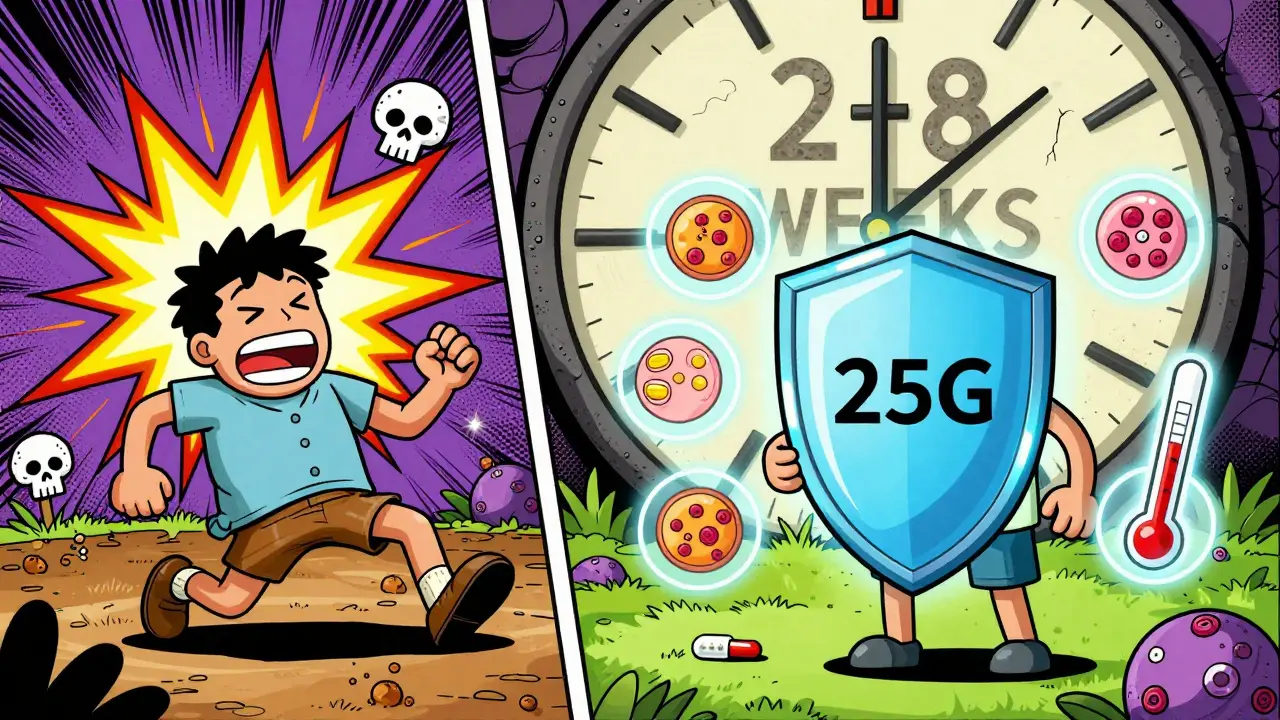
A 2007 study of 1,890 patients taking antiepileptic drugs found that lamotrigine had one of the highest rash rates-2.8% overall. But when combined with valproate? That number jumps. We don’t have the exact percentage, but we know the pattern: faster dose increases = higher risk. And we know the outcome: hospitalizations, intensive care, permanent scarring.There’s a myth that “if I didn’t get a rash in the first week, I’m safe.” False. The peak window is 2-8 weeks. That’s when most reactions occur. And even then, cases have been reported months later.
Some patients are told, “Just take it slow.” But what does slow mean? 25 mg every other day is slow. 50 mg daily is not. Slowing down isn’t about patience-it’s about chemistry. Your liver can’t keep up. You’re flooding your system.
What About Other Medications?
This interaction is unique. Other mood stabilizers like lithium or carbamazepine don’t do this. Carbamazepine actually speeds up lamotrigine clearance. Lithium has no known interaction. That’s why switching from valproate to another mood stabilizer can be a safer option if you’re at risk.And what about lamotrigine alone? The serious rash rate is 0.08%. With valproate? It’s 0.13%. That sounds small. But when you’re talking about 10,000 patients, 0.05% is 5 people. And 5 people with SJS? That’s 5 lives changed-or lost.
Bottom Line: Safety Is in the Details
Valproate and lamotrigine are powerful tools. They help people live better, more stable lives. But they’re not harmless. Their danger lies in how we use them. The science is clear: start low, go slow. Don’t guess. Don’t assume. Follow the protocol.If you’re on this combo:
- Know your dose. Write it down.
- Check your schedule. Are you increasing too fast?
- Watch your skin. Every day.
- Call your doctor at the first sign of anything new.
There’s no magic pill here. No shortcut. Just careful, consistent, evidence-based dosing. And that’s what keeps people safe.
Can I take lamotrigine and valproate together safely?
Yes-but only if you follow strict dosing rules. Start lamotrigine at 25 mg every other day if you’re already on valproate. Increase by 25 mg only every two weeks. Never start higher. Never rush. This reduces serious rash risk from potentially 1%+ down to 0.13%.
How long after starting lamotrigine can a rash appear?
Most rashes appear within 2 to 8 weeks, but cases have been reported up to 6 months after starting. Even if you’ve been stable for weeks, don’t ignore new skin changes. The reaction can still happen.
What should I do if I get a rash while on both drugs?
Stop lamotrigine immediately. Contact your doctor or go to urgent care. Do not wait to see if it gets worse. Do not try to treat it with over-the-counter creams or antihistamines alone. This is a medical emergency. Discontinuing the drug is the only way to prevent progression to life-threatening conditions like Stevens-Johnson Syndrome.
Is this interaction only a problem for adults?
No. Children and teens are at higher risk. The FDA requires a black box warning for lamotrigine in patients under 16, especially with valproate. Some clinics now start pediatric patients at 12.5 mg every other day as a precaution.
Can I switch from valproate to another mood stabilizer to avoid this risk?
Yes. If you’ve had a rash before or are at high risk, switching from valproate to lithium or another mood stabilizer without this interaction can be safer. Talk to your doctor about alternatives. Lamotrigine works well with lithium, and the risk of rash drops significantly.


Angel Wolfe
February 27, 2026 AT 15:47Ajay Krishna
March 1, 2026 AT 03:06Gigi Valdez
March 2, 2026 AT 09:51Sneha Mahapatra
March 2, 2026 AT 10:20bill cook
March 3, 2026 AT 22:57Katherine Farmer
March 4, 2026 AT 18:18Full Scale Webmaster
March 6, 2026 AT 13:54Eimear Gilroy
March 7, 2026 AT 10:35Ben Estella
March 8, 2026 AT 15:02Jimmy Quilty
March 10, 2026 AT 00:42Miranda Anderson
March 10, 2026 AT 22:13Byron Duvall
March 12, 2026 AT 01:08Brandie Bradshaw
March 12, 2026 AT 14:55Sophia Rafiq
March 13, 2026 AT 06:44Martin Halpin
March 13, 2026 AT 08:13