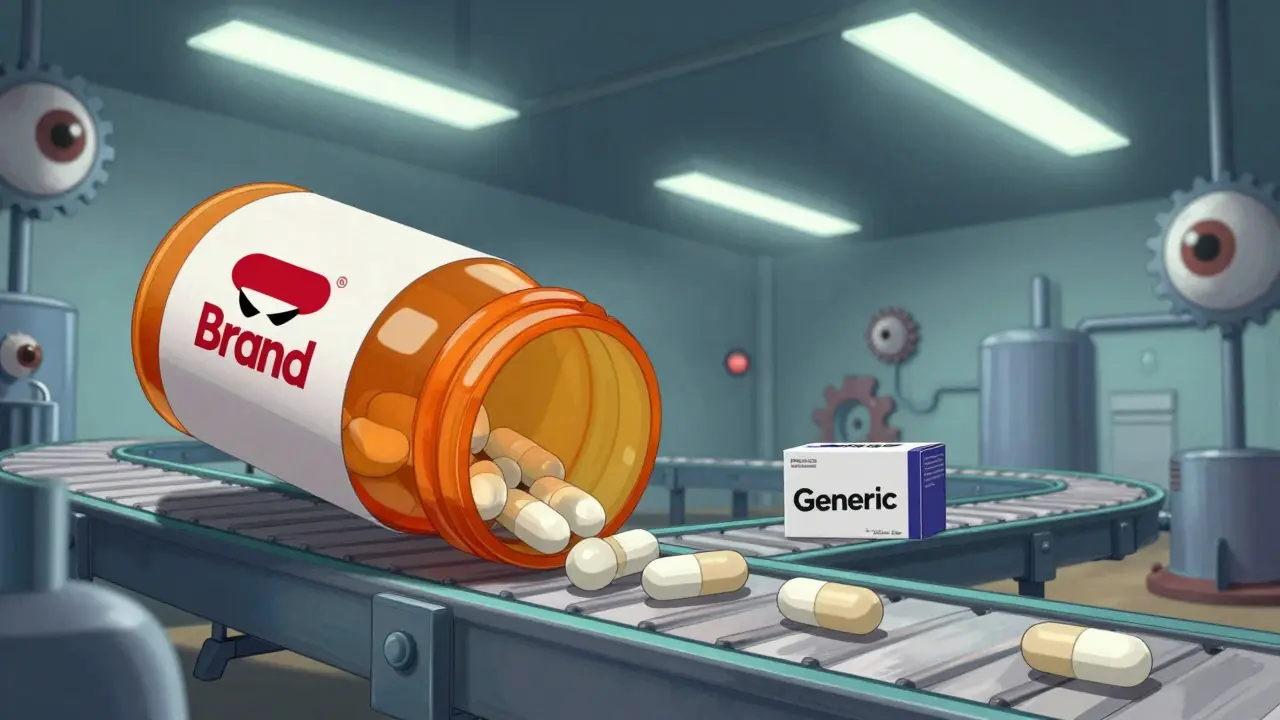
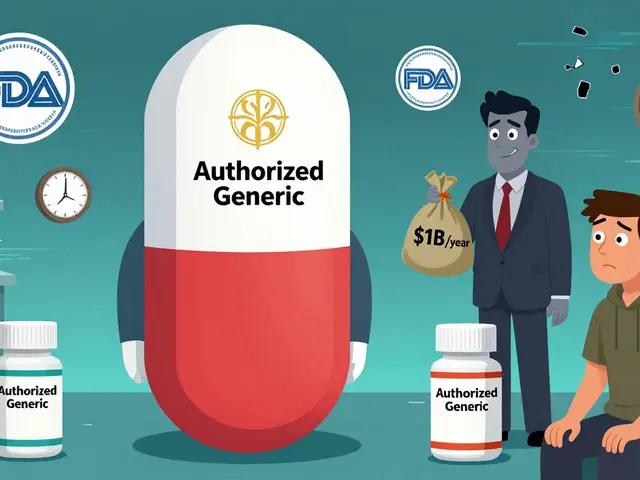
When a brand-name drug loses its patent, prices usually drop by 80% or more. That’s the rule. But here’s the twist: the same company that made the original drug often starts selling its own generic version-right when the patent expires. This isn’t a loophole. It’s a well-planned business move called an authorized generic.
What Exactly Is an Authorized Generic?
An authorized generic is the exact same pill, capsule, or injection as the brand-name drug. Same active ingredient. Same inactive ingredients. Same manufacturing facility. Same quality control. The only differences? The label says "generic," and the packaging looks different to avoid trademark violations. There’s no reformulation. No shortcuts. It’s the same product, just sold under a different name and at a lower price.This isn’t some third-party copycat. It’s made by the original manufacturer-often on the same production line, using the same workers, under the same FDA-approved processes. For example, when Pfizer made the authorized generic version of its cholesterol drug Lipitor, it was identical to the brand version. The only change was the label.
Why Do Companies Do This?
Think of it like this: when your patent runs out, dozens of other companies rush in to make cheaper copies. They undercut your price. You lose market share fast. In some cases, you lose 90% of your sales within a year. That’s not just bad-it’s devastating for a company that spent billions developing the drug.So instead of watching your profits vanish, you launch your own generic. You capture a slice of the new market. You keep control over quality. You avoid the chaos of multiple suppliers. And you still make money-just not as much as before.
In 2019, Teva launched an authorized generic of Copaxone on the day its patent expired. Within three months, it held 22% of the generic market. That’s not a small win. That’s a strategic takeover.
How Is It Made? The Process
The process starts years before the patent expires. Big pharmaceutical companies don’t wait until the last minute. They plan 24 to 36 months ahead. Here’s what happens:- They file an Abbreviated New Drug Application (ANDA) with the FDA. Since they already have all the safety and efficacy data from the brand drug, they don’t need to run new clinical trials.
- They adjust the packaging and labeling. The pill looks the same, but the box says "generic" and lists the manufacturer as a subsidiary or a different brand name.
- The manufacturing line stays the same. No new equipment. No new facility. Same GMP standards. Same inspectors.
- They set up a separate sales team. The FDA requires that the brand and generic versions be marketed differently to avoid confusion.
This whole process takes 6 to 9 months. Compare that to a traditional generic manufacturer, who might wait 17 months just for FDA approval. The brand company has a massive head start.
How It Affects Prices
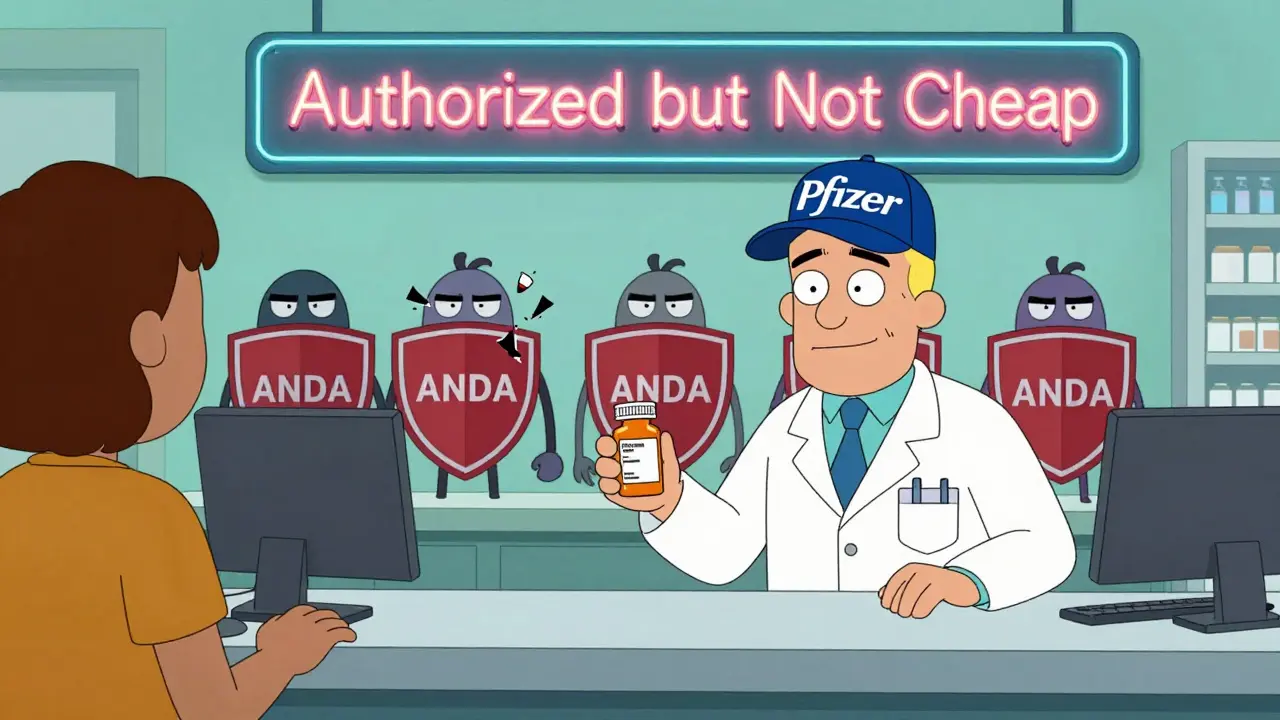
You’d think an authorized generic would drive prices down even further. But it doesn’t always work that way.Here’s the reality: authorized generics usually cost 10-15% less than the brand name-but 5-10% more than the competition. Why? Because the original company doesn’t want to kill its own profit. They’re not trying to win the price war. They’re trying to win the market.
Take Cialis. When Eli Lilly launched its authorized generic in 2018, it sold for $85 per pill. The brand version was $90. Competing generics? $30. So while patients got a slightly cheaper option, the real savings went to the other generic makers. Lilly still kept 78% of the total revenue for that drug.
That’s why some critics call it a "fake discount." Patients think they’re getting a bargain, but they’re not getting the deepest discount possible.

Consumer Confusion and Perception
Here’s something surprising: many patients don’t even know they’re taking an authorized generic.A 2023 Kaiser Family Foundation survey found that 71% of patients preferred authorized generics-because they recognized the pill. Same shape. Same color. Same taste. But 64% had no idea the same company made both versions.
Pharmacists see the confusion too. A 2022 survey by the National Community Pharmacists Association showed that 63% of independent pharmacies reported patients asking, "Why is this generic so expensive?" when it was actually made by the brand company.
On Reddit, users in r/pharmacy called it "the ultimate bait-and-switch." One user wrote: "I switched to the generic to save money. Turns out I’m still paying $85 for the same pill I’ve been taking for 10 years. The brand just changed the box."
But others appreciate the consistency. On Drugs.com, authorized generics have a 4.2 out of 5-star rating. Patients write: "I’ve had zero side effects since switching. Same exact thing. No surprises."
Regulatory and Legal Controversies
The FTC has taken issue with this practice. Between 2015 and 2020, they filed multiple antitrust cases against companies accused of using authorized generics to block competition.The most famous case was against Actavis over the drug Namenda. The FTC claimed Actavis delayed generic competition by launching its own authorized version too early. The company ended up paying $448 million in a settlement.
The law isn’t against authorized generics. It’s against using them to unfairly delay other generics. The CREATES Act of 2019 tried to fix this by making it harder for brand companies to block access to drug samples that generic makers need for testing. But the authorized generic pathway itself remains legal.
Market Impact and Future Trends
Between 2018 and 2022, 68% of the top 50 brand-name drugs that lost patent protection got an authorized generic version from their original maker. That’s not a coincidence. That’s a pattern.Companies like Pfizer, Johnson & Johnson, Roche, Merck, and AbbVie have launched 47 authorized generics since 2020. That number is growing by 28% every year.
Why now? Because the next wave of expiring patents is massive. Around $250 billion in brand-name drug sales will lose protection between 2023 and 2027. Many of those drugs are complex-injectables, long-acting formulations, even biologics.
Johnson & Johnson launched the first authorized generic of a long-acting injectable in 2023. Amgen released the first authorized biosimilar (a copy of its own Enbrel) in 2023. These are new frontiers. Traditional generic makers don’t have the technology or expertise to copy these easily. But the original company does.
Analysts predict that by 2027, authorized generics will make up 25-30% of the entire generic drug market-up from 18% in 2022. That’s a huge shift.
Who Wins? Who Loses?
Let’s break it down:- Brand companies win. They keep revenue, control, and market share.
- Patients get a familiar product with consistent quality. But they don’t always get the lowest price.
- Traditional generic manufacturers lose. They face less competition from other generics because the brand company already took a big chunk of the market.
- Health systems and insurers get some savings, but less than they would if multiple generics competed freely.
According to the Congressional Budget Office, authorized generics save about $2.3 billion a year in U.S. drug spending. Sounds good. But they estimate that if traditional generics competed without interference, savings could reach $6.2 billion. That’s nearly three times more.
So authorized generics aren’t bad. But they’re not the full solution either. They’re a business tool disguised as a consumer benefit.
What Should You Do as a Patient?
If you’re on a brand-name drug that’s about to go generic:- Ask your pharmacist: "Is there an authorized generic?"
- Compare prices: Is the "generic" really cheaper than the other generics?
- Don’t assume "generic" means "cheapest." Sometimes it’s just the brand in disguise.
- If you’re cost-sensitive, ask for the lowest-priced generic-even if it’s from a different maker.
- Keep your pill bottle. If the new version looks different, ask why. It might be a different generic, not an authorized one.
Knowledge is your best tool. You don’t need to be a pharmaceutical expert. You just need to ask the right questions.
Are authorized generics the same as regular generics?
Yes and no. Authorized generics are identical to the brand-name drug in every way-same ingredients, same manufacturer, same factory. Regular generics are made by different companies and must meet the same FDA standards, but they may have different inactive ingredients or slight variations in how the drug is released. Authorized generics are the closest thing to the original brand you can get.
Why are authorized generics sometimes more expensive than other generics?
Because the brand company isn’t trying to win a price war. They’re trying to keep you as a customer. An authorized generic might cost $85 while a traditional generic is $30. The brand company doesn’t want to undercut itself too much, so they price it just low enough to seem like a deal-but not so low that they lose money.
Can I trust an authorized generic as much as the brand name?
Absolutely. Authorized generics are made in the same facility, with the same quality controls, by the same team that made the brand version. The FDA requires them to be bioequivalent-meaning they work the same way in your body. Many patients report fewer side effects with authorized generics because they’re used to the exact same pill.
How do I know if my generic is an authorized generic?
Check the label. The manufacturer’s name will be the same as the brand name-or a subsidiary of it. For example, if you’re taking a generic version of Lipitor and the manufacturer is Pfizer, that’s an authorized generic. You can also ask your pharmacist directly. They can tell you if it’s an authorized version or a traditional generic.
Is it legal for a brand company to make its own generic?
Yes. It’s fully legal under the Hatch-Waxman Act of 1984. The law allows brand manufacturers to enter the generic market. But if they use it to block other generics-like by delaying access to drug samples or paying competitors to stay out of the market-that’s illegal. The FTC has cracked down on those abuses.
What’s Next?
The future of authorized generics is tied to complex drugs-biologics, injectables, and long-acting formulations. These are harder to copy. Traditional generic makers struggle with them. But the original brand companies? They already know how to make them.That means we’ll see more authorized biosimilars-copies of biologic drugs made by the same company that invented them. It’s already happening. And it’s going to change how we think about drug competition.
For now, the system works for manufacturers. It gives patients a familiar option. But it doesn’t deliver the deepest savings. If you’re paying for medication, don’t assume "generic" means "cheap." Ask questions. Know what you’re getting. And don’t let marketing confuse you.
Thomas Anderson
December 15, 2025 AT 09:50Had no idea brand companies did this. I thought generics were always from other makers. My Lipitor generic was way cheaper than the brand, but now I’m wondering if it was actually Pfizer’s version. Guess I’ll ask my pharmacist next time.
Alexis Wright
December 16, 2025 AT 19:41This isn’t a business move-it’s a corporate heist. The FDA lets them play both sides: you pay $90 for the brand, then they slap a "generic" label on the exact same pill and charge $85. Meanwhile, real generics get crushed. This isn’t capitalism-it’s monopolistic theater. They’re not competing. They’re colluding with themselves.
Daniel Wevik
December 16, 2025 AT 22:38Strategic market capture via authorized generics is a textbook example of vertical integration in pharmaceuticals. By controlling the supply chain end-to-end-from R&D to distribution-they mitigate the risk of generic erosion while maintaining margin integrity. It’s not unethical-it’s fiduciary duty.
Tim Bartik
December 17, 2025 AT 02:46AMERICA’S BIG PHARMA IS ROBBING US. THEY MAKE THE DRUG, THEN SAY "OH THIS IS A GENERIC NOW" AND STILL CHARGE 90 BUCKS. THEY’RE LAUGHING AT US WHILE WE PAY FOR THE SAME PILL WITH A DIFFERENT BOX. #PHARMAFRAUD #STOPLIE
Rich Robertson
December 18, 2025 AT 12:51Interesting how this mirrors practices in other regulated industries-like automotive parts or electronics. The original maker producing their own "compatible" version is common. But in pharma, the stakes are higher because lives depend on consistency. That’s why patients trust the authorized version more-it’s not just legal, it’s psychologically reassuring.
Natalie Koeber
December 19, 2025 AT 06:44they told us generics were cheaper but this is all a lie. the fda is in bed with big pharma. they even use the same machines. i bet they add tracking chips in the pills. why else would they let the same company make the "generic"? this is mind control. i stopped taking mine.
Wade Mercer
December 19, 2025 AT 15:29It’s not wrong to protect your investment, but when your "solution" to losing monopoly profits is to corner the new market yourself, it’s not innovation-it’s exploitation. People think they’re saving money, but they’re just being gently herded into a slightly less expensive cage.
Dwayne hiers
December 21, 2025 AT 06:27Authorized generics bypass the ANDA bioequivalence testing burden because they’re identical to the originator product. This creates a regulatory advantage that independent generics cannot replicate without significant capital investment. It’s a structural asymmetry baked into Hatch-Waxman. The FTC’s focus should be on sample access barriers, not the model itself.
Sarthak Jain
December 23, 2025 AT 00:16in india we have a lot of generics but never heard of this. so brand companies make their own cheap version? wow. i guess its smart but feels like cheating. still better than paying full price tho. thanks for explainin this, i learned something today 😊
Daniel Thompson
December 23, 2025 AT 20:51The notion that consumers are being misled by packaging is overstated. The active pharmaceutical ingredient remains unchanged. If a patient is concerned about consistency, they should be grateful for the continuity of formulation-not outraged by the label change. This is a non-issue masquerading as a scandal.
Rulich Pretorius
December 25, 2025 AT 08:10It’s not about whether it’s legal-it’s about whether it’s fair. The system rewards those who already have the most power. The real heroes are the small generic companies trying to break in, and they’re getting squeezed out. We need policies that protect competition, not corporate self-preservation.
Jonny Moran
December 26, 2025 AT 16:16As someone who’s had to switch meds multiple times, I appreciate knowing there’s a version out there that’s identical to what I was on. Even if it’s not the cheapest, it’s the least stressful. I’d rather pay a little more for peace of mind than risk side effects from a new formula.
Sinéad Griffin
December 28, 2025 AT 01:50🚨 BIG PHARMA JUST MADE THE SAME PILLS CHEAPER AND CALLED IT A "GENERIC" 🚨 I’M NOT BUYING IT. 💊💸 #PHARMAISALIEN #WHYARETHEYLAUGHING