
Missed Dose Decision Helper
Which medication are you taking?
When did you miss the dose?
Realizing you've forgotten a dose of your medication is stressful, but when it comes to missed blood thinner dose scenarios, the stakes are higher than a missed vitamin. These medications don't actually make your blood "thinner" in a liquid sense; instead, they slow down the clotting process to prevent life-threatening blockages. For someone with atrial fibrillation or a history of deep vein thrombosis, that missing dose creates a window where the blood can clot too easily. On the flip side, trying to "catch up" by taking extra can lead to dangerous internal bleeding.
The goal is to get back on track without overshooting your dose. Depending on whether you are taking an older medication like Warfarin a traditional anticoagulant that requires regular blood monitoring via INR tests or a newer direct oral anticoagulant (DOAC), the rules change. Here is exactly how to handle a missed dose and when you need to call emergency services.
Quick Guide for Missed Doses
Because different medications have different "half-lives" (how long they stay active in your system), the window for taking a missed dose varies. Never double your dose to compensate, as this significantly spikes your risk of a hemorrhage.
| Medication Type | Examples | What to Do | When to Skip |
|---|---|---|---|
| Warfarin | Coumadin, Jantoven | Take as soon as you remember if it's before midnight. | If it's the next day or past midnight, skip it. |
| DOACs | Apixaban (Eliquis), Rivaroxaban (Xarelto) | Take as soon as you remember on the same day. | Skip if it's very close to your next scheduled dose. |
Handling Warfarin (The "Yellow Book" Protocol)
Warfarin is a bit more complex because it requires precise monitoring of your International Normalized Ratio a standardized measurement of how long it takes your blood to clot (INR). Most people aim for a range between 2.0 and 3.0. Because it stays in your system longer, you have a slightly larger window, but you still need to be careful.
If you miss a dose, the general rule from the NHS is to take it as soon as you remember. However, if you don't realize it's missing until the next day, do not take two doses at once. The danger of doubling up on Warfarin is a major bleeding event, which can happen to 1-3% of patients annually. If you've forgotten a dose, write it down in your anticoagulant record book (often called the "yellow book") and notify your clinic during your next blood test.

Managing Newer Anticoagulants (DOACs)
Medications like Apixaban a direct oral anticoagulant used to reduce the risk of stroke and systemic embolism (Eliquis) are more convenient because they don't require constant blood tests. But there's a trade-off: they leave your system much faster than Warfarin. While Warfarin might last 20-60 hours, Apixaban typically lasts only 8-15 hours.
If you miss an Eliquis dose, take it as soon as you remember, provided it is still the same day. Some clinicians suggest a "6-hour rule": if you are more than 6 hours late, it may be safer to skip the dose and resume your normal schedule. The biggest risk here is the "gap" in protection. Research shows that when adherence to DOACs drops below 80%, the risk of stroke can increase by as much as 57%.
Warning Signs: When to Seek Immediate Help
Missing a dose is one problem, but the signs of a clot or an overdose are emergencies. You need to act fast if you notice your body is reacting poorly. Because blood thinners interfere with the body's ability to stop bleeding, even a small injury can become serious.
Seek medical attention immediately if you experience:
- Unexpected Bleeding: Red or brown discoloration in your urine, or stools that look black and tarry (a sign of GI bleeding).
- Neurological Changes: A sudden, severe headache or dizziness, which could indicate bleeding in the brain.
- Clot Symptoms: Sudden shortness of breath or chest pain (potential pulmonary embolism), or swelling and pain in one leg (potential deep vein thrombosis).
- Trauma: If you hit your head or have a hard fall, call your provider immediately. Even if you feel fine, the medication can cause internal bleeding that isn't visible.
Strategies to Prevent Missed Doses
The best way to handle a missed dose is to make sure it doesn't happen. Since 17-25% of adverse events in anticoagulant patients are linked to missed doses, creating a fail-safe system is a medical necessity.
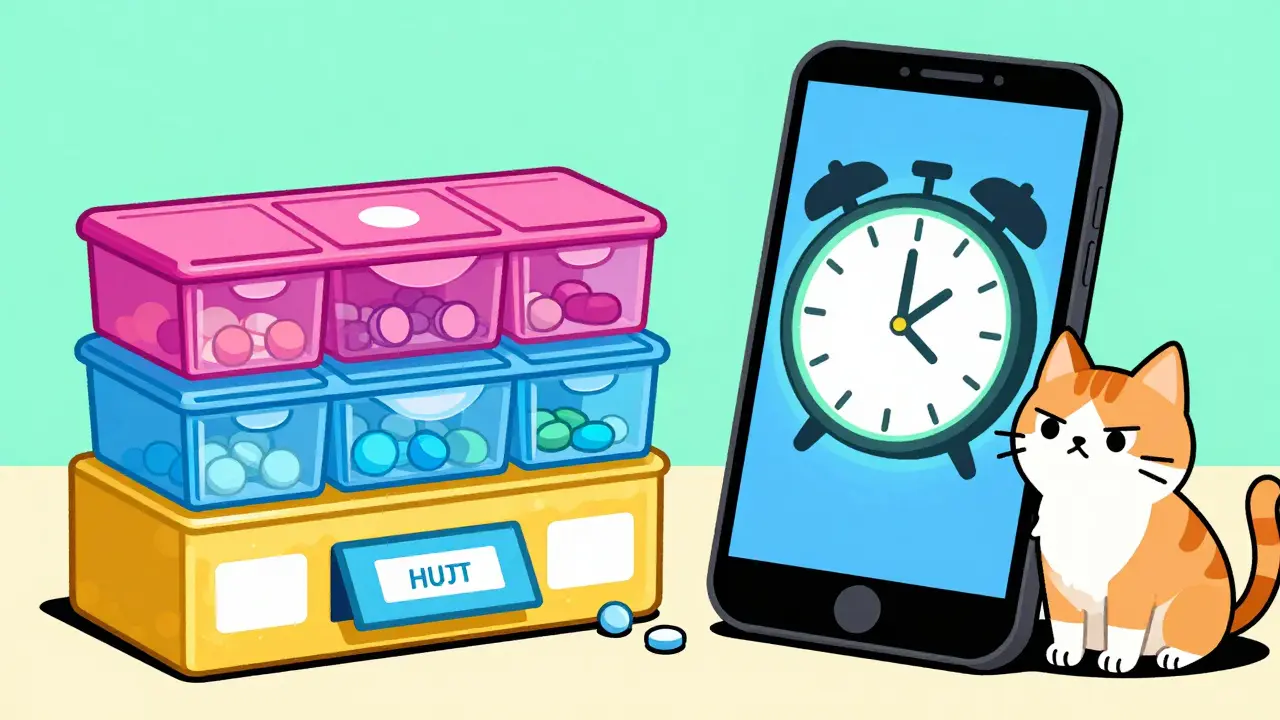
Start by using a pill organizer (pillbox) so you can see at a glance if today's dose is gone. Many people find that linking the dose to a daily habit-like brushing your teeth or feeding a pet-helps the routine stick. For those who struggle with memory, smartphone alarms or medication reminder apps are highly effective. Finally, always refill your prescription before you actually run out; waiting until the last pill can lead to an accidental gap in treatment.
Can I take a double dose to make up for a missed one?
No. You should never take a double dose of any blood thinner. Doing so significantly increases your risk of internal bleeding and other dangerous complications. If you miss a dose, follow the specific timing guidelines for your medication or contact your doctor.
What is the most dangerous consequence of missing a dose?
The primary danger is the formation of a blood clot. Depending on your condition, this could lead to an ischemic stroke, a pulmonary embolism (a clot in the lungs), or deep vein thrombosis (DVT), all of which can be fatal if not treated immediately.
Why does Warfarin need blood tests while Eliquis doesn't?
Warfarin has a wide and unpredictable effect on different people, and its levels can be affected by diet (like leafy greens) and other meds. The INR test ensures the dose is in the "goldilocks zone"-not too low to cause clots, and not too high to cause bleeding. DOACs like Eliquis have a more predictable effect on the body, so routine monitoring isn't required.
Should I worry if my gums bleed when brushing?
Minor bleeding, such as gums bleeding during brushing or an occasional nosebleed, can happen even when your medication levels are perfect. However, if the bleeding is heavy, doesn't stop, or is accompanied by bruising, you should contact your healthcare provider.
What should I do if I'm not sure which medication I'm taking?
Check your prescription bottle or the pharmacy label immediately. If you are still unsure, call your pharmacist or doctor's office. Because the protocols for Warfarin and DOACs differ, it is critical to know exactly which one you are taking before deciding whether to take a missed dose.
Next Steps and Troubleshooting
If you've missed a dose and are feeling anxious, the first step is to check your medication name and the time of day. If you have a "yellow book" for Warfarin, log the error now so you don't forget to tell your nurse. If you have missed more than one dose in a row, do not try to fix it yourself; call your anticoagulant clinic or primary care provider immediately for a revised dosing schedule.
For those who find it impossible to keep up with daily pills, talk to your doctor about alternative delivery methods or more robust reminder systems. If you ever suspect you've taken too much medication, head to the nearest emergency room and bring your medication packaging and your record book with you.



Kenzie Evans
April 15, 2026 AT 05:59This guide is basically common sense. Any idiot knows you don't double up on meds. Why are we even posting this like it's some revolutionary discovery? It's just basic pharmacy 101 and honestly a waste of space for anyone who actually pays attention to their doctor.
Scott Lofquist
April 15, 2026 AT 12:13Actually, the "6-hour rule" mentioned for DOACs is way too simplistic and barely touches on the pharmacokinetics involved 🙄. You can't just apply a blanket time limit without considering the individual's renal function or age. It's irresponsible to give such a generalized tip when biological variability is so high 🤡💊.
Milo Tolley
April 17, 2026 AT 05:15The sheer systemic volatility of a missed anticoagulant dose is absolutely harrowing!!! One minute you're fine, the next you're dealing with a full-blown embolic event!!! The hemodynamic instability is just... unthinkable!!!
Brooke Mowat
April 18, 2026 AT 09:41Life is just a wild ride of forgetfulness isn't it?? it's like we're all just floatin' in this cosmic soup tryin' not to let our blood clump up like old oatmeal lol. Just gotta keep the vibes high and the memory sharp, or at least buy a fancy plastic box to hold the magic pills so we don't drift too far off course in this weird human experiance.
Olivia Lo
April 20, 2026 AT 01:39From a clinical perspective, focusing on the therapeutic window is essential for mitigating the risk of thrombus formation. While the transition from Vitamin K antagonists to direct inhibitors has simplified the regimen, the physiological requirement for adherence remains absolute to avoid suboptimal anticoagulation. It is a delicate balance between preventing an ischemic event and risking a spontaneous hemorrhage, necessitating a calm, evidence-based approach to any dosing error.
Mary Johnson
April 21, 2026 AT 12:21You really think these "guidelines" are just for safety? Big Pharma loves it when you're scared of a single missed dose because it keeps you addicted to the cycle of refills and constant monitoring. They want us paranoid about clots so we never question why these drugs have so many side effects in the first place. It's all a game to keep the profits soaring while we're just numbers in a spreadsheet to them!
Rim Linda
April 21, 2026 AT 12:42Omg I literally had a panic attack last week because I couldn't remember if I took my pill or not!!! I was shaking and crying for like an hour until I found the empty blister pack :'( it was the most stressful morning of my entire life!!!
Princess Busaco
April 22, 2026 AT 18:43It is truly fascinating how some people think a simple pillbox is the pinnacle of medical organization when in reality, the psychological trauma of living with a chronic condition like atrial fibrillation requires a much more holistic approach than just "linking the dose to brushing your teeth," which is honestly such a pedestrian suggestion that it borders on insulting the intelligence of anyone who has actually struggled with a complex healthcare regimen for more than a week, and frankly, the way the medical establishment expects us to just "be more organized" without addressing the systemic failure of patient support is just a tragedy of epic proportions that we all just pretend is normal while we slowly bleed out or clot up in our sleep because the system is broken beyond repair.