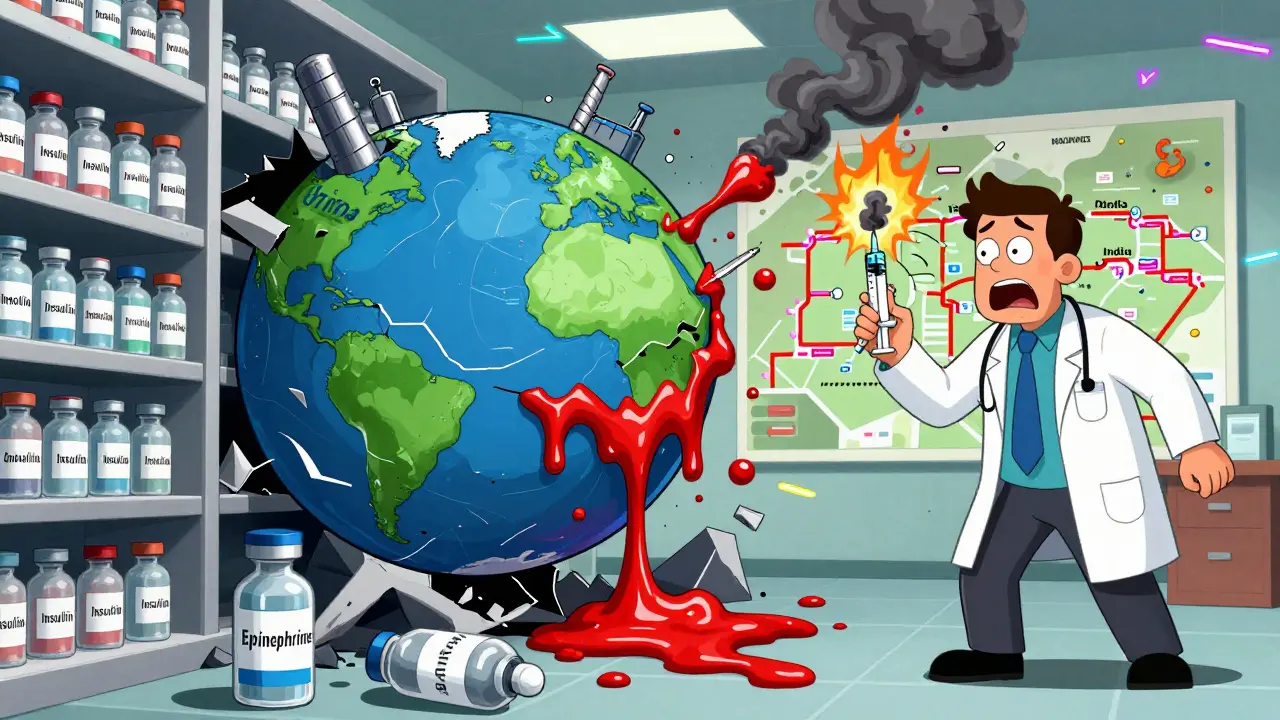
Drug shortages aren’t just inconvenient-they’re dangerous. In 2022, the FDA recorded 245 drug shortages, and more than half of them involved life-saving injectables used in hospitals during emergencies, surgeries, and cancer treatments. These aren’t temporary hiccups. They’re symptoms of a system built for efficiency, not safety. For years, pharmaceutical companies cut costs by relying on just-in-time manufacturing and concentrating production in just a few countries. Now, when a factory in India shuts down for regulatory issues, or a shipping port in China closes due to unrest, patients in the U.S. and UK face delays, substitutions, or no treatment at all. The question isn’t whether this will happen again-it’s whether we’re ready to stop it for good.
Why the Current System Fails
The global drug supply chain was designed to be cheap, not strong. About 72% of the active pharmaceutical ingredients (APIs) used in U.S. medications come from overseas, with nearly half of those coming from just two countries: China and India. This concentration creates a single point of failure. A single natural disaster, political shift, or quality control issue can ripple across continents. In 2020, a factory fire in India disrupted supply of antibiotics used in 40% of U.S. hospitals. In 2021, a cyclone in China delayed production of blood pressure meds for months. These weren’t rare events-they were predictable.Companies didn’t ignore the risks. They calculated the cost of stockpiling versus the cost of occasional shortages. And for most drugs, the math said: wait and see. But when a patient needs a sterile injectable during cardiac arrest, waiting isn’t an option. The financial toll is real too: drug shortages cost the U.S. healthcare system over $216 million in extra expenses each year-from emergency purchases to extended hospital stays.
What Resilience Actually Means
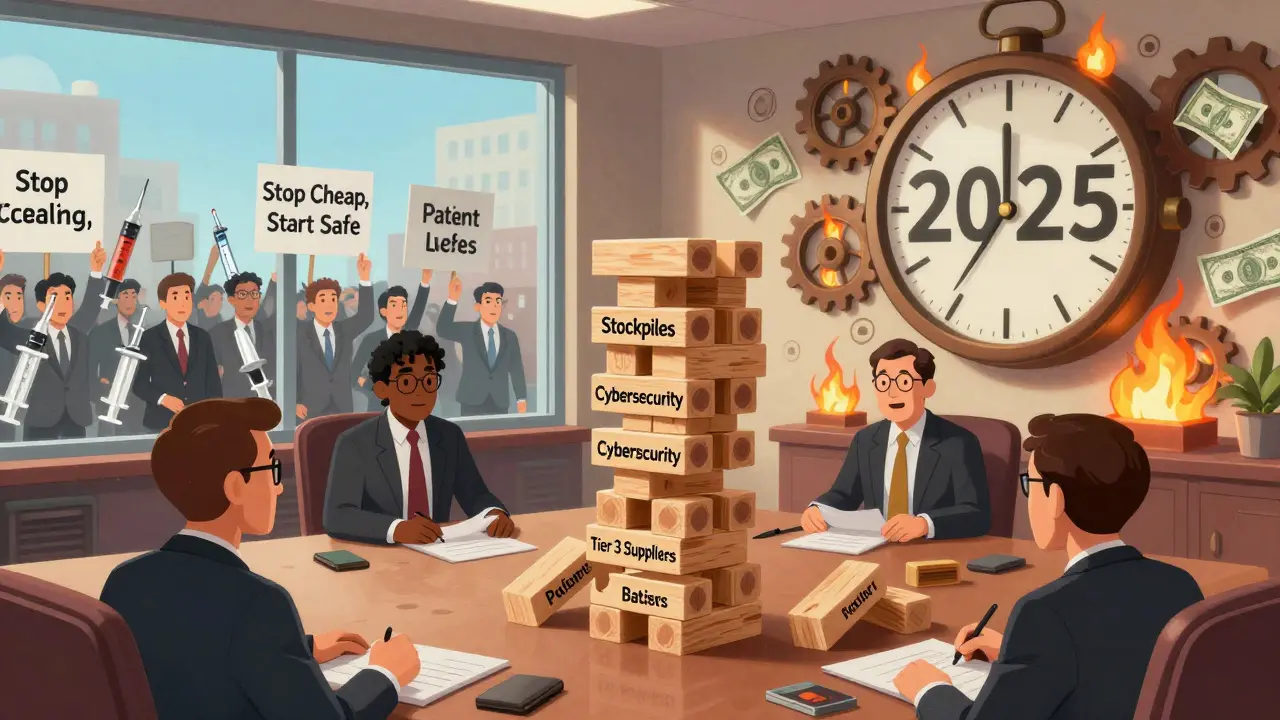
Building resilience doesn’t mean making every drug in America. It means designing a system that can bend without breaking. The National Academies of Sciences laid out a clear framework: resilience is about three things-anticipating problems, planning ahead, and managing risks before they explode.Take buffer stockpiling. For critical medicines, keeping 6 to 12 months of supply on hand isn’t excessive-it’s essential. The FDA recommends this for injectables, anesthetics, and antibiotics. But only 18% of manufacturers currently do it. Why? Because storing drugs costs money, and buyers demand the lowest price. Yet, when a shortage hits, hospitals pay 300% more for the same drug on the spot market. The real cost isn’t the storage-it’s the delay in care.
Another key piece is supplier diversification. If you’re making a life-saving drug, you shouldn’t rely on one factory in one country. The rule of thumb? At least three suppliers, spread across different continents. Merck did this for 12 key antibiotics after the pandemic, shifting 95% of their API sourcing to U.S.-based facilities. It cost them 31% more to produce, but they eliminated the risk of foreign disruptions. That’s the trade-off: pay more now, or risk lives later.
The Hidden Blind Spots
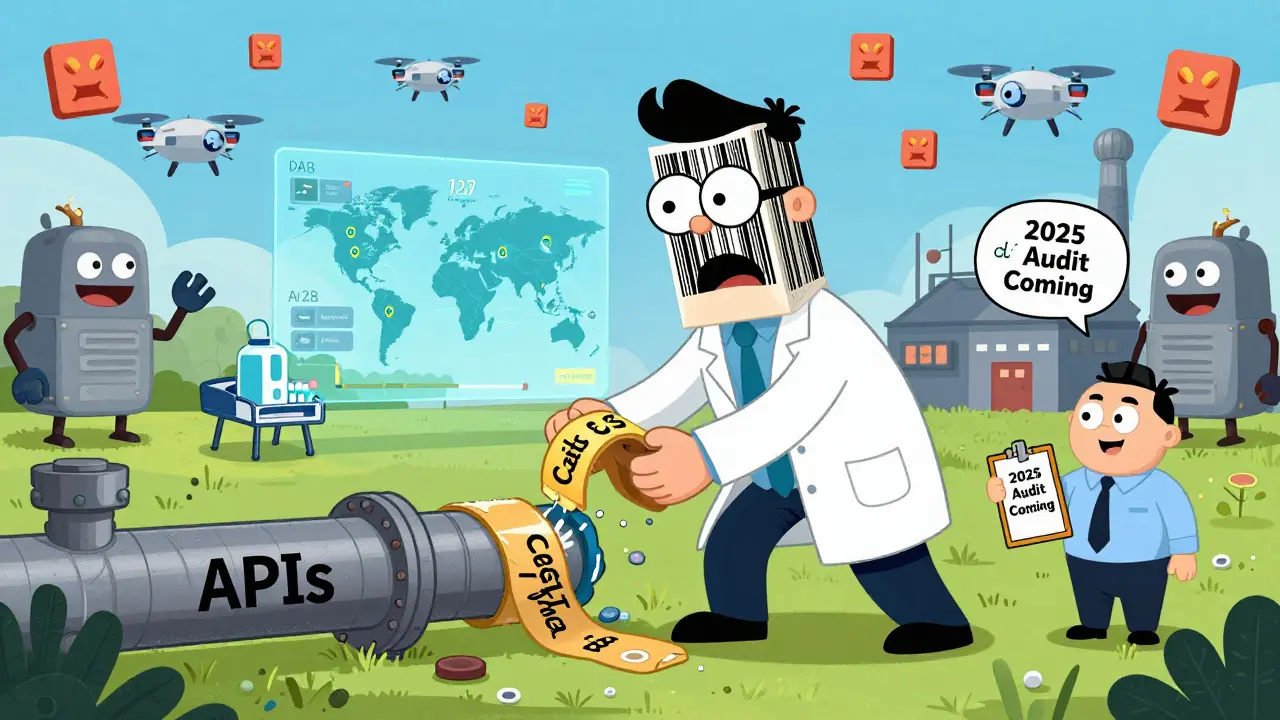
Most companies only see their direct suppliers-Tier 1. But the real risks are deeper. The raw materials, chemicals, and packaging components come from Tier 3 or 4 suppliers, often in countries no one tracks. Only 12% of pharmaceutical firms have visibility beyond Tier 1. That means they don’t know if the chemical used in their heart medication comes from a plant in Turkey that’s running low on electricity, or if the glass vials are made in a factory in Vietnam with outdated quality controls.Supply chain mapping tools are changing that. Companies using AI-powered mapping tools report 32% fewer disruptions-even though these tools make up just 8% of their resilience spending. Why? Because they spot risks before they become crises. One distributor in Ohio used mapping software to trace a shortage of insulin back to a single dye supplier in South Korea. They switched suppliers in 11 days. Without the tool, it would’ve taken six months.
Cybersecurity Is Part of the Drug Supply
You wouldn’t leave your medicine cabinet unlocked. Why would you leave your supply chain open to hackers? Between 2020 and 2023, cyberattacks on healthcare supply chains jumped 214%. Ransomware can shut down a manufacturing plant overnight. A single breach can erase production schedules, alter inventory records, or even poison digital systems controlling drug purity. The Healthcare Distribution Alliance says coordinated threat-sharing reduces response time by 47%. That’s not optional-it’s as critical as GMP compliance.Companies now need to follow the NIST Cybersecurity Framework across every partner in their chain. That includes third-party logistics firms, raw material vendors, and even cloud storage providers. If your API supplier uses an unsecured server, you’re at risk too. The FDA’s new 2023 guidance requires manufacturers to assess cybersecurity risks annually. Starting in 2025, failing to do so could mean losing approval to sell a drug.
Domestic vs. Diversified: What Works Best
There’s a myth that bringing all drug production back to the U.S. is the answer. It’s not. Reshoring API manufacturing adds 25-40% to costs. That’s why it’s only practical for the most critical drugs-like epinephrine, heparin, or chemotherapy agents. For others, it’s economically unsustainable.A smarter approach is hybrid: keep domestic capacity for the top 50 high-risk drugs, and diversify globally for the rest. The Duke-Margolis Center estimates this model prevents 85% of critical shortages at a cost of $1.2-1.8 billion a year. Compare that to stockpiling alone, which costs $3.5-4.2 billion and only prevents 45% of shortages. Or to reshoring everything-unaffordable and unnecessary.
The European Union is already doing this. Since 2022, EU regulators have pushed manufacturers to build parallel supply chains for both the U.S. and EU markets. Now, 63% of global pharma companies maintain dual sourcing. That’s not redundancy-it’s insurance.
How Real Companies Are Fixing This
Pfizer spent $220 million and 18 months building an AI-driven forecasting system across 150 distribution centers. Result? A 38% drop in stockouts. Merck’s domestic API project, backed by $85 million in federal funding, now supplies 12 critical antibiotics with 95% U.S. content. A regional distributor in rural Iowa started using drone deliveries to get insulin and antibiotics to pharmacies in 4 hours instead of 72. Regulatory hurdles? Yes. But they got waivers from 38 states after proving patient outcomes improved.These aren’t outliers. They’re proof that change is possible. The common thread? They didn’t wait for a crisis. They mapped their chains, identified weak links, and invested in solutions before patients suffered.
The Road Ahead: What’s Changing in 2025-2026
The U.S. government is finally stepping up. The HHS 2024 Resilience Plan allocates $520 million to boost domestic production of 50 critical drugs, aiming for 40% API production in the U.S. by 2027. The FDA’s new rules require annual vulnerability assessments starting in Q3 2025. And in 2026, Medicare will start tying reimbursement to supply chain transparency-forcing manufacturers to disclose every step of their production chain.Internationally, the Pharmaceutical Security Institute’s Global Resilience Partnership now includes 17 countries working to harmonize standards for 200 critical medicines. AI adoption in supply chains has jumped from 22% in 2021 to 58% in 2023. Predictive models now forecast disruptions with 83% accuracy up to 30 days ahead.
The biggest shift? The workforce. By 2027, the industry will need 125,000 new specialists trained in supply chain risk analysis. Right now, only 35% of companies have staff with that skill. Training programs are launching at universities in Manchester, Boston, and Berlin. The gap is real-but it’s closing.
What Needs to Happen Next
If you’re a policymaker: fund domestic capacity for the 50 most critical drugs, not every drug. Tie Medicare payments to transparency. Require annual cybersecurity audits.If you’re a hospital administrator: stop buying based on price alone. Demand supplier diversity data. Build 6-month stockpiles for injectables. Train staff on alternative medications.
If you’re a manufacturer: map your entire supply chain down to Tier 3. Use AI to predict disruptions. Partner with other companies to share risk. Don’t wait for a crisis to act.
Resilience isn’t a one-time project. It’s a daily practice. It’s about choosing safety over savings, planning over panic, and long-term stability over short-term profit. The technology exists. The data is there. The cost of doing nothing is measured in lives. The question now is: who will act first?
What causes most drug shortages today?
Most drug shortages today are caused by concentrated manufacturing-especially for active pharmaceutical ingredients (APIs)-in just a few countries like China and India. A single factory shutdown, regulatory issue, or natural disaster can disrupt supply for millions of patients. Other major causes include lack of supplier diversity, poor supply chain visibility beyond Tier 1, and cybersecurity breaches that halt production.
Is making drugs in the U.S. the best solution?
Not for all drugs. Reshoring production adds 25-40% to costs, which makes it unsustainable for most medications. The best approach is targeted domestic production for the 50-100 most critical drugs-like life-saving injectables-and diversified international sourcing for others. This hybrid model prevents 85% of shortages at a fraction of the cost of full reshoring.
How long should hospitals stockpile critical drugs?
For critical injectables like epinephrine, insulin, or antibiotics, hospitals should maintain 6 to 12 months of supply. This buffer gives time to respond to disruptions without risking patient care. Stockpiling alone won’t prevent all shortages, but it’s the most immediate way to protect patients during crises.
Why is cybersecurity part of the drug supply chain?
Cyberattacks can shut down manufacturing plants, alter inventory records, or corrupt quality control systems. Between 2020 and 2023, cyberattacks on pharmaceutical supply chains increased by 214%. A breach at a supplier can delay or contaminate drugs. That’s why companies must now follow the NIST Cybersecurity Framework across all partners-just like they follow FDA quality rules.
Can AI really help prevent drug shortages?
Yes. AI-powered tools now predict disruptions with 83% accuracy up to 30 days ahead by analyzing weather, political events, shipping delays, and supplier performance. Companies using AI report 32% fewer disruptions. These tools map supply chains down to raw material sources, flagging risks long before they cause shortages.
What’s the biggest barrier to fixing drug shortages?
The biggest barrier is price-driven procurement. Hospitals and insurers choose drugs based on the lowest cost, not resilience. Manufacturers can’t justify spending extra on diversification or stockpiling if buyers won’t pay for it. Changing this requires policy shifts-like tying Medicare reimbursement to supply chain transparency-so safety is rewarded, not penalized.


Anna Pryde-Smith
January 23, 2026 AT 11:03This system is a death trap waiting to happen-and we’re all just sitting here like it’s a Netflix documentary. I’ve seen nurses scramble for alternatives during cardiac arrests because the damn epinephrine was gone. Again. And no one’s fired. No one’s held accountable. We’re not talking about a minor inconvenience-we’re talking about people dying because CEOs thought ‘just-in-time’ sounded cool on a PowerPoint slide. It’s criminal.
And don’t give me that ‘it’s too expensive’ nonsense. How much is a life worth? $216 million a year in extra costs? That’s pocket change compared to the lawsuits, the grief, the funeral bills. We’re literally gambling with human lives because someone’s bonus depends on quarterly profits. Fix this now-or I’m starting a petition to name every drug shortage after the person who died because of it.
Dawson Taylor
January 25, 2026 AT 05:56The structural fragility of the pharmaceutical supply chain reflects a broader epistemological failure in modern capitalism: the conflation of efficiency with virtue. When cost minimization becomes the sole metric of success, resilience is not merely neglected-it is pathologized as inefficiency. The data presented here is not anomalous; it is the logical outcome of a system optimized for shareholder value, not human survival.
Resilience, in this context, is not a technical problem but a moral one. The question is not whether we can afford to stockpile or diversify, but whether we can afford not to.
charley lopez
January 26, 2026 AT 13:08Current supply chain architectures exhibit suboptimal redundancy profiles, particularly with respect to Tier 1 API sourcing concentration. The concentration index for active pharmaceutical ingredients (APIs) in China and India exceeds 72%, resulting in systemic vulnerability to exogenous shocks-geopolitical, climatological, or regulatory. Mitigation strategies must incorporate multi-tier supply mapping, buffer inventory thresholds (6–12 months for critical injectables), and cybersecurity compliance aligned with NIST CSF 2.0.
Furthermore, the absence of Tier 3–4 visibility constitutes a critical control gap. Only 12% of firms possess end-to-end traceability, rendering risk assessment incomplete. AI-driven predictive analytics, while underutilized (58% adoption), demonstrate 83% forecast accuracy at 30-day horizons, yielding a 32% reduction in disruption events. Implementation is not optional-it is a regulatory and operational imperative.
Susannah Green
January 26, 2026 AT 15:25Okay, real talk: I work in a hospital pharmacy, and I’ve had to call 12 different distributors in one week just to find one vial of norepinephrine. We’ve had to use expired stock because it was the only thing left. No one’s talking about the nurses who cry because they can’t give a kid the right dose. No one’s talking about the patients who get switched to a drug that makes them vomit for three days because the ‘equivalent’ isn’t equivalent at all.
Stop pretending this is a ‘cost issue.’ It’s a people issue. Hospitals can’t afford to pay 300% more? Fine. But we can’t afford to lose patients because someone didn’t want to spend $5 extra per vial to keep a backup. If you’re buying the cheapest drug without asking where it’s made or how many backups exist-you’re not saving money. You’re gambling with lives. And I’m tired of being the one cleaning up the mess.
Kerry Moore
January 28, 2026 AT 09:08Thank you for this comprehensive and rigorously documented analysis. The integration of cybersecurity into pharmaceutical supply chain governance represents a paradigmatic shift in risk management. The 214% increase in cyberattacks between 2020 and 2023 is not merely a statistical anomaly-it is an indicator of systemic vulnerability to non-traditional threats. The requirement for NIST CSF compliance across all tiers, including third-party logistics and cloud infrastructure, is not only prudent but necessary for regulatory continuity.
Furthermore, the proposed hybrid model-targeted domestic production for critical agents and diversified international sourcing for non-critical agents-represents a cost-effective, empirically validated approach. The Duke-Margolis estimate of 85% shortage prevention at $1.2–1.8 billion annually is compelling, particularly when contrasted with the $3.5–4.2 billion cost of pure stockpiling. I urge policymakers to prioritize this model in legislative frameworks.
Stacy Thomes
January 30, 2026 AT 06:47ENOUGH IS ENOUGH. We are letting people die because someone’s spreadsheet says it’s cheaper to wait. I’ve seen a grandmother on chemo get a substitute drug that gave her seizures. Her family had to sell their car to pay for it. This isn’t politics. This isn’t economics. This is a moral emergency. We need to make supply chain resilience a LAW. Not a suggestion. Not a guideline. A LAW. And if a company cuts corners and someone dies? They go to jail. That’s it. No more excuses. No more ‘we didn’t know.’ We know. And we’re still doing nothing.
Who’s with me? Let’s make this the next big movement. Not ‘save the whales.’ Save the epinephrine.
dana torgersen
January 31, 2026 AT 13:06i mean… like… we’ve been doing this wrong for DECADES right?? like, why is it so hard to just… have backup factories?? it’s not rocket science. and why are we letting one country control half the world’s meds?? it’s like, what if china just… decided to stop?? like… what then??
and the cyber thing?? omg. imagine your insulin recipe gets hacked and changed?? like… that’s not a movie. that’s real. and no one’s talking about it. we need to fix this. like, yesterday. please??
Laura Rice
February 1, 2026 AT 06:07Hey, I just want to say-I’m a nurse in rural Ohio, and I’ve been trying to get my hospital to stockpile for years. No one listens. They say ‘it’s too expensive.’ But then when a kid needs epinephrine and we don’t have it, suddenly money’s no object. That’s the problem.
And yeah, I know AI sounds fancy, but it’s not magic. It’s just better tracking. We’ve got the tools. We just need to care enough to use them. To everyone in charge: please don’t wait for someone you love to be the one who gets hurt. Start now. Map your chains. Talk to your suppliers. Ask hard questions. You don’t need a PhD to do this. You just need to remember that behind every drug is a person who needs it to live.
And you? You’re the one holding the keys.
Sue Stone
February 2, 2026 AT 03:35So… we’re saying we need to spend more money to not have people die? Hmm. Guess I’ll just wait until my next appointment to find out if my blood pressure med is in stock. 😅
Oladeji Omobolaji
February 3, 2026 AT 16:33Interesting. In Nigeria, we don’t even have this problem because we don’t have the infrastructure to make it happen. We just get what’s left after the rich countries take it all. So… maybe the real issue isn’t just supply chain design-it’s global inequality. If the U.S. and EU can afford to fix this, why can’t the rest of us? Who gets to be safe, and who just gets lucky?
Janet King
February 4, 2026 AT 10:57While the data presented is compelling, the proposed solutions require significant capital investment and regulatory coordination. The $520 million allocated by HHS is a positive step, but it represents less than 0.02% of annual U.S. healthcare expenditures. To achieve sustainable resilience, public-private partnerships must be formalized through incentive structures that reward transparency and penalize opacity. Additionally, the FDA’s 2025 cybersecurity audit mandate must be accompanied by standardized audit protocols and third-party verification mechanisms to ensure compliance integrity. Without enforcement, policy remains aspirational.