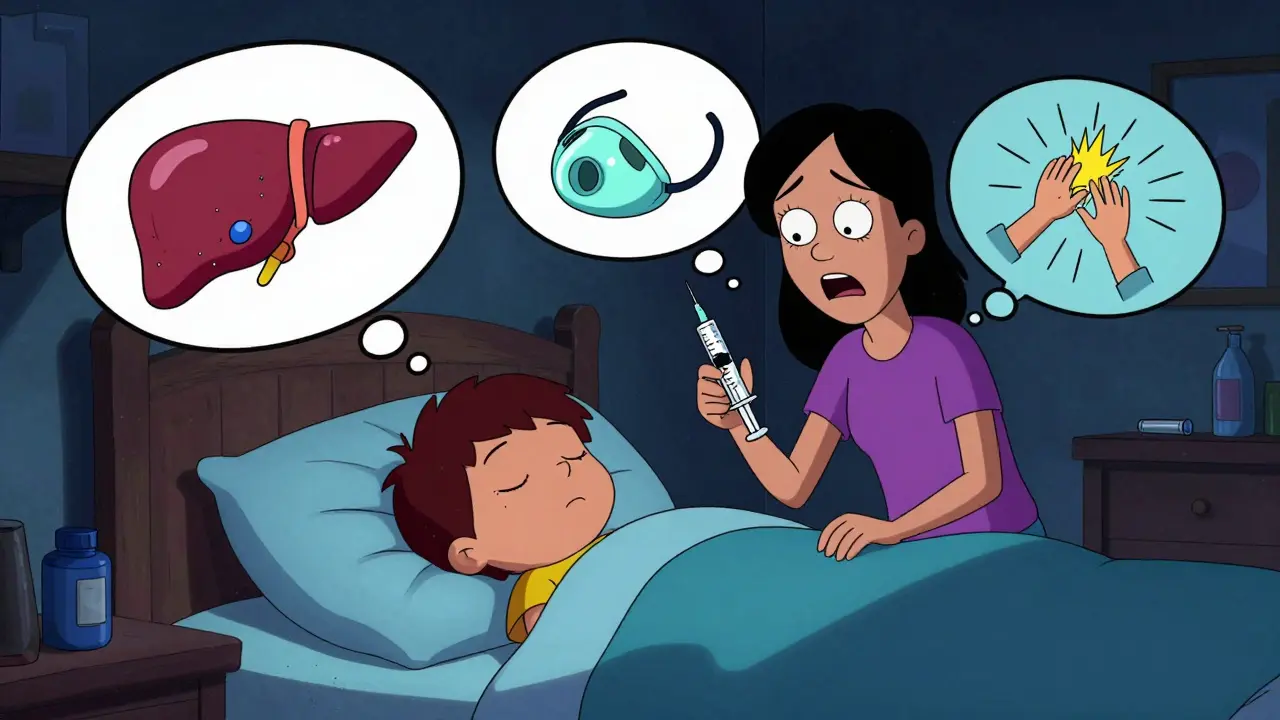
When your child misses a dose of medicine, it’s natural to panic. Did they need that dose? Should you give it now? Should you double up later? These questions are common-and dangerous-if answered wrong. A missed dose isn’t just an oversight; it’s a potential safety risk. In fact, medication errors are behind 11% of all preventable harm in pediatric hospitals, and nearly 36% of those are dosing mistakes. The good news? With clear rules and simple steps, you can handle missed doses safely-every time.
Never Double the Dose
This is the most important rule. Never, ever give two doses at once to make up for a missed one. Children’s bodies process medicine differently than adults. Their livers and kidneys aren’t fully developed, so they can’t clear drugs as quickly. Doubling a dose can lead to serious side effects-drowsiness, breathing trouble, seizures, or even organ damage. Dr. Sarah Verbiest’s 2023 review found that doubling doses increases the risk of severe reactions in kids under 12 by 278%. That’s not a small risk. It’s life-threatening.Even if you think your child didn’t get the full dose-maybe they spit it out or you think they didn’t swallow it-don’t give more. Contact your doctor or pharmacist instead. They’ll tell you if it’s safe to repeat the dose or if you should wait.
Use the Time-Based Rule for Each Dosing Schedule
The timing of the missed dose matters more than how late it is. Different medications have different rules based on how often they’re given. Here’s what to do:- Once-daily meds: If you remember within 12 hours of the usual time, give it. If it’s been more than 12 hours, skip it. Don’t give it the next day early to "catch up." Just go back to the regular schedule.
- Twice-daily meds (every 12 hours): If you miss a dose and it’s been less than 6 hours since it was due, give it. If it’s been more than 6 hours, skip it. For example, if your child’s dose is at 8 a.m. and 8 p.m., and you remember at 3 p.m., skip the evening dose and resume at 8 p.m.
- Three times daily (every 8 hours): If less than 3 hours have passed since the missed dose, give it. If more than 3 hours have passed, skip it. Don’t try to squeeze in three doses in one day.
- Four times daily (every 6 hours): If less than 2 hours have passed, give the missed dose. If more than 2 hours have passed, skip it.
- Every 2-4 hours (like pain or fever meds): If you miss a dose by more than 2 hours, skip it. These meds are often given for symptom control, and giving them too close together can lead to overdose.
These time thresholds come from clinical guidelines used by Children’s Wisconsin, Cincinnati Children’s Hospital, and other leading pediatric centers. They’re based on how long drugs stay active in a child’s body and how quickly they can build up to dangerous levels.
Special Cases: Oncology and High-Risk Medications
Some medications are so sensitive that missing even one dose can affect treatment. This is especially true for chemotherapy, immunosuppressants, and certain antibiotics used for chronic conditions. If your child takes any of these, the rule is simple: call your care team immediately. Don’t guess. Don’t wait. Don’t assume the next dose will fix it. For kids with cancer or serious immune disorders, timing is part of the cure. Missing a dose might mean the treatment doesn’t work as well.High-risk medications-those marked as "red" by safety agencies-are especially tricky. A 2021 review found that 25% of these drugs have no missed dose instructions on their packaging. That’s a gap in the system. If your child’s medication doesn’t say what to do when a dose is missed, contact your pharmacist or doctor before the next dose is due. Don’t rely on guesswork.
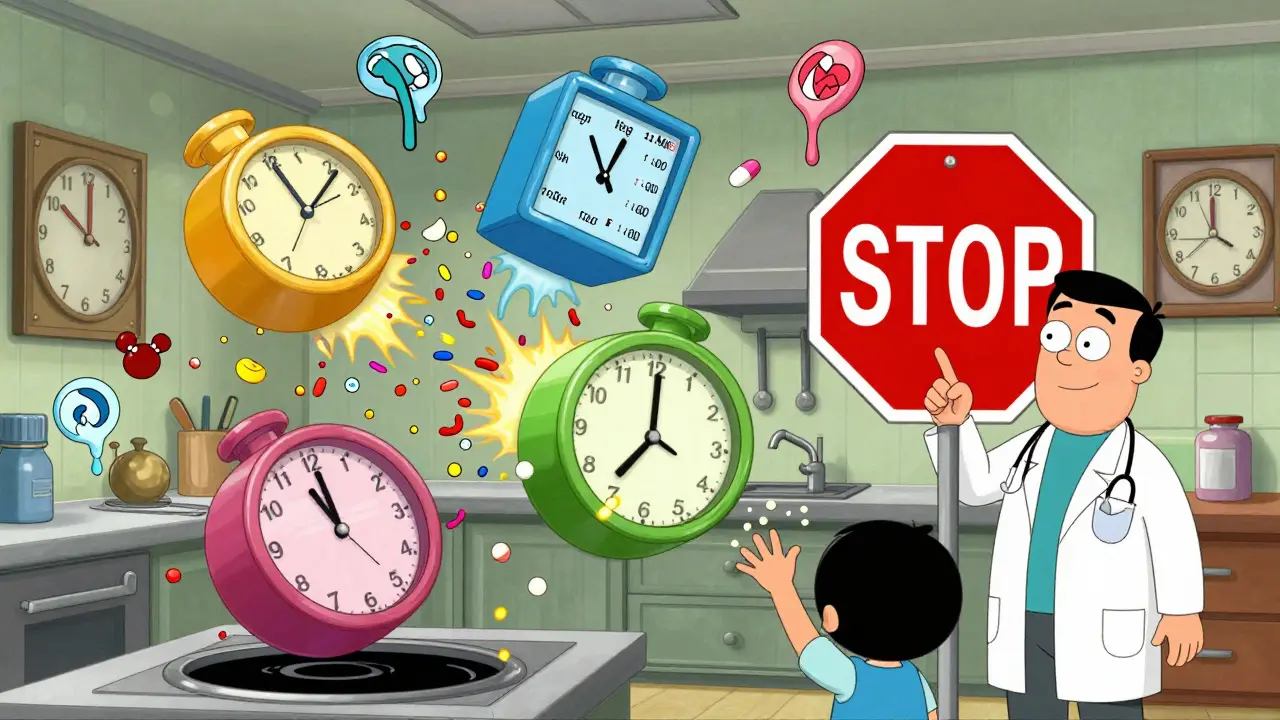
How to Avoid Missed Doses in the First Place
Prevention is better than correction. Here’s how to reduce the chance of missing doses:- Use a pill organizer with alarms. Simple weekly boxes with compartments for morning, afternoon, and night help. Add a phone alarm or use a smart dispenser like those used in clinical trials-they reduce missed doses by 68%.
- Write it down. Keep a daily log. Check off each dose as it’s given. Even if your child is on just one med, writing it down helps you remember.
- Use oral syringes, not spoons. The FDA warns that household spoons vary wildly in size. Using a syringe reduces measurement errors by 58%. Always use the one that came with the medicine.
- Use color-coded charts. If your child takes multiple meds, color-code them. Red for morning, blue for afternoon, green for night. Boston Children’s Hospital found this cuts missed doses by 44%.
- Teach-back method. After your doctor explains the schedule, ask your child to repeat it back-or better yet, have them show you how they’d give the dose. Studies show this improves retention by 37%.
What to Do If You’re Still Unsure
Sometimes, you just don’t know. Maybe your child’s medicine isn’t listed here. Maybe the instructions are vague. Maybe you’re tired, stressed, or overwhelmed. That’s okay. You don’t have to figure it out alone.Call your pharmacist. They’re trained for this. They can look up the exact drug, check its half-life, and tell you whether it’s safe to give the missed dose. Many pharmacies offer free 24/7 medication advice lines.
If it’s after hours and you can’t reach your doctor or pharmacist, and you’re worried about symptoms-like vomiting, dizziness, or trouble breathing-go to urgent care or call emergency services. It’s better to be safe than sorry.

Why This Matters More Than You Think
Medication errors cost the U.S. healthcare system $3.5 billion a year. But the real cost is measured in children’s health. One study found that kids with complex medical needs-those on four or more medications-have a 300% higher chance of making a dosing error. That’s not because parents are careless. It’s because the system isn’t designed for them.Parents on Reddit and parenting forums say they’ve doubled doses "just to stay on schedule," even though they know it’s risky. That’s stress talking. That’s fear talking. But it’s not safe. The goal isn’t to keep perfect records-it’s to keep your child safe.
There are new tools helping. The American Academy of Pediatrics launched a free app in 2023 called the Pediatric Medication Safety Calculator. You enter the medicine, the time missed, and the usual schedule, and it tells you what to do. Beta users saw an 83% improvement in correct decisions. If you have a smartphone, download it. It’s free, no ads, no sign-up.
What to Do After a Missed Dose
After you’ve handled the missed dose, take a moment to reflect:- Did you understand the schedule clearly from the start?
- Was the medicine labeled correctly?
- Did you have a system in place to remind you?
If the answer is no to any of these, talk to your care team. Ask for a written schedule. Ask for a demo on how to use the syringe. Ask for a follow-up visit. You’re not alone. And you’re not failing. You’re learning.
Medication safety isn’t about perfection. It’s about knowing what to do when things go wrong-and having the tools to fix it.


Martin Viau
December 31, 2025 AT 20:14Who the hell wrote this? It's like a pharmaceutical ad disguised as parenting advice. Doubling doses is bad? Shocking. Next you'll tell us water is wet. And why the hell are we trusting Children's Wisconsin like they're the Vatican of pediatric medicine? I've seen kids on chemo get dosed wrong by nurses and live just fine. This is overkill.
Also, that 'Pediatric Medication Safety Calculator' app? Probably built by some Ivy League grad who's never held a crying kid with a fever at 3 a.m. I use my gut. It's worked for 12 years. Don't need an app to tell me my kid isn't dying because I gave Tylenol at 11 instead of 12.
Also, 'use oral syringes' - yeah, right. Try getting a 2-year-old to sit still while you jab a plastic needle into their mouth. Good luck with that. I use a damn spoon. They live. We move on.
Robb Rice
January 2, 2026 AT 18:02Thank you for this comprehensive guide. I appreciate the clinical grounding and clear time-based thresholds - especially the distinction between once-daily and q6h dosing. As a nurse, I’ve seen too many parents double up out of anxiety, and the consequences are often preventable. The reference to Children’s Wisconsin and Cincinnati Children’s adds credibility.
I’d only add: always check the drug’s half-life if possible. For example, ibuprofen’s half-life is 2–4 hours in children, so missing a dose by 3 hours is generally safe to skip - which aligns with your guidelines. Well done.
Harriet Hollingsworth
January 3, 2026 AT 21:34THIS IS WHY OUR KIDS ARE DYING. I DON’T CARE WHAT THE 'CLINICAL GUIDELINES' SAY - IF YOU MISS A DOSE AND YOUR KID IS IN PAIN, YOU GIVE THE MEDICINE. PERIOD. WHO CARES IF THE LIVER CAN'T HANDLE IT? YOUR CHILD IS CRYING. YOU DON'T WAIT FOR A PHARMACIST TO CALL BACK. YOU SAVE THEM. THIS ARTICLE IS A COLD, CALCULATING MANUAL FOR PARENTS WHO HAVE LOST THEIR HEARTS.
My son had a seizure because I followed the 'skip if over 6 hours' rule. He’s fine now. But I’ll never trust a doctor who doesn’t understand that love isn’t measured in half-lives.
Deepika D
January 5, 2026 AT 07:43Hey everyone, I just want to say - you’re not alone. I’m a mom of three, one with epilepsy and two on daily antibiotics, and I’ve been where you are - panicked, exhausted, scrolling at 2 a.m. wondering if I just killed my kid by giving the wrong dose.
Here’s what helped me: I made a color-coded chart with stickers. Red = morning, blue = afternoon, green = night. I put it on the fridge. Every time I gave a dose, my 5-year-old stuck a star on it. We turned it into a game. Now she reminds ME when it’s time.
And yes, I use the oral syringe - even though it’s messy. I keep it in a little pouch with the meds. I don’t trust spoons. Not after my cousin’s kid got a double dose of amoxicillin because of a soup spoon.
Also - download that AAP app. It’s free, no ads, no sign-up. I used it when I missed a dose of my daughter’s seizure med and it told me to wait. I did. She was fine. No drama. No panic. Just calm, smart parenting.
You’re doing better than you think. And if you’re reading this? You’re already trying harder than most. Keep going. You’ve got this. 💪❤️
Bennett Ryynanen
January 6, 2026 AT 15:48Okay but let’s be real - who the fuck has time to follow all this? I work two jobs, my kid has asthma, ADHD, and a peanut allergy, and you want me to calculate half-lives and use color-coded charts? I’m not a pharmacist, I’m a parent. I give the damn pill when I remember. If I’m late, I give it. If I forget, I give it tomorrow. If my kid pukes it up, I give it again. I don’t have time for your 12-step medical protocol.
And yeah, I’ve doubled doses. My kid didn’t die. He’s 8. He’s alive. That’s all that matters. You wanna live in a world of guidelines? Go ahead. I’ll be here with my kid, breathing, eating, laughing - and not scared to give him Tylenol when he needs it.
Chandreson Chandreas
January 8, 2026 AT 01:54Life is messy. Kids are messy. Medicine is messy. 😅
But here’s the thing - the goal isn’t perfection. It’s presence.
I used to stress over every missed dose like it was a cosmic failure. Then I realized: my kid doesn’t care if the dose was 47 minutes late. He cares if I’m calm. If I’m there. If I hold him while he swallows the bitter syrup.
So I use the app. I use the syringe. I write it down. But I don’t beat myself up when I forget. I just reset. One breath. One dose. One day at a time.
And if you’re reading this and feeling guilty? You’re already a better parent than you think. 🙏❤️
Darren Pearson
January 9, 2026 AT 05:51The author’s reliance on institutional guidelines from Children’s Wisconsin and Cincinnati Children’s Hospital is commendable, yet insufficiently contextualized. The statistical references - 278% increase in severe reactions, 83% improvement with the app - are presented without citation of primary literature, rendering them rhetorically persuasive but epistemologically suspect.
Furthermore, the suggestion that parents should defer to pharmacists for half-life calculations assumes a level of medical literacy and access that is neither universal nor equitable. This is not parenting advice - it is technocratic paternalism disguised as empowerment.
One must ask: who benefits from this level of procedural complexity? The pharmaceutical industry? The healthcare system? Or the parent trying to get their child to swallow a pill before school?
Stewart Smith
January 9, 2026 AT 06:52So let me get this straight - if I miss a dose by 1 hour and 59 minutes, I give it. But if I miss it by 2 hours and 1 minute? I’m supposed to let my kid suffer through a fever because some algorithm said so?
Wow. I’m so glad we’ve moved past ‘trust your instincts’ and into ‘trust the spreadsheet.’
Also, I love how the article says ‘don’t double the dose’ like it’s some revolutionary insight. I didn’t know pediatricians were secretly training parents to be pharmacists now. Next they’ll be requiring us to pass a certification exam before we can give aspirin.
Meanwhile, my kid’s still alive. And I didn’t need an app to figure that out. 😴
Retha Dungga
January 10, 2026 AT 04:22we are all just trying to survive here
my kid spits out meds like they're poison
so i mix it with chocolate syrup
and if i miss a dose
i just give it later
or sometimes
i just don't
and we keep going
that's all there is
no charts
no apps
just love and chaos
and somehow
they grow up
even if we mess up
they still love us
so maybe
that's enough
❤️
Jenny Salmingo
January 10, 2026 AT 07:49This is so helpful. I’m from a culture where we don’t talk about meds like this - it’s ‘take what the doctor says’ and that’s it. But I’ve seen friends lose kids because they didn’t know what to do when a dose was missed.
I shared this with my mom. She cried. Said she wished someone had told her this when she was raising my cousin. I printed it out and taped it to the fridge.
Thank you for writing this like a human, not a textbook. We need more of this - simple, clear, kind.
Aaron Bales
January 10, 2026 AT 15:29Stick to the time windows. Skip if you’re past them. Call if unsure. That’s it.
No charts. No apps. No guilt.
Just follow the rules. You’re not failing. You’re learning.
And if you’re still worried? Call the pharmacist. They’re paid to answer this exact question.
Lawver Stanton
January 11, 2026 AT 03:20Okay, but let’s talk about the real elephant in the room - the fact that 25% of high-risk meds don’t even have missed-dose instructions on the packaging. That’s not an oversight. That’s negligence. That’s corporate greed dressed up as medical science. Why the hell are we letting pharmaceutical companies get away with printing labels that don’t tell parents how to handle the most common mistake? It’s like selling a car without a manual and then blaming the driver when they crash.
And don’t get me started on the ‘Pediatric Medication Safety Calculator’ app. It’s free? No ads? No sign-up? That’s not a tool - that’s a PR stunt. The same companies that make these dangerous meds are funding the ‘solution’ so they can say, ‘Look, we care!’ while their profit margins stay untouched.
Meanwhile, parents are still Googling ‘what to do if I gave two doses of amoxicillin’ at 3 a.m. with a screaming child and no phone signal. This isn’t guidance. It’s a bandage on a bullet wound.
Sara Stinnett
January 12, 2026 AT 02:33How quaint. A step-by-step guide to parenting, as if children are robots that respond to algorithmic dosing schedules. You’ve turned a deeply human experience - the panic, the exhaustion, the love, the fear - into a clinical checklist. And you call it ‘safety.’
Let me guess - you’ve never held a child who’s convulsing because you waited 6 hours to give the second dose. You’ve never stared at a pill bottle and wondered if you’re killing them by giving it - or killing them by not giving it.
These guidelines are written by people who’ve never changed a diaper at 4 a.m. They assume parents have time, access, and emotional bandwidth. They assume we’re not drowning.
Real safety isn’t in the half-life. It’s in the arms that hold them. In the tears that fall on the syringe. In the whispered, ‘I’m sorry, baby, I forgot.’
Don’t tell parents how to grieve their mistakes. Tell the system to stop making them.