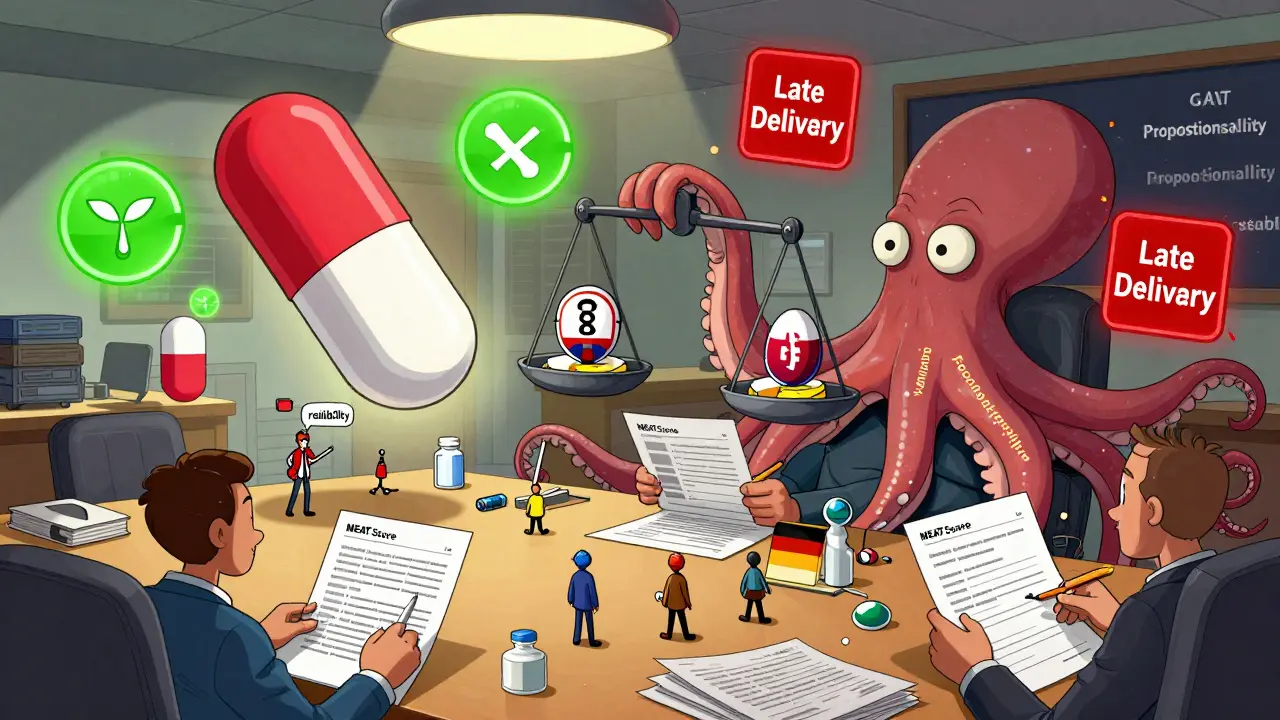
How Europe Buys Generic Drugs - And Why It Matters
Every year, European governments spend over €2 trillion on public contracts. About 14% of that - roughly €280 billion - goes to healthcare. And a huge chunk of that? Generic medicines. But here’s the thing: they don’t just buy them off the shelf. They run tendering systems - formal, legal, competitive bidding processes that decide who gets to supply hospitals, pharmacies, and clinics across the EU.
This isn’t about who offers the lowest price. It’s about who offers the best value. And that’s where Europe’s approach gets interesting - and complex.
The Rules: A Single Market, One Set of Laws
Europe doesn’t have 27 different ways to buy generics. It has one unified system built on EU directives. The current rules come from Directive 2014/25/EU, which applies to public utilities - including state-run health services. These rules force all member states to follow the same core principles: transparency, non-discrimination, and proportionality.
Proportionality is key. If a hospital needs €500,000 worth of generic antibiotics, they can’t require suppliers to have €10 million in annual revenue. That’s illegal. The requirements must match the scale of the contract. This opens the door for smaller, specialized manufacturers - often the ones producing the cheapest generics - to compete with big pharma.
All tenders above a certain value (usually €100,000 for health goods) must be published in the Tenders Electronic Daily (TED), the EU’s central public portal. That means a pharmacy chain in Poland can bid on a contract in Portugal. A manufacturer in Slovakia can supply generics to a German state hospital. Cross-border competition is built into the system.
The Four Main Ways Europe Tenders for Generics
There are four main tendering procedures used across the EU. Each has its own use case - and its own trade-offs.
- Open Procedure: Any supplier can submit a bid. No pre-qualification. It’s the most transparent and competitive - but also the most paperwork-heavy. About 45% of EU health tenders use this method. It’s common for simple, high-volume purchases like paracetamol or metformin.
- Restricted Procedure: Suppliers first apply to be pre-qualified. Only those who pass get to submit a full bid. This cuts down on the number of bids authorities have to review. About 35% of tenders use this. It’s popular for mid-sized contracts where authorities want efficiency without sacrificing fairness.
- Competitive Negotiated Procedure: Used when the requirements are too complex for a standard bid. Maybe the drug needs special storage, or it’s part of a bundled service like home delivery. Negotiations happen after initial bids. Only 20% of tenders use this, but it’s growing in areas like rare disease treatments.
- Competitive Dialogue: For truly complex or innovative procurements. Authorities don’t even know exactly what they need at the start. They talk to suppliers, refine the specs together, then choose the best solution. This is rare in generics - but not unheard of, especially when integrating digital monitoring tools with drug delivery.
Most generic drug tenders stick to Open or Restricted. Why? Because the product is well-defined. The active ingredient is the same. The packaging is standard. There’s little room for innovation - just cost and reliability.
It’s Not Just About Price: The MEAT Rule
Here’s where Europe breaks from the rest of the world. Most countries just pick the lowest bid. Europe doesn’t. It uses MEAT - Most Economically Advantageous Tender.
MEAT means evaluating more than just price. Quality, delivery time, reliability, environmental impact, even after-sales support - all get scored. For generics, that often means:
- Supplier’s track record for on-time delivery
- Quality control certifications (GMP compliance)
- History of regulatory violations
- Ability to supply during shortages
- Use of sustainable packaging
A 2023 study by the European Public Procurement Observatory found that authorities using MEAT properly saw 15.7% higher innovation in their contracts - even for generics. How? Because suppliers started investing in better logistics, digital tracking, and packaging to stand out.
Since 2022, EU rules require that at least 50% of the score in any tender over €1 million must be based on non-price factors. That’s huge. It means a supplier offering €0.01 less per pill won’t automatically win if their delivery record is shaky.
Who Wins? Who Loses?
Small and mid-sized generic manufacturers in Eastern Europe - Poland, Hungary, Romania - have become major players. Why? Because they’re lean, efficient, and often produce the same active ingredients as big Western brands, but at 60-80% lower cost.
But it’s not easy. A 2023 Eurochambres survey found that small businesses spend an average of 117 hours preparing a single tender. That’s nearly three full workweeks. For a company with five employees, that’s a huge investment.
Some win big. A Belgian generics maker, Medipharma, qualified for a multi-supplier framework agreement with the Dutch national health service. They went from bidding on 15 contracts a year to getting automatic access to 60 mini-tenders - all pre-approved. Their sales jumped 40% in two years.
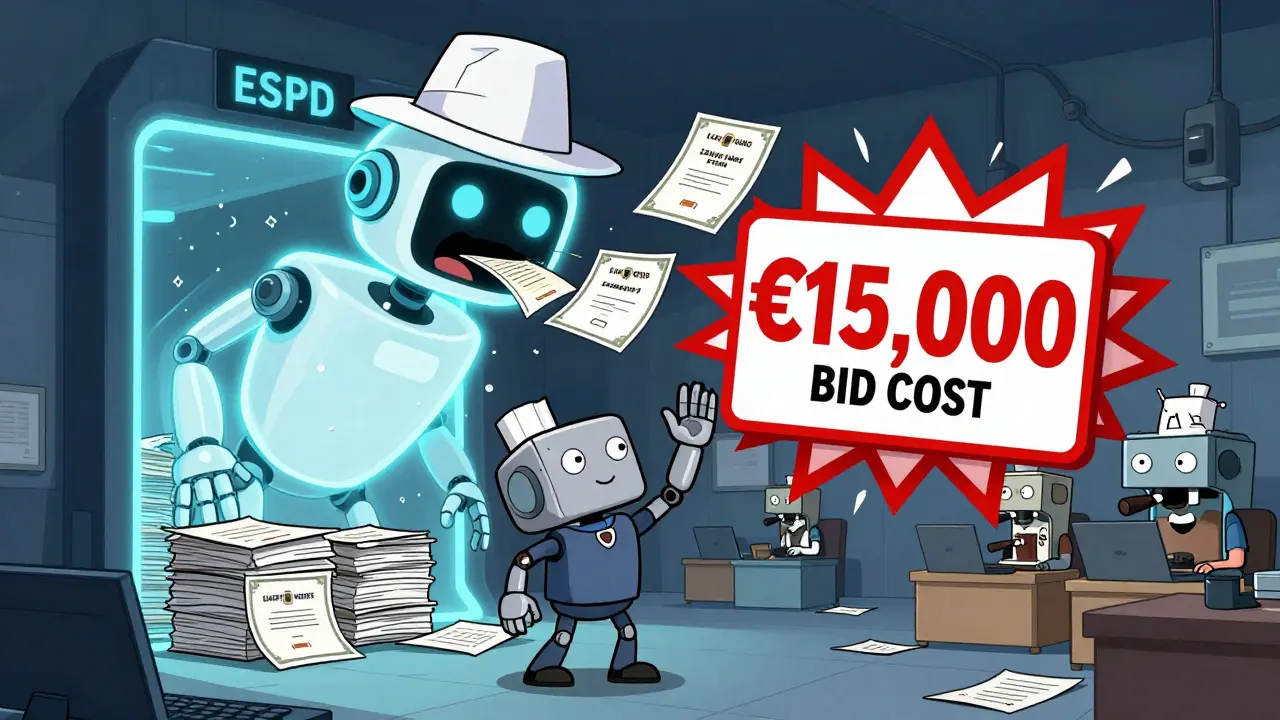
Others get burned. A French SME spent €15,000 on documentation to join a framework for insulin pens. They got one mini-tender in 18 months. The cost of bidding far outweighed the return.
That’s why many small firms now rely on consortiums - teaming up with other suppliers to share the administrative load. Or they use digital platforms that auto-fill EU tender forms using templates.
The Digital Shift: How Tech Is Changing the Game
Europe is moving fast on e-procurement. In 2016, only 39% of health tenders were done online. By 2023, that jumped to 76%. The European Single Procurement Document (ESPD) lets suppliers submit all their certifications - tax records, quality audits, financial stability - in one digital form. It cuts paperwork by 40%.
Some countries are ahead. The Netherlands and Denmark have near-perfect digital portals. Suppliers can search, filter, and submit bids in under 20 minutes. In contrast, some Eastern European systems still require printed documents and physical signatures.
AI is starting to play a role too. Pilot programs in Finland and France now use algorithms to score bids - checking for consistency, flagging suspiciously low prices, and even predicting delivery risks based on supplier history. These systems cut evaluation time by 30% and reduce human bias.
Sustainability Is No Longer Optional
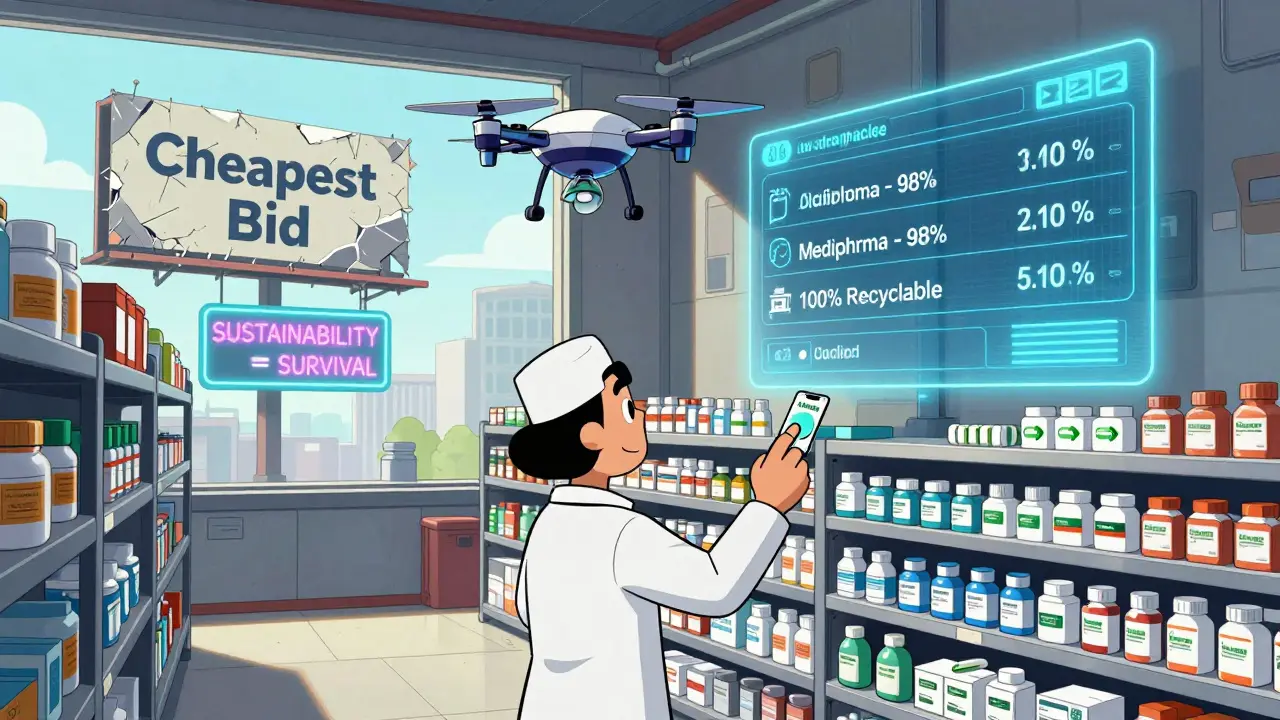
By 2025, 85% of high-value health tenders in Europe will include sustainability criteria. That means:
- Carbon footprint of manufacturing and transport
- Use of recyclable or biodegradable packaging
- Waste reduction in production
- Responsible sourcing of raw materials
One German hospital recently awarded a contract for generic asthma inhalers not just because it was cheapest - but because the supplier used 100% recyclable plastic and had a take-back program for used devices. The price was 7% higher. The hospital accepted it. Why? Because they’re legally required to consider environmental impact.
It’s not just greenwashing. The EU has made it clear: public money should support sustainable economies. Generics manufacturers who ignore this risk being left out of future tenders.
The Big Challenge: Fragmentation
Despite the rules, implementation varies wildly. In Nordic countries, 92% of tenders are fully electronic. In Southern Europe, it’s 43%. Some countries interpret proportionality strictly. Others allow vague requirements that quietly favor big local firms.
The European Court of Justice has issued 147 rulings on procurement since 2022 - mostly to fix these inconsistencies. One case in Spain canceled a €180 million rail signaling contract because the technical specs were too vague. Another forced a French region to reopen a tender after it unfairly favored a local supplier.
The biggest risk? Fragmentation. If suppliers can’t trust that the rules are applied equally across borders, the single market breaks down. That’s why the EU is pushing for mandatory training for all public procurement officers by 2027.
What’s Next?
By 2028, 75% of high-value health tenders in Europe will include circular economy criteria. That means suppliers will need to prove they’re designing products for reuse, recycling, or safe disposal - not just making pills.
AI-driven evaluation will become standard. Real-time supplier performance dashboards will be linked to contracts - if a company misses three deliveries, they get automatically flagged.
And the pressure to cut costs? It’s only growing. With aging populations and rising drug demand, European health systems need generics more than ever. But they won’t just buy the cheapest. They’ll buy the most reliable, the most sustainable, and the most transparent.
The tendering system isn’t perfect. It’s slow. It’s bureaucratic. But it’s the reason Europe can offer affordable, high-quality generics to millions - without sacrificing fairness or accountability.
What is the difference between a tender and a regular purchase in Europe?
A regular purchase is a simple buy - like a hospital ordering 1,000 boxes of paracetamol from a known supplier. A tender is a formal, public process where multiple suppliers compete under strict rules. It’s required for contracts above €100,000 and ensures transparency, competition, and value for public money.
Why don’t European hospitals just buy the cheapest generic?
Because the cheapest option isn’t always the best. A drug might be cheaper, but if the supplier has a history of late deliveries, poor quality control, or environmental violations, the hospital could face stockouts, patient risks, or legal penalties. MEAT evaluation looks at total value - not just price.
Can small generic manufacturers compete in EU tenders?
Yes - and they often win. Many of Europe’s lowest-priced generics come from small manufacturers in Poland, Hungary, and Romania. The rules prohibit unfair requirements like minimum revenue thresholds. But they need to be organized: digital tools, consortiums, and certified procurement staff help them compete.
What is the ESPD and why does it matter?
The European Single Procurement Document (ESPD) is a digital form that lets suppliers declare their eligibility - financial health, legal compliance, quality certifications - in one place. It replaces dozens of paper documents. It cuts submission time by 40% and makes cross-border bidding much easier.
Are sustainability requirements making generics more expensive?
Sometimes, but not always. Many suppliers are finding ways to cut costs while going green - like using lighter packaging that reduces shipping emissions, or switching to solar-powered manufacturing. In the long run, sustainable practices often lead to efficiency gains. Plus, buyers now prioritize reliability and ethics over a few cents per unit.

Jamillah Rodriguez
February 3, 2026 AT 17:24Susheel Sharma
February 4, 2026 AT 04:52Janice Williams
February 5, 2026 AT 16:41Roshan Gudhe
February 7, 2026 AT 09:19Rachel Kipps
February 9, 2026 AT 00:13Wendy Lamb
February 9, 2026 AT 12:46Antwonette Robinson
February 11, 2026 AT 02:21Ed Mackey
February 12, 2026 AT 19:36Katherine Urbahn
February 14, 2026 AT 17:58