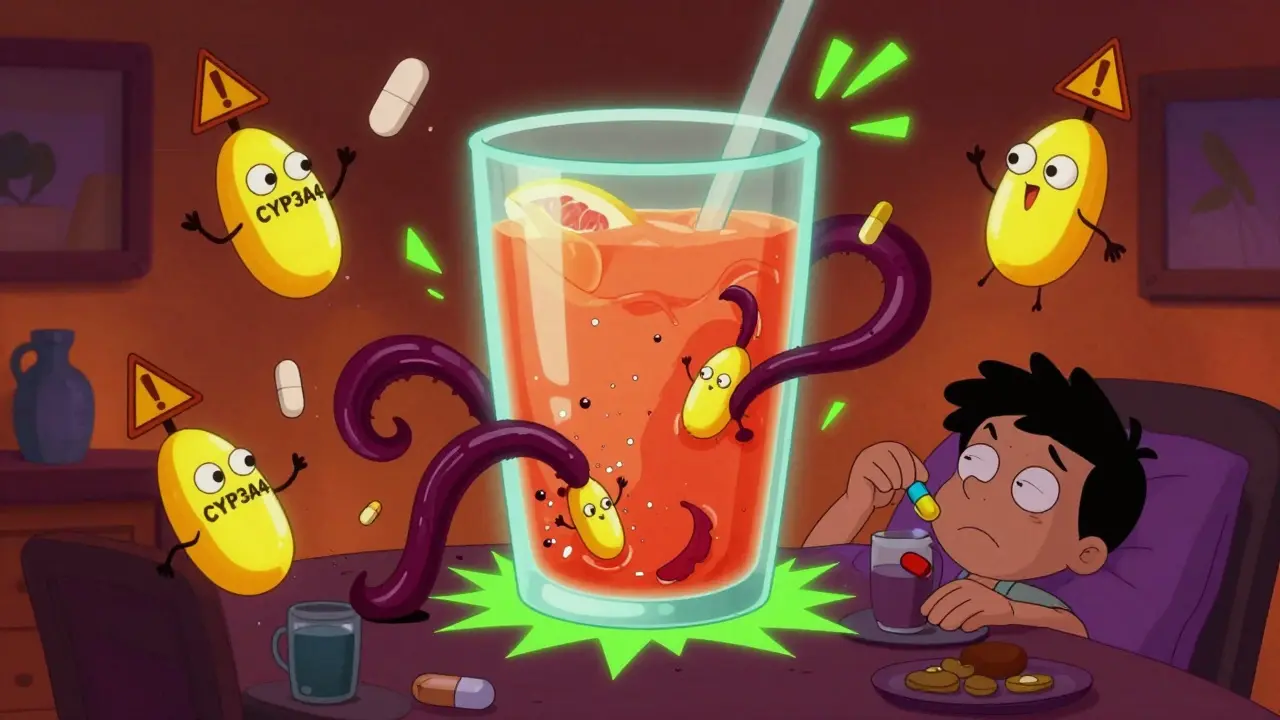
One glass of grapefruit juice in the morning might seem like a healthy start-until it turns into a silent danger if you’re taking certain medications. This isn’t just a myth or a warning on a label you skim over. It’s a real, measurable, and sometimes life-threatening interaction that affects more than 85 medications, with nearly half of them carrying serious risks. And it’s not about sugar or acidity. It’s about your body’s ability to process drugs-and grapefruit juice quietly shuts down that process.
How Grapefruit Juice Disrupts Your Medications
The culprit isn’t the fruit itself, but a group of natural chemicals called furanocoumarins, mainly bergamottin and 6',7'-dihydroxybergamottin. These compounds don’t just sit in your stomach. They target a key enzyme in your small intestine called CYP3A4. This enzyme is responsible for breaking down about half of all prescription drugs before they even enter your bloodstream. When furanocoumarins hit it, they don’t just slow it down-they permanently disable it. Your body has to make new enzymes to replace them, and that takes about three days. The result? More of your medication gets absorbed than intended. For example, if you take simvastatin (a cholesterol drug) with grapefruit juice, your blood levels of the drug can spike by 330%. That’s not a small increase-it’s enough to raise your risk of severe muscle damage, kidney failure, or even death. Even a single 200mL glass (about 6.8 fluid ounces) is enough to trigger this effect. And it doesn’t matter if it’s fresh, frozen, or from concentrate. All forms contain the same dangerous compounds.Which Medications Are Most at Risk?
Not all drugs are affected the same way. Some are highly vulnerable. Others aren’t touched at all. The difference comes down to how the drug is processed in your body.- Statins: Simvastatin, lovastatin, and atorvastatin are all broken down by CYP3A4. Taking them with grapefruit juice can lead to dangerous muscle breakdown (rhabdomyolysis). Pravastatin, rosuvastatin, and fluvastatin? Safe. They use different metabolic pathways.
- Calcium channel blockers: Felodipine and nifedipine can see their blood levels jump by 300-800% with grapefruit juice. Amlodipine? No significant interaction. The difference lies in how much each drug relies on intestinal CYP3A4 for its first pass.
- Benzodiazepines: Oral midazolam (used for sedation) can increase by 515%. Triazolam? A 52% rise. Both are risky, but the scale of danger varies.
- Immunosuppressants: Cyclosporine and tacrolimus-critical for transplant patients-can reach toxic levels, leading to kidney damage or nerve problems.
- Antiarrhythmics: Amiodarone can spike 80%, increasing the risk of irregular heart rhythms.
Why This Isn’t Just a “Be Careful” Warning
This isn’t theoretical. Between 2000 and 2019, 12 people in the European Union died from grapefruit-drug interactions. In the U.S., the FDA now requires warning labels on 21 high-risk medications, including Zocor (simvastatin), Plendil (felodipine), and Neoral (cyclosporine). Around 19% of all prescription labels carry grapefruit warnings today-up from 12% in 2015. The real problem? Most people don’t know. A 2021 study found only 28% of patients could correctly identify which of their meds were affected-even after being told. And 47% of patients on high-risk drugs still drink grapefruit juice after being warned. Among those over 65, the number jumps to 63%. Older adults are especially vulnerable because they’re more likely to take multiple medications, have reduced liver and kidney function, and may not realize how long the effect lasts.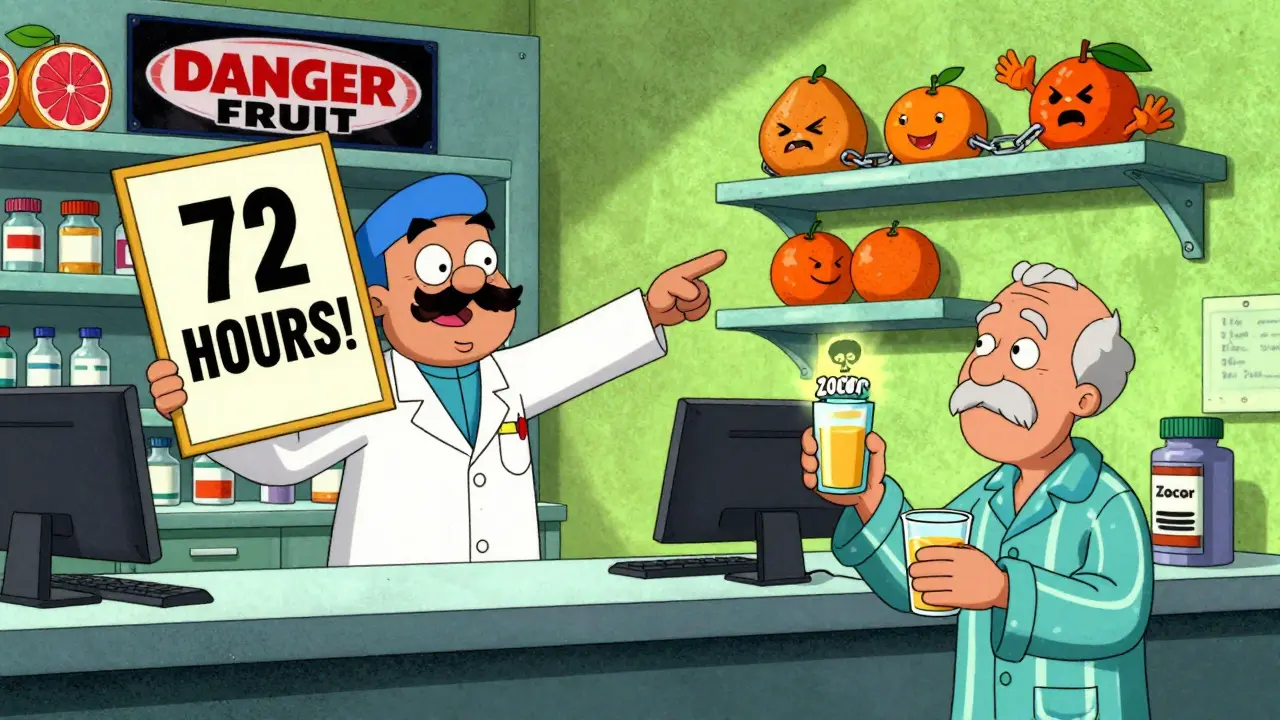
How Long Does the Effect Last?
Many think, “I’ll just drink my juice two hours before my pill.” That doesn’t work. Because the enzyme inhibition is irreversible, the damage lasts until your body makes new CYP3A4 enzymes. That takes about 72 hours. So if you take your blood pressure medication on Monday morning, drinking grapefruit juice on Friday morning could still be dangerous. The University of Florida’s 2022 guidelines recommend avoiding grapefruit products entirely for 72 hours before and during treatment with affected drugs. For drugs affected by OATP inhibition-like fexofenadine (Allegra)-a 4-hour gap might be enough. But unless you know exactly how your drug works, the only safe choice is complete avoidance.What About Other Citrus Fruits?
Not all citrus is the same. Regular oranges, tangerines, and clementines? Safe. They don’t contain furanocoumarins. But Seville oranges (used in marmalade) and pomelos? Just as dangerous as grapefruit. They contain the same chemicals. So if you’re on a high-risk medication, skip the marmalade on your toast.
What Can You Do?
If you’re taking any prescription medication, here’s what to do:- Check your label. If it says “avoid grapefruit juice,” don’t ignore it.
- Ask your pharmacist. They’re trained to spot these interactions and can tell you if your meds are risky.
- Don’t assume “it’s just one glass.” Even small amounts matter.
- If you love citrus, switch to oranges, tangerines, or lemon water.
- If your doctor prescribes a new drug, ask: “Is grapefruit juice safe with this?” Don’t wait for them to tell you.
What’s Changing in 2025?
Science is catching up. Researchers at the University of Florida are testing CRISPR-edited grapefruit varieties that lack furanocoumarins-still in trials, but promising. The FDA’s 2024 Patient Communication Plan will soon require clearer, standardized warnings on all high-risk prescriptions. And for the first time, genetic testing is being explored to predict who’s most at risk. A variant called CYP3A4*22 makes people more sensitive to grapefruit’s effects. In the future, your DNA might tell you whether you’re in the 0% or 800% risk group. But right now? The safest rule is simple: if your medication warns against grapefruit, avoid it completely. No exceptions. No compromises. Because this isn’t about flavor. It’s about survival.Can I drink grapefruit juice if I take my medication at night?
No. Grapefruit juice disables intestinal enzymes for up to 72 hours. Taking your medication at night doesn’t help if you drank juice in the morning-or even two days ago. The enzyme damage lasts until your body makes new ones, which takes about three days. Avoid grapefruit entirely while on affected medications.
Is fresh grapefruit worse than juice?
No. Fresh fruit, juice, frozen concentrate, and even grapefruit-flavored products all contain the same active compounds-furanocoumarins. The amount in one whole grapefruit or 200mL of juice is enough to cause an interaction. It’s not about form-it’s about the chemicals.
Do all statins interact with grapefruit juice?
No. Only simvastatin, lovastatin, and atorvastatin are affected because they rely on the CYP3A4 enzyme. Pravastatin, rosuvastatin, and fluvastatin are metabolized differently and are safe to take with grapefruit juice.
Can I take grapefruit juice with blood pressure meds?
Some can be dangerous. Felodipine and nifedipine can cause dangerously low blood pressure or heart rhythm problems when mixed with grapefruit juice. Amlodipine, however, is not affected. Always check your specific medication label or ask your pharmacist.
Why don’t doctors always warn patients about this?
Many don’t realize how common and serious this is. A 2021 study found only 37% of pharmacists consistently warn patients. Doctors may assume patients know, or they’re focused on other risks. But grapefruit interactions cause 1.3% of all reported drug adverse events globally. It’s under-recognized, not under-reported.

sharad vyas
January 1, 2026 AT 21:15My grandfather in India used to say, 'What the body doesn't know, the medicine can't hurt.' He drank grapefruit juice with his blood pressure pills and lived to 92. Maybe the body adapts? Or maybe we're overcomplicating nature.
Not saying ignore science. But maybe there's more to this than enzymes and labels.
Sally Denham-Vaughan
January 2, 2026 AT 16:55Ugh I just realized I’ve been drinking grapefruit juice with my statin for 3 years 😳
Thanks for this post-going to call my pharmacist right now. Also, orange juice is my new BFF now 🍊❤️
Bill Medley
January 4, 2026 AT 15:25Scientific consensus confirms irreversible CYP3A4 inhibition by furanocoumarins. Duration exceeds 72 hours. Clinical guidelines recommend complete avoidance. No exceptions.
Ann Romine
January 4, 2026 AT 18:18I wonder if this interaction varies by ethnicity or gut microbiome. I’ve read studies suggesting Asian populations metabolize some drugs differently. Could that affect grapefruit sensitivity?
Just thinking out loud. Would love to see more research on that.
Todd Nickel
January 5, 2026 AT 04:53It’s fascinating how something so natural-something we’re told is ‘healthy’-can have such a profound and dangerous effect on pharmaceuticals. The irony is thick here. We’ve built this entire medical infrastructure around precision dosing, bioavailability, metabolic pathways… and then we go and drink a glass of fruit juice that casually disables a key enzyme like it’s turning off a light switch.
And it’s not just grapefruit. It’s the entire illusion of ‘natural equals safe.’ That’s the real danger. People think if it’s organic, or cold-pressed, or from a local farm, it can’t hurt. But biology doesn’t care about your farmer’s market credentials. The furanocoumarins don’t read the label that says ‘100% pure.’ They just do their job-destroying CYP3A4 like tiny molecular saboteurs.
And the 72-hour window? That’s the kicker. It’s not a one-time thing. It’s a lingering ghost in your gut. You think you’re being careful by spacing it out, but your enzymes are still down. Your body doesn’t have a reset button. It has to rebuild from scratch. That’s not just inconvenient-it’s terrifying when you realize how many people are walking around thinking they’re fine because they drank it ‘two hours ago.’
And then there’s the cultural side. In the U.S., we treat citrus like a morning ritual. But in other places, it’s just fruit. Maybe we’ve over-romanticized it. Maybe the real problem isn’t the juice-it’s how we’ve made it a symbol of health, when in reality, it’s just a biochemical wildcard.
Also, I’m now checking every single one of my meds. Just in case.
Austin Mac-Anabraba
January 6, 2026 AT 19:38People are idiots. You read a warning label and still do it? You’re not ‘health-conscious,’ you’re just dumb. This isn’t rocket science. It’s not even biology-it’s basic reading comprehension. And now you want to blame doctors? They’ve been screaming it for decades. The problem isn’t the system. The problem is the people who think they’re smarter than science.
And don’t even get me started on ‘but my grandpa drank it and lived to 90.’ Yeah, and he also smoked three packs a day. Congrats, you’re a survivor of bad decisions. That doesn’t make it safe.
Phoebe McKenzie
January 7, 2026 AT 19:56THIS IS WHY WE CAN’T HAVE NICE THINGS.
Big Pharma doesn’t want you to know this because if people stopped drinking grapefruit juice, they’d have to make NEW drugs that DON’T interact with fruit. And that would cost them BILLIONS.
They’re letting people die so they can keep selling the same toxic pills. And now they’re putting ‘warnings’ on labels like that’s enough? LMAO. I bet they don’t even put the warning in bold. It’s probably in 6-point font under ‘other side effects.’
They want you to think it’s YOUR fault for drinking juice. But it’s THEIR fault for making drugs that break with a single glass of citrus. I’m calling my senator.
Also, I’m boycotting all pharmaceuticals. Going full herbal. 🌿😤
gerard najera
January 9, 2026 AT 15:1472 hours. Not 12. Not 24. 72.
Stephen Gikuma
January 11, 2026 AT 07:42Who controls the grapefruit supply? Why is this only a problem in the West? Why don’t we hear about this in China or Russia? Something’s not right.
And why did the FDA only start requiring labels in 2015? Coincidence? I think not. This is a controlled distraction. They want you to focus on juice while they quietly replace your meds with something else.
Also, ‘Seville oranges’? That’s a Spanish name. Who’s pushing this? The EU? The UN? This smells like globalist agenda.
Dusty Weeks
January 12, 2026 AT 13:34bruh i just drank grapefruit juice with my blood pressure med and now i’m scared 😭😭😭
is it too late?? i’m gonna go google ‘how to survive grapefruit overdose’
pls someone tell me i’m not gonna die 😭🍊
Richard Thomas
January 12, 2026 AT 16:12There’s something deeply human about this whole thing. We’re taught to trust our bodies, to listen to nature, to eat clean and fresh. And then we’re told that one of the most natural, wholesome things we can consume-juice from a fruit, sunshine and rain turned into liquid-can quietly sabotage the very medicine keeping us alive.
It’s a collision of two truths: science says one thing, instinct says another. We want to believe that health is simple. Eat well. Avoid sugar. Drink juice. But biology doesn’t care about our intentions. It doesn’t care if you’re trying to be healthy. It just reacts.
And the worst part? The effect lasts three days. That’s longer than a weekend. Longer than a work week’s worth of breakfasts. It means you can’t just ‘time it right.’ You have to give up something you love, not for a day, but for as long as you’re on the drug. That’s not a warning-it’s a sacrifice.
I used to drink grapefruit juice every morning. Now I drink orange. It’s not the same. But I’m alive. And that’s the only thing that matters.
Maybe the real lesson isn’t about enzymes or labels. Maybe it’s about humility. We think we control our health. But sometimes, the smallest thing-the simplest pleasure-can remind us how little control we really have.