Carrying prescription medications across international borders isn’t just about packing your pills. If your meds contain controlled substances-like opioids, stimulants, benzodiazepines, or ADHD medications-you’re entering a legal gray zone that can lead to detention, fines, or even jail time-even if you have a valid prescription. The problem isn’t the medicine. It’s the paperwork.
Why a Doctor’s Letter Isn’t Optional
Every country has its own rules about what drugs are allowed in. The international system behind these rules goes back to treaties from the 1960s and 70s, like the 1961 Single Convention on Narcotic Drugs and the 1971 Convention on Psychotropic Substances. These treaties let countries restrict drugs to stop abuse, but they also allow exceptions for travelers with real medical needs. The catch? You need proof.The International Narcotics Control Board (INCB) says 142 countries have formal rules for travelers carrying controlled substances. And according to the CDC’s 2023 Yellow Book, 68% of medication-related travel incidents happen because people didn’t bring the right letter. That’s not a small risk. That’s the difference between a smooth airport check-in and a 14-day detention.
What Goes in a Proper Doctor’s Letter
A generic note from your doctor won’t cut it. The letter must include specific details that match international standards. Here’s what it needs:- Your full name and date of birth (must match your passport)
- Full name, license number, and contact info of your prescribing doctor
- Generic name of each medication (not brand names-Adderall becomes amphetamine, Xanax becomes alprazolam)
- Dosage, frequency, and route of administration (e.g., 10 mg oral tablet, once daily)
- Clear statement of your medical condition (e.g., “treatment for attention deficit hyperactivity disorder”)
- A formal request that you be allowed to carry these medications for personal medical use
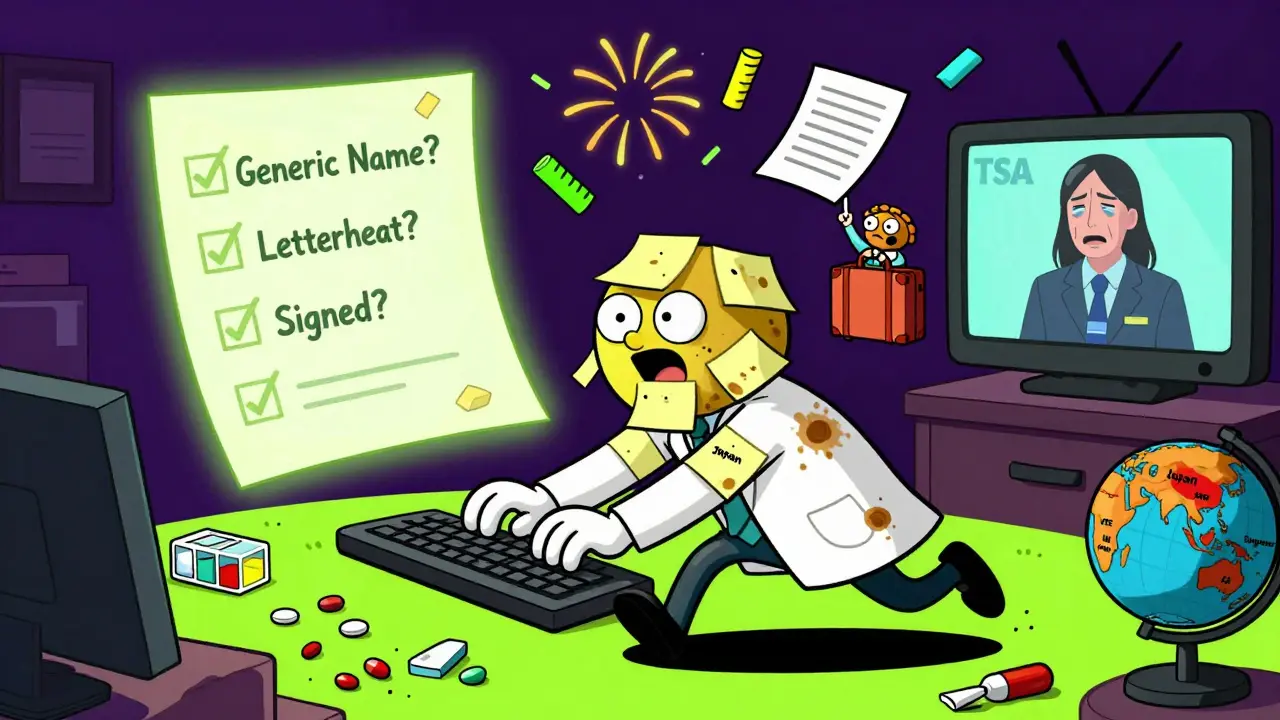
The letter must be printed on official letterhead, signed, and dated. No emails. No handwritten notes. No templates you found online unless they’re from the CDC or WHO. The DEA and FDA require this level of detail for Schedule II-V drugs. If your doctor skips the generic name or doesn’t state the medical condition clearly, you’re at risk.
Quantity Limits and Packaging Rules
You can’t just bring a year’s supply. The FDA and U.S. Customs and Border Protection (CBP) recommend no more than a 90-day supply for personal use. Some countries are stricter. Singapore and Malaysia allow only 30 days’ worth-even with a letter. Exceed that, and you could face criminal charges.Medications must be in their original containers with the pharmacy label showing your name, the drug name, and dosage. This is non-negotiable. If you’ve transferred pills to a pill organizer, you need a separate letter for each medication and the original bottles in your luggage. The FDA says you must maintain a 1:1 match between your letter and your pills. One letter per drug. No exceptions.
Country-Specific Rules You Can’t Ignore
Not all countries treat doctor’s letters the same. Here’s what you need to know:- Japan: Adderall, Ritalin, and other amphetamine-based ADHD meds are banned outright-even with a letter. Many common U.S. prescriptions are illegal there.
- United Arab Emirates: You need advance approval from the Ministry of Health. Apply at least 30 days before travel. A letter alone won’t get you through.
- European Union: Most EU countries recognize doctor’s letters from other EU nations. You still need the original packaging and a 90-day limit.
- United States: If you’re returning to the U.S. with meds bought abroad, you need both a letter and a valid U.S. prescription. The FDA doesn’t allow foreign prescriptions.
- Canada: Accepts doctor’s letters alone for up to 100 dosage units. No prescription needed if the letter is complete.
And don’t assume your destination’s embassy website has accurate info. The U.S. Department of State found that 58% of travelers rely on outdated or incorrect sources. Always check the official government health or customs website of your destination country. Look for phrases like “importation of controlled substances” or “medications for personal use.”
What Happens If You Get Caught Without the Right Paperwork
In 2022, the INCB documented 127 cases where travelers were detained because their medical documentation was incomplete or missing. Average detention time? 14.3 days. That’s not a delay. That’s a disruption to your job, your family, your health.Dr. Ghada Wible of UNODC says the absence of proper documentation is the single biggest cause of traveler detention related to medication. And it’s not just about opioids. The most common drugs involved are stimulants (22%), benzodiazepines (19%), and ADHD meds (89% of countries require special documentation for these).
Even if you’re not arrested, you could be held for hours while officials verify your letter. Airlines may refuse to board you. Your meds could be confiscated. You might be forced to buy replacements at inflated prices abroad-assuming they’re even available.
How to Get It Right
Start early. At least two months before your trip. Here’s your step-by-step plan:- Make a complete list of all your medications, including generic names, dosages, and why you take them.
- Call your doctor’s office and ask them to write a letter using the CDC’s template (available online since 2019). Don’t assume they know what to write-many don’t.
- Verify the letter includes all required elements. If it doesn’t, ask for a revision.
- Check your destination country’s official health or customs website. Don’t rely on travel blogs or forums.
- Contact the country’s embassy or consulate. Ask: “What are the exact requirements for bringing [generic drug name] into your country?” Get their answer in writing.
- Pack your meds in original bottles with labels intact. Bring extra copies of your letter. Keep one in your carry-on, one in your checked bag.
- If you’re flying with multiple controlled substances, bring a separate letter for each one.
A 2022 survey by the International Association for Medical Assistance to Travellers found that 72% of physicians fail to provide complete medication details. Don’t be one of the people who assume your doctor will handle it. Take charge.
What’s Changing in 2025
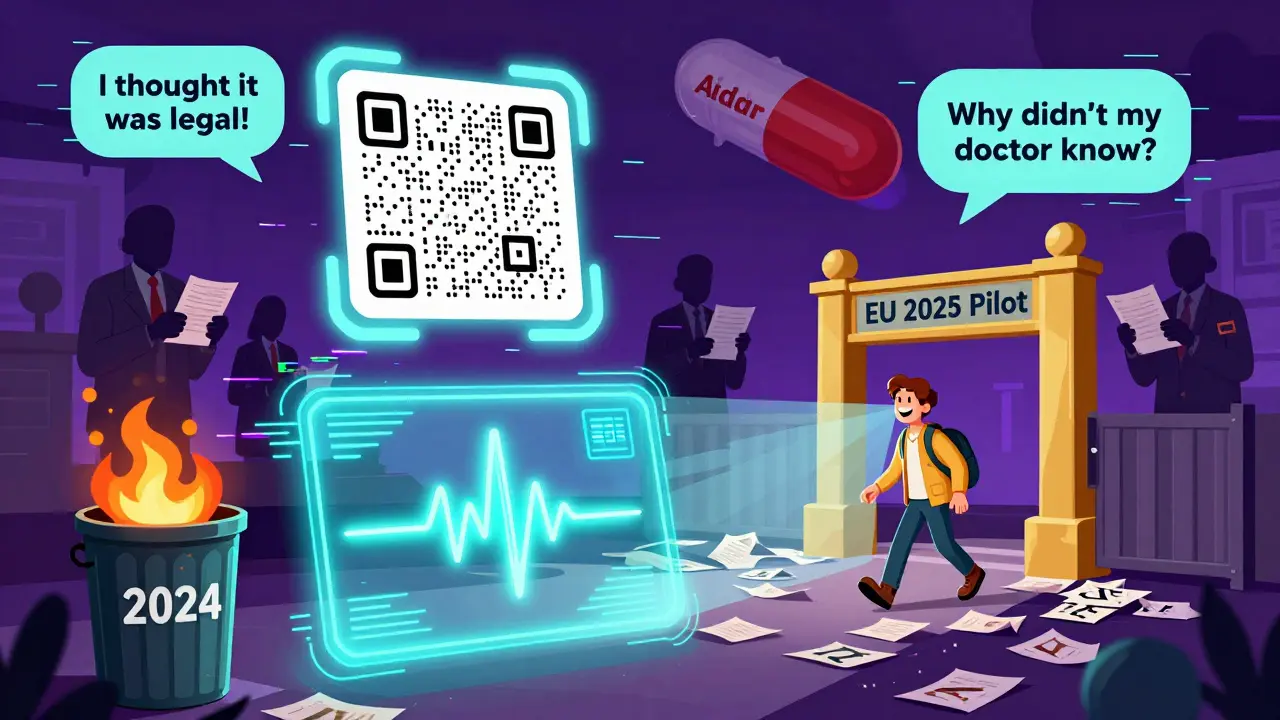
The INCB is rolling out a digital medical certificate pilot in 12 European countries as of mid-2023. The European Commission is funding a €2.4 million project to create a unified EU-wide system for medication travel documentation, launching in late 2024. The goal? A QR code you can show at customs that links to your verified medical record.But until that system is global, you’re still stuck with paper. And with 28 countries introducing new restrictions in 2022 alone, the landscape is getting more complex-not less. The FDA and CBP updated their guidance in May 2023 to accept telemedicine prescriptions and electronic letters-but only if they’re signed with a digital signature that meets legal standards. Not all e-signatures count.
Bottom Line: Don’t Risk It
Traveling with controlled substances isn’t about convenience. It’s about legal compliance. A doctor’s letter isn’t a suggestion. It’s your legal shield. The difference between a smooth trip and a nightmare is a few typed sentences on official letterhead.If you’re taking ADHD meds, opioids, anxiety drugs, or sleep aids across borders, treat this like you would a visa application. Start early. Double-check every detail. Don’t trust hearsay. Use the CDC template. Get it signed. Pack it right. And never, ever assume your meds are fine just because they’re legal at home.
Do I need a doctor’s letter if I’m only carrying a 30-day supply?
Yes. Even a 30-day supply of a controlled substance requires documentation in most countries. The length of the supply doesn’t override the need for proof that the medication is legally prescribed. Countries like Singapore and Malaysia allow 30 days but still require a letter. Others, like Japan, ban certain drugs regardless of quantity.
Can I use an electronic copy of the letter on my phone?
Some countries accept digital copies, but many still require a printed, signed original. U.S. Customs and Border Protection recommends carrying a physical copy. Airlines may also require it at check-in. Always bring at least two printed copies-one in your carry-on, one in checked luggage.
What if my medication isn’t available in the country I’m visiting?
Don’t assume you can buy it there. Many countries restrict or ban medications that are legal elsewhere. For example, Adderall is illegal in Japan and the UAE. If your medication isn’t available, talk to your doctor before you travel. They may be able to prescribe an alternative that’s allowed in your destination. Never try to buy meds abroad without checking local laws first.
Does my insurance cover the cost of getting a doctor’s letter?
Most insurance plans don’t cover the cost of writing a travel letter. It’s considered an administrative task, not a medical service. Your doctor’s office may charge a fee-typically $25 to $75. Ask upfront. It’s worth it to avoid being detained or having your meds confiscated.
Can I bring over-the-counter meds with controlled ingredients?
Yes, but only if they contain substances listed under international drug treaties. For example, some cough syrups contain codeine or dextromethorphan, which are controlled in many countries. Even if you bought them legally at home, they may be illegal abroad. Always check the active ingredients. If it’s a controlled substance, treat it like a prescription drug.
What if I have multiple prescriptions for controlled substances?
You need a separate letter for each one. A single letter covering multiple drugs is often rejected. Each letter must clearly identify the medication by its generic name, dosage, and medical purpose. This is required by the DEA and enforced by CBP. Don’t combine them-carry individual letters for each controlled substance.
Are there any countries that don’t require a doctor’s letter at all?
Very few. Even countries with relaxed drug policies, like the Netherlands or Portugal, require documentation for controlled substances. The INCB reports that 78 countries require letters for all controlled substances, and 32 require them for specific classes. No major international destination fully waives documentation. Always assume you need one.

Sue Stone
January 23, 2026 AT 00:01Just packed my Xanax for a trip to Thailand. Hope I don’t get locked up. 😅
Stacy Thomes
January 23, 2026 AT 07:49MY DOCTOR REFUSED TO WRITE THE LETTER. Said it’s ‘not his job.’ I had to pay $60 at a travel clinic. This is insane. We’re not criminals, we’re people with anxiety! 😭
dana torgersen
January 24, 2026 AT 17:03i just found out my adderall is banned in japan?? like... how?? i've been taking it for 8 years and now i'm supposed to just... stop?? i mean, i get it, but like... what if i have a panic attack in tokyo?? i'm gonna need my brain to function, you know??
Janet King
January 26, 2026 AT 03:00Always carry two printed copies. One in your carry-on, one in your checked bag. And keep the original bottles with pharmacy labels. No exceptions. I’ve seen people lose their meds because they trusted a pill organizer. It’s not worth the risk.
Andrew Smirnykh
January 27, 2026 AT 02:44As someone who’s traveled through 17 countries with ADHD meds, I can confirm: the UAE requires a 30-day advance application. No exceptions. I got denied once because my letter said ‘anxiety’ instead of ‘generalized anxiety disorder.’ They’re picky. Be precise.
Dawson Taylor
January 27, 2026 AT 06:48It’s not about trust. It’s about systems. Governments don’t know your story. They only know the law. A letter isn’t a favor-it’s a translation of your need into bureaucratic language.
Sallie Jane Barnes
January 27, 2026 AT 14:58I’m a nurse and I’ve seen too many patients get detained because they thought ‘it’s just a little pill.’ You wouldn’t fly without a passport. Don’t fly without a letter. I printed mine on my clinic’s letterhead, had my MD sign it, and kept it in a plastic sleeve with my passport. It took 15 minutes. Worth every second.
Kerry Evans
January 28, 2026 AT 23:45People who complain about this are the same ones who think ‘I’m not a criminal, so I shouldn’t need paperwork.’ But the law doesn’t care about your intentions. It cares about compliance. If you can’t follow a simple procedure, don’t travel with controlled substances. It’s not that hard.
Vanessa Barber
January 30, 2026 AT 07:35Actually, Canada doesn’t require a letter for up to 100 units if it’s a Schedule I drug. I’ve done it twice. The border agent just glanced at my bottle and waved me through. This whole thing is overblown.
charley lopez
January 30, 2026 AT 09:40Per the INCB’s 2023 Harmonized Guidelines, the letter must adhere to WHO Model Format 4B, which mandates inclusion of the ATC code alongside the generic name. Failure to comply constitutes non-conformity under Article 7.2 of the Single Convention.
Oladeji Omobolaji
January 31, 2026 AT 04:02My cousin got stopped in Dubai with his antidepressants. They made him sit for 6 hours. He didn’t even have a letter. Now he’s scared to fly anywhere. This isn’t just about rules. It’s about fear.
Susannah Green
February 1, 2026 AT 08:05Don’t forget: if your meds are in a pill organizer, you need a separate letter for each one. I learned this the hard way. I had four different meds, all in one organizer. Got pulled aside. Took two hours to explain. Never again.
Kerry Moore
February 1, 2026 AT 23:12Has anyone tried the new EU digital certificate pilot? I’m in Germany and heard it’s working smoothly. My doctor uploaded my details through the national portal and I got a QR code. Customs scanned it and everything was verified instantly. Still in beta, but promising.
Anna Pryde-Smith
February 2, 2026 AT 06:59I’m so tired of being treated like a drug dealer just because I take medicine. My anxiety isn’t a crime. My ADHD isn’t a felony. And yet, I have to beg my doctor for a letter like I’m asking for a loan. This system is dehumanizing.
Laura Rice
February 2, 2026 AT 16:14thank you for this. i’ve been traveling with my benzos for years and never thought to check the country rules. i thought ‘if it’s legal here, it’s fine.’ wow. i just canceled my trip to singapore. i didn’t even know they only allow 30 days. i had 90. i’m so lucky i didn’t get arrested. thank you. truly. i’m printing my letter right now.