Risk Comparison Calculator
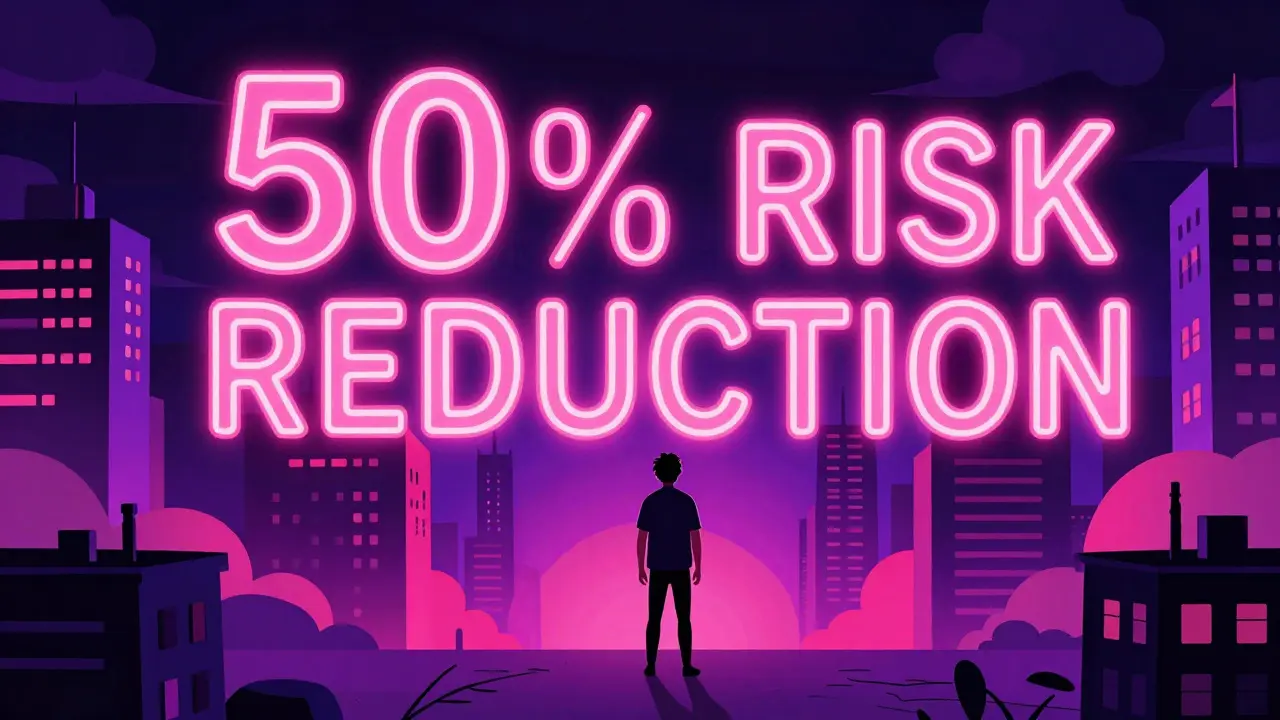
Imagine you see a headline claiming a new medication "cuts the risk of a heart attack by 50%." It sounds like a miracle drug, right? But what if the actual risk only dropped from 2% to 1%? You're still looking at a 99% chance that you won't have a heart attack regardless of the pill. This is the gap between relative and absolute risk, and it's where a lot of people-and even some doctors-get tripped up.
When you're reading about drug side effects, the way the numbers are framed can completely change how you feel about a treatment. If a company says a side effect is "twice as likely" with a certain drug, that sounds terrifying. But if the risk goes from 0.1% to 0.2%, the actual danger is still incredibly low. Understanding these two ways of measuring risk helps you make decisions based on reality, not marketing.
The Basics: What is Absolute Risk?
Absolute Risk is the actual probability of an event happening in a specific group of people. It is the most honest way to look at data because it tells you exactly how common a side effect or benefit is in the real world. If 100 people take a drug and 5 of them develop a rash, the absolute risk is 5%.
The beauty of absolute risk is that it provides immediate context. You don't need to compare it to anything else to understand if a risk is high or low. For example, if a drug has an absolute risk of a severe reaction of 0.001%, you know that the event is extremely rare, regardless of how it compares to a placebo.
The Twist: Understanding Relative Risk
Relative Risk is a ratio that compares the risk of an event in one group to the risk in another group. Instead of telling you the actual chance of something happening, it tells you how much more (or less) likely it is compared to a different group.
If a control group has a 2% risk of a side effect and the treatment group has a 4% risk, the relative risk is 2.0. This means patients are "twice as likely" to experience the side effect. While this is mathematically true, it often hides the fact that the absolute increase is only 2 percentage points. This is why Relative Risk Reduction (RRR) is often used in pharmaceutical ads-it makes the numbers look much bigger and more impressive than the absolute change.
| Feature | Absolute Risk | Relative Risk |
|---|---|---|
| What it tells you | The actual chance of an event | The difference between two groups |
| Calculation | Events / Total Population | Risk Group A / Risk Group B |
| Typical Look | Small percentages (e.g., 1%) | Large percentages (e.g., 50%) |
| Main Use | Personal decision making | Identifying risk factors |

How to Spot "Statistical Deception"
You've probably noticed that health news and drug commercials rarely lead with absolute numbers. There's a reason for that. If a drug reduces the incidence of a disease from 1 in 100,000 to 1 in 1,000,000, that is a massive 90% relative risk reduction. That sounds like a game-changer. However, the absolute risk reduction is only 0.099%.
This discrepancy is often used to inflate benefits or downplay risks. For instance, if a medication causes a specific side effect in 20% of patients versus 8.3% in a placebo group, a report might say the relative risk is 2.41-meaning you're over two times more likely to get that side effect. While true, the absolute difference is only about 11.7%. Depending on how severe the side effect is, that 11% difference might be a deal-breaker or a non-issue.
The Number Needed to Treat (NNT)
If you want to move beyond percentages and get a concrete number, look for the Number Needed to Treat (NNT). The NNT tells you how many people need to take a drug for one person to experience the benefit. It is calculated by taking the inverse of the Absolute Risk Reduction (ARR).
For example, if a drug reduces the risk of a heart attack from 2% to 1%, the ARR is 1% (or 0.01). The NNT is 1 / 0.01, which equals 100. This means 100 people must take the drug for one person to avoid a heart attack. The other 99 people either wouldn't have had a heart attack anyway or took the drug and had one regardless. When you see it this way, a "50% relative risk reduction" feels much less dramatic.
Practical Steps for Interpreting Your Meds
Next time you're talking to your doctor about a new prescription, don't just accept the percentages. Try these strategies to get a clearer picture:
- Ask for the baseline: If they say a drug reduces risk by 30%, ask, "What was the risk before the drug? Was it 10% or 0.1%?"
- Request absolute numbers: Ask for the number of people who experienced the side effect out of 100 or 1,000.
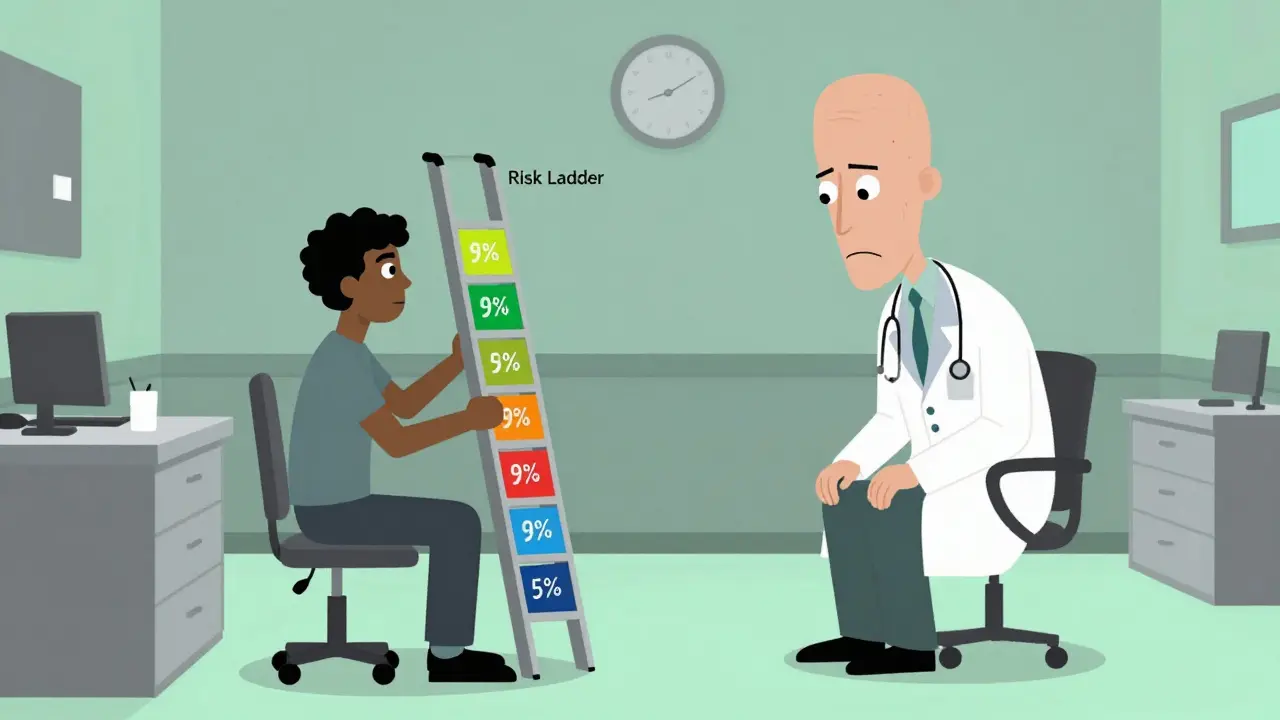
- Use a risk ladder: Visualize 100 people. If the risk is 2%, imagine 2 people in a room of 100 getting the side effect. Then imagine if it drops to 1%-only one person now. Does that change in a single person justify the cost or other side effects of the drug?
- Compare benefit vs. harm: Compare the absolute risk of the side effect with the absolute risk reduction of the disease. If the drug prevents a 1% risk of a stroke but causes a 5% risk of severe nausea, you have a clear trade-off to consider.
Why This Matters for Your Health
The goal isn't to distrust all medical data, but to demand more transparency. Both metrics are useful; relative risk is great for researchers identifying that a certain chemical causes cancer, but absolute risk is what you need to decide if you should actually take a pill every morning. Many patients refuse necessary treatments because they misunderstand a relative risk increase, or they take risky drugs because they've been sold on a relative risk reduction.
When you focus on absolute risk, you stop looking at the "marketing" of the drug and start looking at the reality of your own health. The most important question isn't "How much better is this drug?" but "How much better will my life be if I take it?"
What is the main difference between absolute and relative risk?
Absolute risk tells you the actual chance of an event happening (e.g., 2 out of 100 people), while relative risk tells you how much the risk changes compared to another group (e.g., the risk is 50% lower than the placebo group). Absolute risk provides the real-world scale, while relative risk shows the magnitude of the difference.
Why do pharmaceutical companies prefer relative risk in ads?
Relative risk numbers usually look much larger and more impressive. Reducing a risk from 2% to 1% is only a 1 percentage point absolute drop, but it's a 50% relative drop. A "50% reduction" is a much more powerful marketing claim than a "1% reduction," even though they describe the same result.
What does NNT stand for and why is it useful?
NNT stands for Number Needed to Treat. It tells you exactly how many patients must receive a treatment for one person to benefit. It is incredibly useful because it strips away percentages and gives you a concrete human number, making it easier to judge if a drug's benefit outweighs its side effects.
Can relative risk be misleading?
Yes, when presented without the absolute baseline. If a side effect increases from 0.01% to 0.02%, the relative risk is a 100% increase (double the risk). While mathematically accurate, presenting it as a "100% increase" makes a very rare event sound common and dangerous.
How can I ask my doctor for the "real" numbers?
Ask your doctor: "Out of 100 people like me, how many would actually experience this side effect?" and "Out of 100 people, how many would actually benefit from this medication compared to taking nothing?" This forces the conversation into absolute risk terms.